



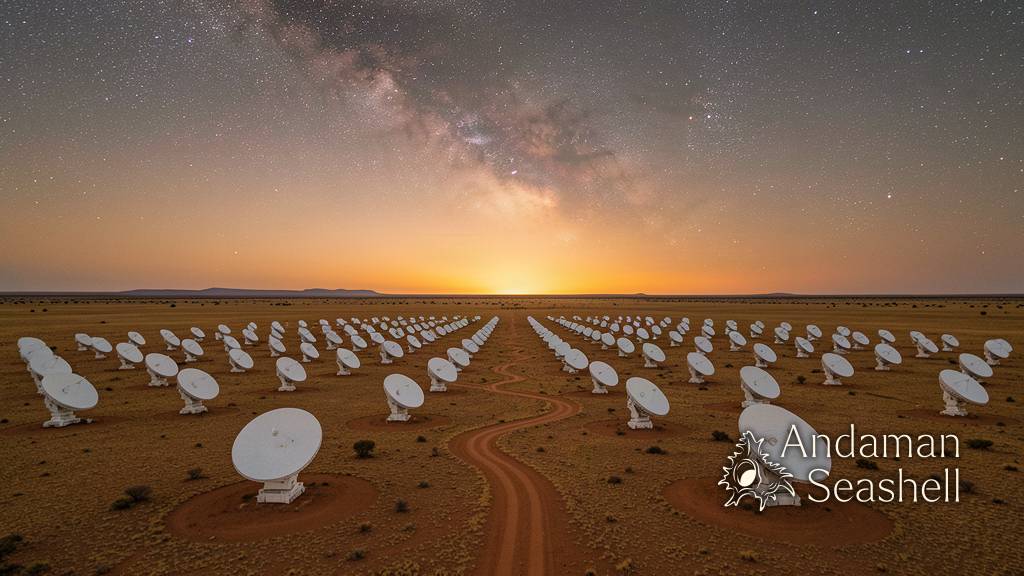
On 4 March 2024, in the dry golden plains of South Africa's Karoo desert, 64 radio dishes turned at once toward the same patch of sky. A moment earlier, something enormous had flashed — a blink so fast you could miss it a thousand times over. Astronomers named it FRB 20240304B, and this week the James Webb Space Telescope finally revealed its home: a galaxy so small and so distant that nobody saw it coming. [ref:1]
The flash that lasts a millisecond
Fast radio bursts — FRBs — are one of the universe's favourite magic tricks: blasts of radio waves that last about a millisecond, arrive from billions of light-years away, and usually never repeat. The first one was discovered in 2007, and in nearly two decades since, scientists have collected plenty of theories but no conclusive proof of what makes them. [ref:1]
This one was caught by the MeerTRAP team using the MeerKAT telescope in the Northern Cape — 64 dishes, each 13.5 metres wide, spread across the Karoo. The telescope's name is a playful pun: it grew out of the Karoo Array Telescope (KAT), and when the budget allowed 64 dishes instead of 20, it became "MeerKAT" — "more KAT", and also the Afrikaans name of the region's most beloved little animal. [ref:4]
A galaxy playing hide-and-seek
The radio data said the burst was extremely distant — possibly the most distant ever seen. To prove it, astronomers needed to find its home galaxy. One problem: the world's largest ground-based telescopes looked at the exact spot and saw nothing at all. [ref:1]
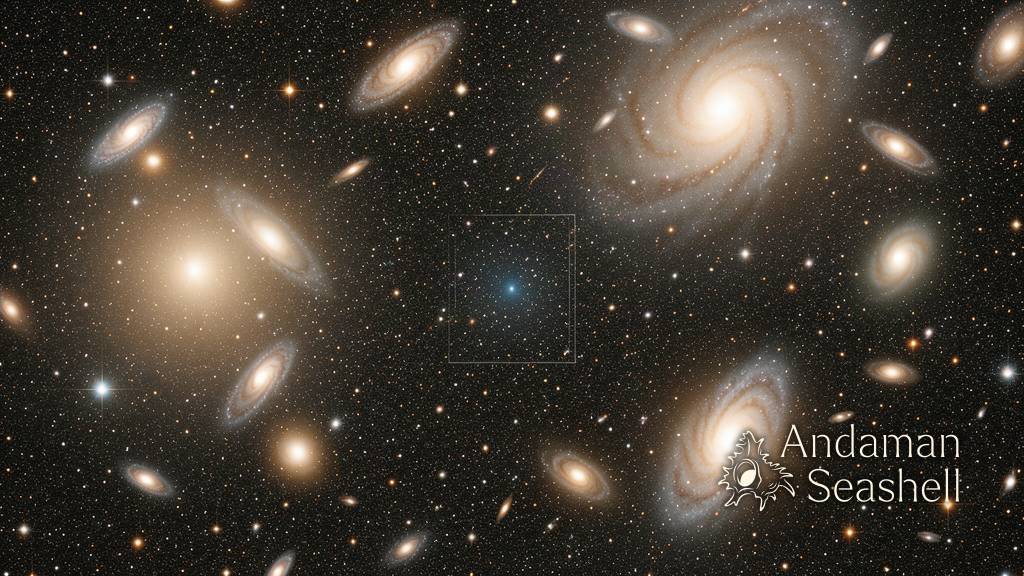
So the team called in Webb. Webb's NIRCam camera picked out a faint galaxy right where the burst had come from, and its NIRSpec spectrograph read the galaxy's light to measure its redshift — how much the expanding universe has stretched that light on its journey to us. The answer: 2.148. That means the flash happened just 3 billion years after the Big Bang, during "cosmic noon", the peak era of star formation in the universe. [ref:1][ref:2]
The surprise that cracked the case
Then came the twist. Most galaxies known to host FRBs are massive, star-churning giants. This one was about 1,000 times less massive than expected — a dwarf galaxy, small but furiously young, with most of its stars likely forming within just 30 million years. [ref:1]
"We thought it would be a big, nicely formed galaxy with lots of stars, and instead it was a little dwarf galaxy," said Manisha Caleb of the University of Sydney, lead author of the study published in the journal Science. [ref:3]
That small detail is the clue that solves the mystery. One theory says FRBs come from two neutron stars slowly spiralling together — but that dance takes billions of years, so the home galaxy should be old and settled. A young dwarf galaxy means almost no waiting time between stars forming and the flash firing. That points to a magnetar: a young, wildly magnetic neutron star that can fire off an FRB almost immediately after its parent star explodes. As Caleb put it, the findings make it very unlikely this burst came from a merger. [ref:1]
A flashlight through the cosmic web
The burst delivered one more gift. On its way here, it passed through everything between its galaxy and ours — and carried the imprint of the journey. Astronomers found traces of two structures stamped into the signal: a previously unknown galaxy cluster about 3.5 billion light-years away, and our neighbour, the Virgo Cluster, roughly 54 million light-years from Earth. Co-author J. Xavier Prochaska compares an FRB to a cosmic flashlight, lighting up the otherwise invisible cosmic web. [ref:1]
And more records are on the way. The team estimates that MeerKAT alone may catch several FRBs per year from more than halfway back to the beginning of the universe — with Webb standing ready to introduce each new home galaxy. [ref:1]
So next time you look up at the stars, remember: somewhere out there, a tiny young galaxy just blinked — and 64 dishes in a desert, and a golden mirror floating far beyond the Moon, both saw it.


No comments yet. Be the first to share a thought.