



Look east after sunset this week and you'll spot it: a steady, golden point of light shining bravely through the dusk. That's Saturn — and it is putting on its best show of the year, arriving at opposition on October 4, the moment Earth slides directly between it and the Sun. The ringed planet will be at its closest, brightest, and visible all night long, easy to find with just your eyes [ref:3].
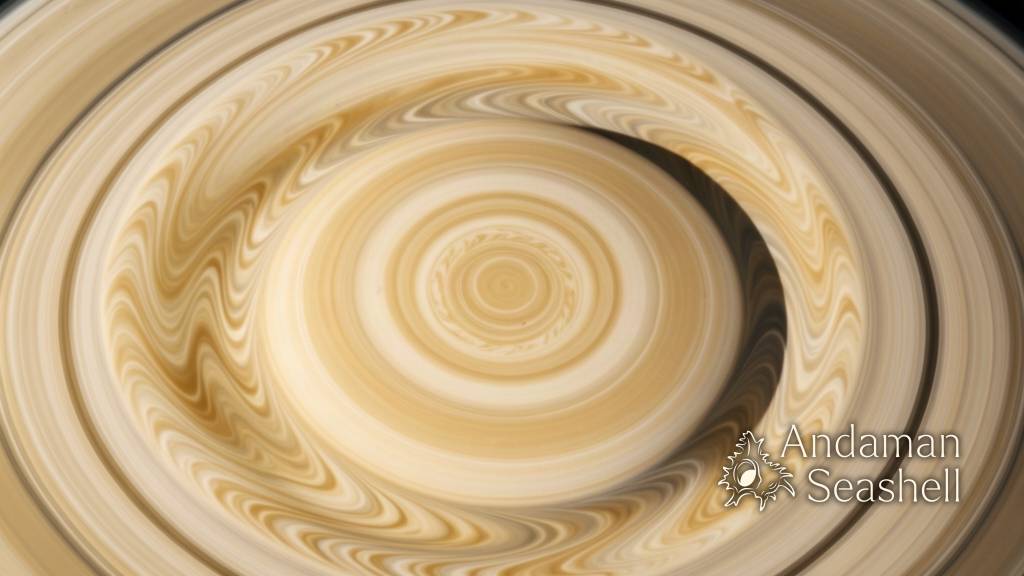
And this year, Saturn has decided to celebrate with a surprise. The Hubble Space Telescope has confirmed that a brand-new ten-sided cloud pattern — a "decagon" — has formed around Saturn's south pole [ref:1]. It is the first large, straight-sided jet pattern ever seen in the planet's southern hemisphere, and it appears to still be growing stronger. As discoveries go, this one is gloriously rare: not a frozen ancient landmark, but a shape being born while we watch.

A shape no one has ever seen there before
Saturn's north pole has famously worn a hexagon — a six-sided jet stream about 30,000 kilometres wide, with winds blowing at roughly 500 km/h — for more than 40 years of observations. It is so big that more than two Earths could fit inside it [ref:4]. Scientists have wondered for decades why the south pole had no matching shape. They have been searching Hubble images for a southern twin since 1990, and the Cassini spacecraft, which orbited Saturn from 2004 to 2017, never saw a hint of one either [ref:1].
Now, at last, there is an answer taking shape. Piecing together years of Hubble observations, researchers traced the decagon's faint beginnings back to 2023. It then showed up as a subtle wavy band in 2024 images and looked far more defined through 2025 — before Hubble's sharp eyes confirmed it as a true ten-sided wave, a result published in the journal Science Advances [ref:1].
Amateurs saw it first
Here's the most delightful part of the story: professional astronomers didn't spot the decagon first — backyard stargazers did. In 2024, planetary scientist Agustín Sánchez-Lavega of the University of the Basque Country, working with amateur astronomers Trevor Barry and Jean-Paul Oger, noticed a faint undulating band near Saturn's south pole in ground-based telescope images submitted to a public planetary image archive. Those early citizen images, followed by stronger 2025 observations, were the breadcrumb trail that led Hubble to confirm the discovery [ref:2].
Amy Simon, a co-author of the study at NASA's Goddard Space Flight Center, put it perfectly: "We've never seen anything quite like this in Saturn's southern hemisphere… This feature is different — it appears to be strengthening, giving us the rare opportunity to watch a giant atmospheric pattern develop" [ref:1].
What exactly is it?
The decagon is not a solid object or a drawing on the clouds — it's a wave inside one of Saturn's powerful jet streams, and it runs through multiple layers of the atmosphere, making it a towering, vertically deep structure rather than a surface decoration. Scientists can even use different wavelengths of light to peek at different altitudes: the decagon's position appears to shift slightly depending on the wavelength, which lets them map its height [ref:1].
Why ten sides? Why now? Nobody knows yet — and that open question is honestly the best part. The team's next steps include follow-up observations with Hubble and the James Webb Space Telescope, plus computer modelling, to work out what drives the wave and whether it will settle into a stable, long-lived formation like its northern cousin the hexagon [ref:1].
The discovery also showcases something Hubble does better than any newer telescope: patience. The OPAL program has photographed the outer planets every year for more than a decade, and those long, unglamorous yearly check-ups are exactly what let scientists catch a brand-new storm pattern in the act of forming [ref:1].
How to see Saturn while it shows off
You don't need to wait for the decagon — Saturn itself is easy company right now. Around its October 4 opposition, it rises in the east at sunset and stays visible all night, shining about as brightly as the brightest stars [ref:3]. Through steady binoculars it looks like a tiny oval; any small backyard telescope will show the rings, which are tipped about 7.5 degrees from our point of view this season [ref:3].
So look up this week and find that steady golden light. Somewhere over a billion kilometres away, inside a jet stream wider than our whole planet, a ten-sided storm is writing itself into existence — and for once, astronomy gets to watch a wonder being born rather than admiring one that has always been there.


No comments yet. Be the first to share a thought.