



Tonight, the Dragon opens its eyes. As the sky fades from orange to deep blue on the evening of October 8, look toward the north and you are looking straight into the glittering head of Draco — the great celestial dragon — where two orange stars named Eltanin and Rastaban glow like a pair of watchful eyes. And this week, the Dragon might blink.
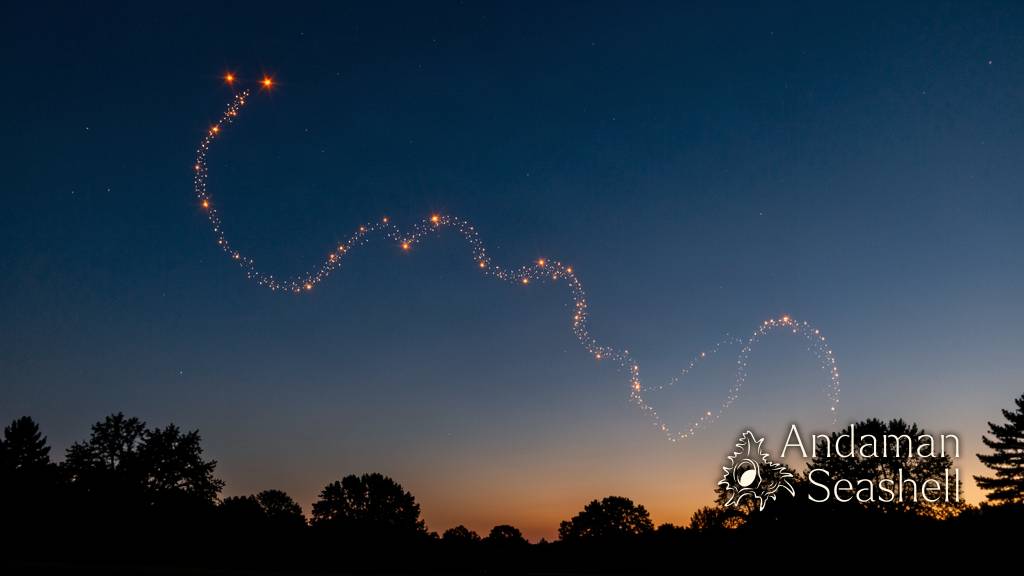
That's because the annual Draconid meteor shower is reaching its peak. Predicted to crest around 1 a.m. Universal Time on October 9, the shower is active from October 6 through 10, and in 2026 it arrives under beautifully dark skies — the new moon falls on October 10, so only a thin waning crescent will rise just before dawn, far too late and far too faint to spoil the show [ref:1]. Under ideal dark conditions, you might catch around 10 meteors an hour [ref:2].
The shower you watch before bedtime
Here is the Draconids' loveliest trick. Almost every famous meteor shower — the Perseids, the Geminids — rewards the sleepless, demanding you stumble outside at 3 a.m. The Draconids are the opposite. Their radiant point stands highest in the sky just as darkness falls, which means more Draconids fly in the evening hours than after midnight [ref:1]. This is a meteor shower you can enjoy right after dinner, with the whole family, and still be in bed by ten.
A dragon made of comet dust
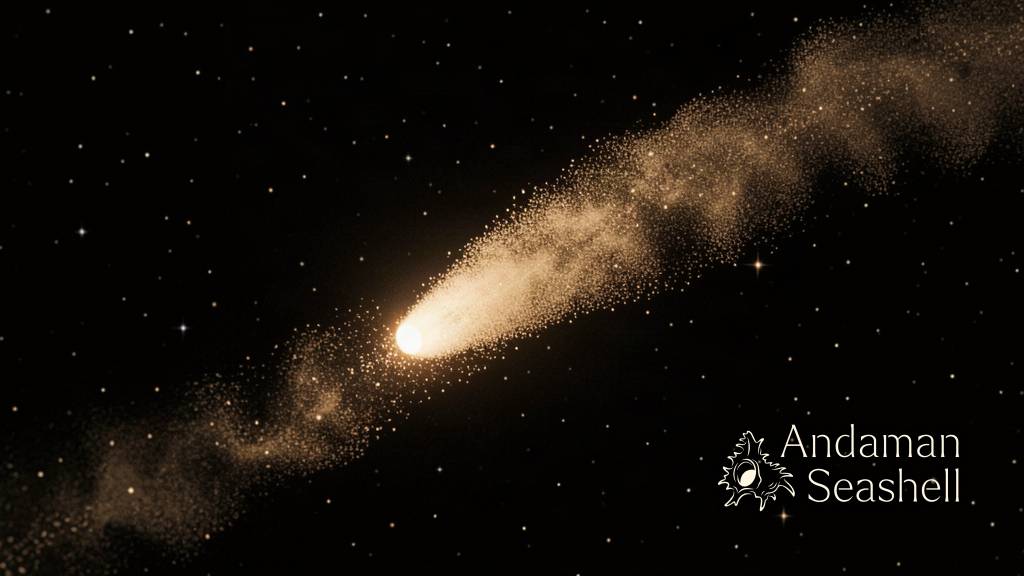
Every streak you see is a tiny piece of Comet 21P/Giacobini-Zinner, a small wanderer that loops around the Sun every 6.6 years, swinging as close to the Sun as Earth does before sailing back out past Jupiter's orbit [ref:1]. The comet was discovered from Nice Observatory in France by Michel Giacobini on December 20, 1900, then rediscovered — after astronomers missed its return — by Ernst Zinner in Germany on October 23, 1913 [ref:1]. In September 1985 it became the first comet ever visited by a spacecraft, when the International Cometary Explorer flew through its tail [ref:1].
The dust is not scattered evenly along the comet's path. Much of it stays bunched near the comet itself — and the comet passed its closest point to the Sun, perihelion, on March 29, 2025 [ref:1]. Its clustered debris is still nearby, which is exactly why skywatchers keep such a fond eye on this modest shower.
Will the Dragon storm?
Most years the Draconids are a gentle, drowsy shower — a handful of slow, lazy streaks per hour. But when the Dragon truly wakes, it becomes one of the greatest sky shows on record. In 1933 and 1946, the shower erupted into genuine meteor storms with several thousand meteors an hour, among the most active displays of the entire 20th century [ref:2]. European observers counted over 600 meteors per hour in 2011 [ref:1].
Each streak, by the way, is caused by a particle as small as a grain of sand burning up in our atmosphere — a fact worth telling the smallest member of your watch party [ref:2]. And you don't need binoculars or a telescope: meteors fly every which way across the sky, so the best instrument is simply a wide view, a dark horizon, and patience [ref:2].
Tips for tonight
- Go out as soon as it's properly dark on October 8 — the radiant is highest at nightfall and sinks as the night goes on [ref:1].
- Face north and look high in the sky; you can trace meteors backward toward Draco's head, between the Big Dipper and the bright Summer Triangle [ref:1].
- Give your eyes 20 minutes to adapt to the dark, and keep phones and torches away from your line of sight [ref:2].
- The shower favours the Northern Hemisphere; from low northern latitudes — anywhere around 8 degrees north, for instance — Draco rides lower on the northern horizon at dusk, so an open view in that direction is your best seat [ref:1].
Whatever the Dragon decides — ten slow embers an hour or a surprise flurry — tonight's dark, moonless sky is a gift. Step outside after dinner, look north, and let a 6.6-year comet's dust wish you goodnight.


No comments yet. Be the first to share a thought.