



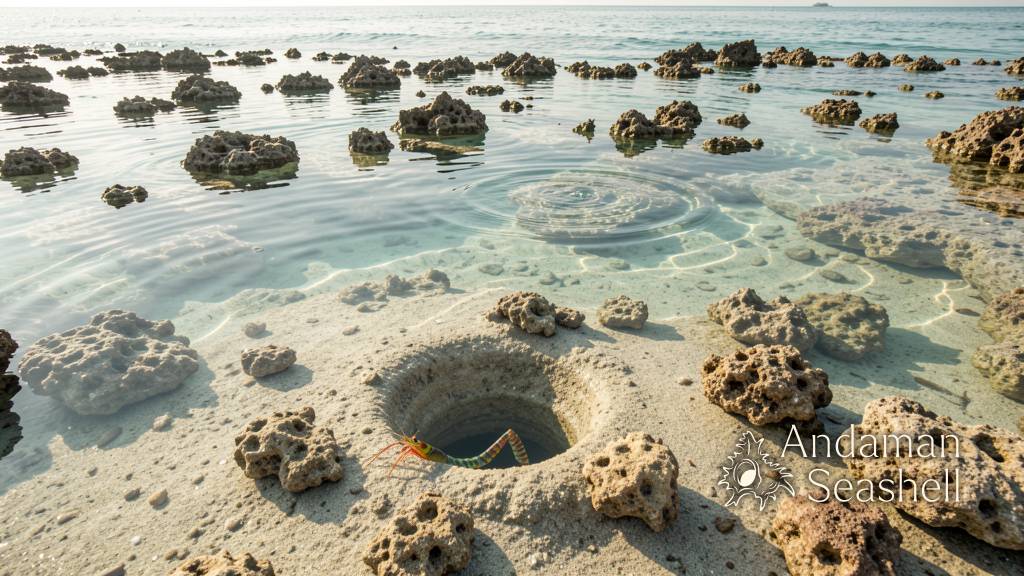
Lift the slab of limestone at the waterline on Koh Yao Noi at low spring tide, and three things happen at once: a blur of electric emerald green shoots backward into a burrow, a pair of turquoise eyes on stalks swivel to track your shadow, and — if you're very lucky — you hear a faint click that sounds like someone snapping a cocktail stick in half.
That blur is Odontodactylus scyllarus, the peacock mantis shrimp, and it is quite possibly the most extraordinary animal you will ever meet in an Andaman tide pool. It looks like a jewelled box: a body of layered emerald, sapphire, and vermilion, legs like polished oars, and a tail fan edged in golden ringers. But the real marvel is what this creature can do — things that sound impossible until you check the science.
Eyes That See a Universe We Cannot
We humans are proud of our colour vision. We have three types of colour photoreceptors — red, green, and blue — and our brains mix those signals into the full rainbow we see. The mantis shrimp has up to sixteen.
Some of those photoreceptors detect ultraviolet light, which is invisible to us. Others are tuned to polarised light — the orientation of light waves as they travel through water [ref:1]. This means a mantis shrimp can see patterns and signals on the reef that are completely invisible to every fish, every turtle, and every snorkeller gliding past.
Each of its two compound eyes is divided into three separate regions, giving it trinocular vision with a single eye. It can judge distance with a precision that takes humans two eyes and a lot of brainpower to manage [ref:1]. Researchers at the University of Queensland and elsewhere have spent decades mapping this system, and it remains one of the most complex visual setups ever evolved on Earth.
The Fastest Punch in the Ocean
Now crouch closer — but not too close. The peacock mantis shrimp is a smasher. Folded beneath its head are two hammer-like appendages called dactyl clubs, made of a biological composite so tough that materials scientists have spent years trying to copy it [ref:2].
When the mantis shrimp strikes, those clubs accelerate from rest to over 80 kilometres per hour in less than a millisecond — a force of more than 10,000 times the acceleration of gravity. The impact is so fast that it boils a tiny pocket of water in front of the club, creating a cavitation bubble that collapses with a flash of heat and a sharp bang. The prey — a crab, a snail, a clam — is hit twice in the same instant: once by the club itself, and once by the shockwave from the collapsing bubble [ref:3].
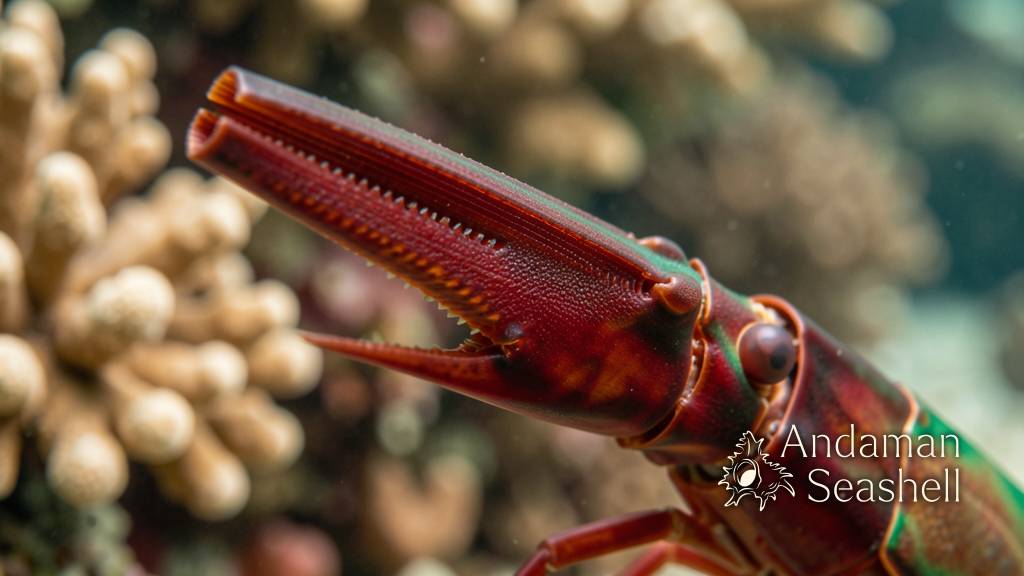
Aquarium keepers have learned the hard way: peacock mantis shrimp can crack the glass walls of a tank. In the wild, they use this power to break open tough-shelled prey that few other reef hunters can access.
A Blueprint Worth Copying
The club's secret is its internal architecture. Layers of chitin fibres are arranged in a spiralling helicoidal pattern — like a spiral staircase built from tiny cables — that absorbs and dissipates impact energy without cracking. Engineers have dubbed this the bouligand structure, and it has inspired new classes of impact-resistant composites for body armour, sports helmets, and vehicle frames [ref:2]. A creature a few centimetres long has been solving a materials problem that human engineers only recently learned to articulate.
A Window Into Reef Health
Here on the Andaman coast, mantis shrimp are more than a marvel — they are indicator species. Because they rely on clear water, healthy hard coral for burrow structure, and a steady supply of shelled prey, their presence tells you the reef is in good shape. Marine surveys around the Similan and Surin islands regularly record peacock mantis shrimp on shallow reef flats, a sign that protection and recovery efforts are working [ref:3].
How to Meet One (Gently)
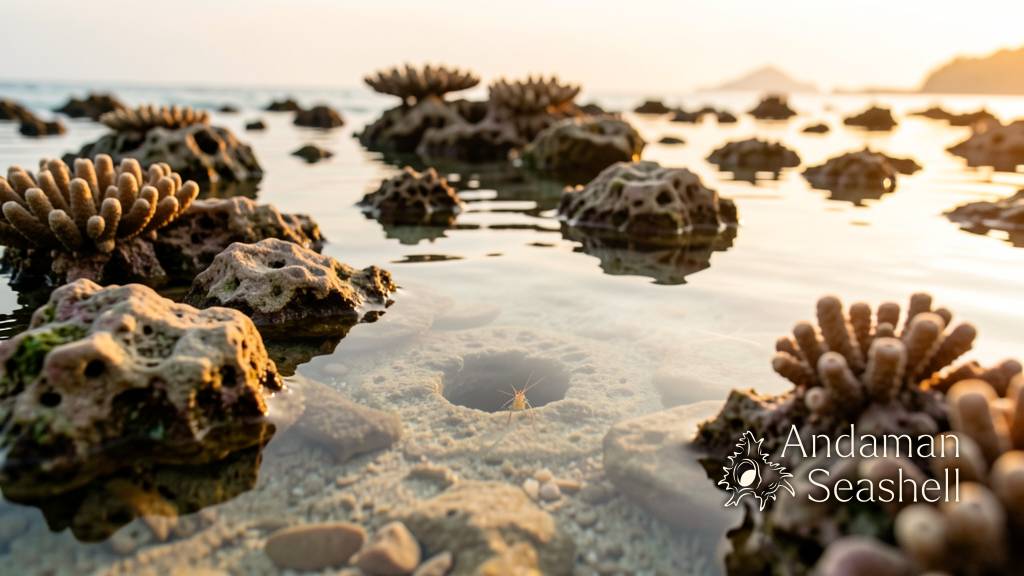
If you want to see a mantis shrimp for yourself, the Andaman coast is one of the best places on Earth to try. Snorkel the shallow reef flats around Koh Yao Noi, Koh Phra Thong, or the Similan Islands during a calm neap tide. Look for circular burrow entrances in the sand or rubble near the reef edge. Stay still. Watch for a flash of electric green.
Two rules: never reach into a burrow (those clubs can bruise a finger badly), and never try to collect one. Like all reef creatures here, mantis shrimp are most magical when left exactly where they are — doing the extraordinary work of being themselves.
The next time you crouch beside a tide pool on the Andaman coast, remember: the small jewelled creature backing into a burrow is seeing colours you cannot imagine and carrying a punch that rewrites the rules of biology. The reef is full of wonders. This one just happens to be the most spectacular.


No comments yet. Be the first to share a thought.