



It is smaller than a single bacterium, shaped like a tiny spearhead, and it spent some 56 million years asleep in mud on the North Atlantic seafloor. This month, scientists woke it up with a beam of X-rays — and discovered what may be the oldest navigation instrument ever built by an animal [ref:2].
Researchers from the University of Cambridge and the Helmholtz-Zentrum Berlin have now produced the first 3D images of the magnetic structure inside these so-called giant magnetofossils, and the picture that emerged is wonderful: a tornado-shaped vortex of magnetism, exquisitely tuned to read Earth's magnetic field the way a modern navigator reads satellites [ref:1].
A compass from the age of dinosaurs
The magnetofossils were preserved in ancient seafloor sediments and come in shapes resembling spearheads, spindles, bullets and needles — each no larger than a bacterial cell [ref:2]. The oldest examples date back 97 million years, to the Cretaceous period, when long-necked sauropods still walked the land and the Atlantic Ocean was still widening.
That age is the headline. The discovery provides the first direct evidence that animals have been navigating with Earth's magnetic field for at least 97 million years — pushing the fossil record of this remarkable sense, known as magnetoreception, deep into the age of dinosaurs [ref:1].
Built like nothing bacteria make
Some aquatic bacteria already carry a simple version of a magnetic compass: chains of magnetite particles just 50–100 nanometres wide, which Professor Rich Harrison of Cambridge calls "the perfect compass needles" [ref:1]. But those bacterial needles only tell an organism which way is up and down.
The giant magnetofossils are different. They are roughly 10 to 20 times larger than the particles bacteria use — big enough that some scientists had dismissed them as clumsy, or even suggested they served as protective spines [ref:2]. The single spearhead examined in the new study measures about 1.1 micrometres across and 2.25 micrometres long — still microscopic, but enormous by compass standards [ref:4].
The vortex that reads latitude and longitude
To see inside the fossil, the team used a technique called magnetic vector tomography, developed in part by co-author Claire Donnelly at the Max Planck Institute, and carried out at the Diamond X-ray facility in Oxfordshire, England [ref:2]. Conventional X-rays could not penetrate particles this large — the new method finally made them transparent.
What the images revealed was an unexpectedly complex pattern: magnetic moments spiralling around a central line, like a tornado frozen mid-spin [ref:2]. And that geometry, it turns out, is precisely what a navigator needs. The vortex detects the tilt of Earth's magnetic field — which corresponds to latitude — while also measuring the field's strength, which varies with longitude. A stable, two-coordinate reading, from a single microscopic particle [ref:3].
"If nature developed a GPS, a particle that can be relied upon to navigate thousands of kilometres across the ocean, then it would be something like this," Harrison said [ref:2].

So who built it? The eel files
The identity of the particle's maker remains the open mystery — but the research narrows the search. It must have been a migratory animal common enough in the oceans to leave abundant fossil remains [ref:2].
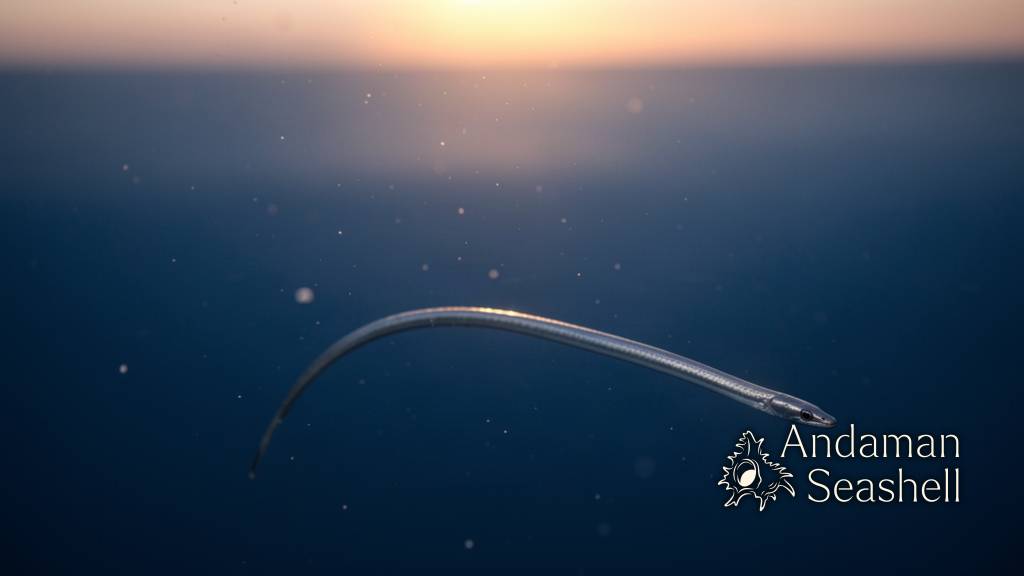
Harrison's prime suspect is the eel. Eels evolved around 100 million years ago, comfortably overlapping with the oldest magnetofossils, and they remain among the most elusive animals alive today. Modern European and American eels travel thousands of kilometres from freshwater rivers to spawn in the Sargasso Sea, and researchers know eels can sense Earth's magnetic field — magnetite particles have even been found in their bodies, though never yet imaged inside their cells [ref:2].
Why a tiny fossil matters
Magnetoreception remains one of the least understood senses in nature. Birds, fish and insects cross entire oceans and continents using cues we still cannot fully explain. The new work, published in the journal Communications Earth & Environment, traces a clear evolutionary staircase: from a bacterial needle that knows up from down, to a vortex-tuned instrument that may have guided an animal across an ancient sea [ref:1].
The next time a bird crosses a hemisphere or a fish returns to the stream of its birth, it is following a sense with a very long family history — one whose earliest fossil signature is a spearhead, spinning quietly in the dark, 97 million years before anyone thought to look [ref:3].
References
- University of Cambridge — Ancient 'animal GPS' identified in magnetic fossils
- ScienceDaily / University of Cambridge — 97-million-year-old fossils reveal the earliest known animal 'GPS'
- Diamond Light Source — Magnetic fossils powered ancient animal navigation
- Phys.org / Helmholtz-Zentrum Berlin — Giant magnetofossils suggest ancient ocean life had built-in 'GPS'


No comments yet. Be the first to share a thought.