



On a clear Andaman evening, a child can point at one bright dot and ask the best question in astronomy: “How far away is that?” This week, ESA’s Euclid space telescope gave the universe a sparkling new answer — 31 ancient quasars, including two record-setting beacons whose light began its journey when the cosmos was only about 670 million years old [ref:1].

That number is wonderfully hard to imagine. The universe is about 13.8 billion years old, so these quasars are like postcards mailed from the baby years of everything: before Earth had beaches, before shells, before the Andaman Sea, before any human had ever looked up and wondered.
What is a quasar?
A quasar is the brilliant center of a young galaxy, powered by a supermassive black hole. That sounds like a giant idea, but the picture is simple: gas and dust whirl around the black hole, heat up, and shine with extraordinary energy. Some quasars can outshine the galaxy around them, which is why astronomers use them as bright markers for studying the early universe [ref:3].
Think of a quasar as a lighthouse at the edge of deep time. The lighthouse is not close. It is not large in our sky. In telescope images it may look like a tiny dot. But if that dot is bright enough, and if scientists measure its color carefully, it can tell us when the light left home.
Euclid’s new finds are especially exciting because two objects — known by their catalogue names EUCL J172902.75+641018.1 and EUCL J125308.55+705432.3 — are reported as the most distant quasars yet found, at redshifts 7.77 and 7.69. Subaru Telescope notes that they are seen from more than 13 billion light-years away, dating to around 670 million years after the Big Bang [ref:3].
Why Euclid is so good at this
Euclid launched in 2023 to make a vast map of the universe and help scientists understand dark energy, the mysterious reason the universe’s expansion is speeding up [ref:1]. To do that, it does something beautifully practical: it looks wide and deep. Instead of staring at one small patch only, Euclid surveys huge areas with sensitive instruments.
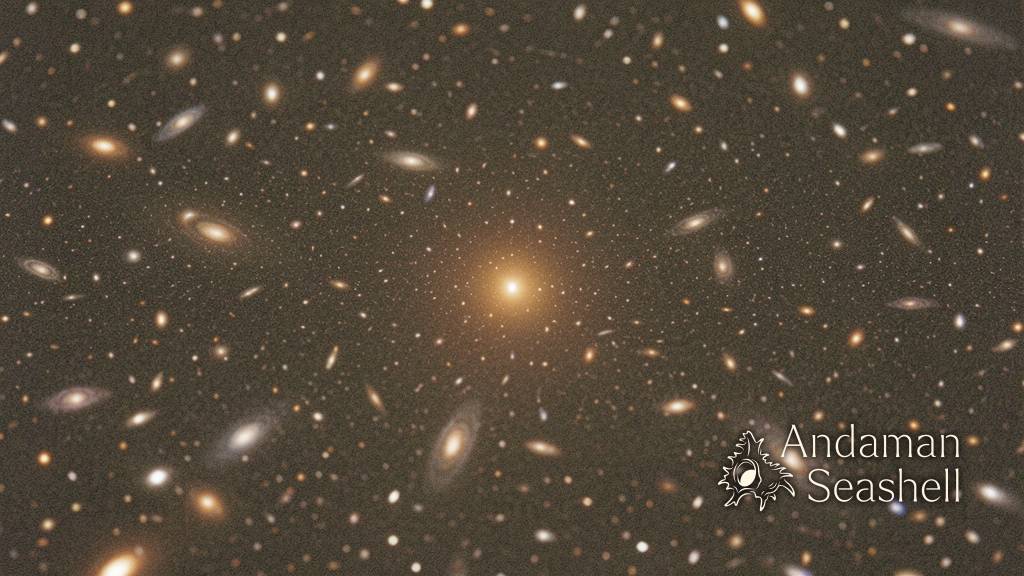
That combination matters. Subaru Telescope explains that Euclid can detect quasars 10 to 100 times fainter than objects found in earlier wide-field surveys [ref:3]. In everyday language: Euclid is very good at noticing shy little sparks in an enormous dark room.
Before this result, astronomers knew only nine quasars beyond redshift 7. This discovery adds 12 more in that very distant group, giving researchers a richer set of early-universe beacons to compare [ref:3]. More beacons mean better clues: how quickly early galaxies grew, how supermassive black holes became so large so soon, and what the young universe looked like when its first grand structures were taking shape.
A small dot with a big story
Here is the part to tell a curious friend: when we look far into space, we also look back in time. Light travels fast, but the universe is so huge that even light needs billions of years to cross it. The glow from these quasars has been traveling since long before our planet became the blue-green world we know.
That makes telescope images wonderfully humble. A quasar may appear as a dot, but it is not “just a dot.” It is a timestamp. It is a clue. It is a little golden pin on the universe’s childhood map.
NASA’s report also points to a lovely handoff between missions: Euclid’s discoveries will help inform plans for NASA’s Nancy Grace Roman Space Telescope, another wide-view observatory designed to study cosmic expansion and dark energy [ref:1]. Science often works like that — one instrument opens a door, another walks through with fresh questions.
Try this tonight
If clouds are kind and the sky opens above Phang Nga or Phuket, step outside for one quiet minute. You will not see these quasars with your eyes; they are much too far and faint. But you can practice the feeling that leads to discoveries like this.
Pick one star. Imagine its light traveling to you. Then imagine a much older light, crossing more than 13 billion years, arriving as a tiny signal in a telescope built by people curious enough to catch it.

That is the beautiful gift of Euclid’s ancient quasars. They make the night sky feel bigger, but also friendlier — full of messages waiting patiently for someone to notice.


No comments yet. Be the first to share a thought.