



A huge amber planet slips across a tiny orange-white star, and for a few hours the universe looks like a perfect science trick. On 1 July 2026, astronomers reported that the James Webb Space Telescope had watched WD 1856 b pass in front of its host star, a compact white dwarf about 80 light-years from Earth [ref:1].
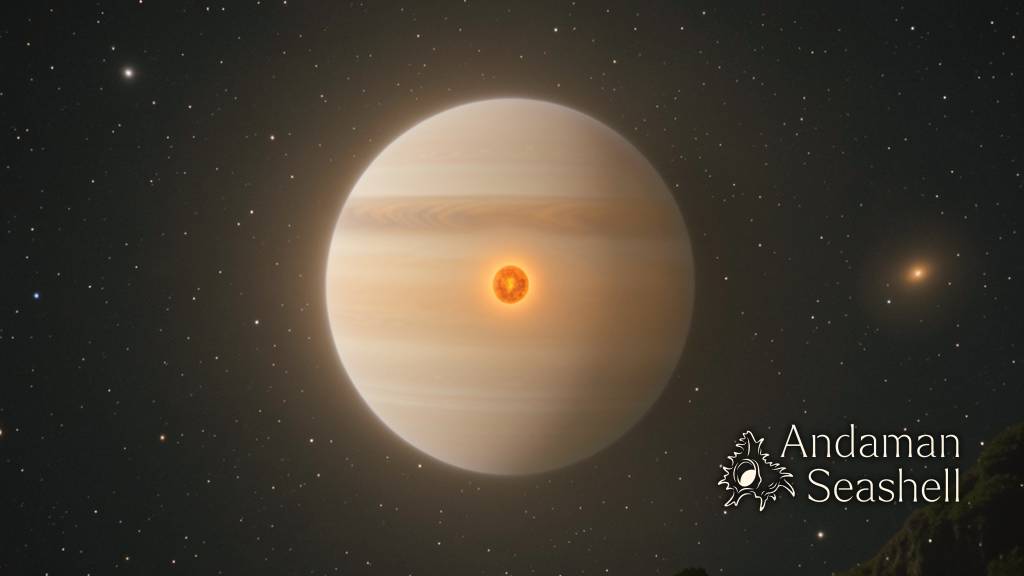
The fun part is the scale. WD 1856 b is about the size of Jupiter, while the white dwarf WD 1856+534 is roughly the size of Earth, so the planet is about seven times larger than the star it circles [ref:1]. Imagine a basketball gliding in front of a marble, except both are made of physics, heat, and ancient starlight.
A transit that works like a cosmic measuring cup
Webb studied a transit: the moment when a planet crosses a star from our point of view and blocks a little light. This is one of astronomy’s neatest tools because a small dip in brightness can reveal a planet’s size, orbit, atmosphere, and sometimes even chemistry.
In this case, the transit helped scientists estimate WD 1856 b’s mass at between four and eleven times Jupiter’s mass [ref:1]. The planet orbits every 34 hours at a separation of less than 3 million kilometres, about 50 times closer than Earth orbits the Sun [ref:1]. That is wonderfully compact: a giant world racing around a stellar remnant in less than two Earth days.
Webb also noticed something especially clever. During the transit, the star’s light dimmed, but infrared light dipped less than other wavelengths. The difference pointed to heat coming from the planet itself. The team estimated the planet’s temperature at about 126°C — warmer than expected from the white dwarf’s light alone [ref:1].
A warm clue with methane in the air
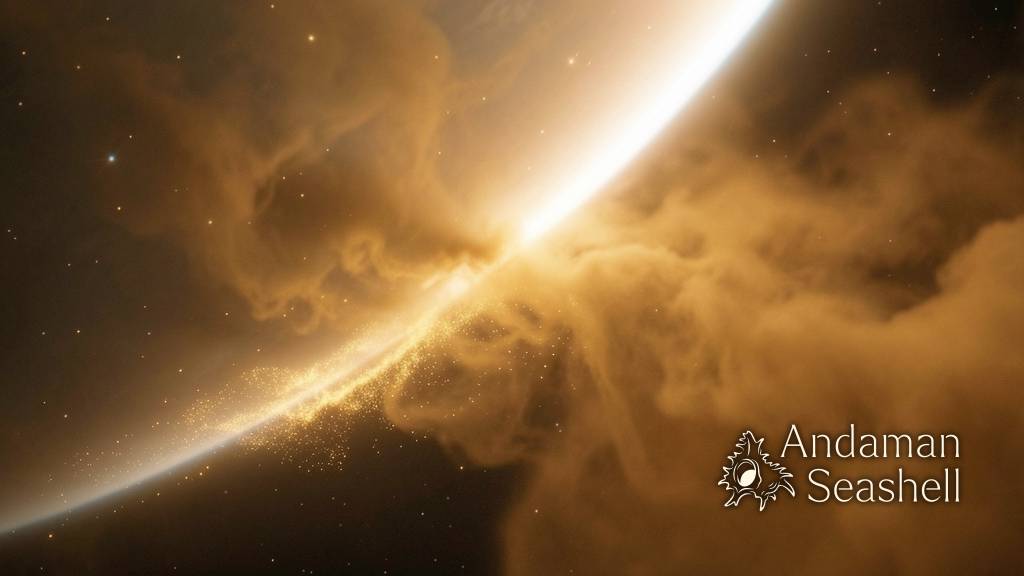
That extra warmth is a clue with a story inside it. The researchers modelled how objects like WD 1856 b cool over time and concluded that the planet was likely heated after the star had already become a white dwarf, between 3 and 5.5 billion years into the white dwarf stage [ref:1]. The leading idea is beautifully gravitational: the planet began farther out, stayed safe during the star’s red-giant phase, then later migrated inward because of interactions in the system.
There is another bright detail. Webb’s light also carried signs of the planet’s atmosphere. Cornell astronomer Victoria Boehm said the team saw signatures of small cloud particles and hydrocarbons, most likely methane — the first atmosphere detected on a planet transiting a white dwarf [ref:1]. Cornell’s report adds that the methane and hazes may give WD 1856 b a colour similar to Saturn’s moon Titan [ref:2].
That makes the scene easier to picture: a large, warm, hazy world circling a small orange-tinted stellar ember. The white dwarf formed from a Sun-like star roughly five billion years ago and has been cooling ever since, according to Cornell’s summary [ref:2].
Why this tiny star matters
The discovery is exciting because it gives astronomers a preview of what can happen to big outer planets after a Sun-like star changes form. ESA notes that in about five billion years, our Sun will run low on hydrogen fuel, expand more than 100 times larger than it is now, shed its outer layers, and eventually become a white dwarf [ref:1].
That sounds enormous, but the science question is wonderfully focused: what happens to giant planets farther out, like Jupiter and Saturn? WD 1856 b cannot answer every question, yet it gives researchers a real example to measure instead of only a model to imagine.
Lead author Ryan MacDonald described the result as a kind of time machine: telescopes usually look back into the past, but this system lets scientists look forward to a possible future for outer planets around Sun-like stars [ref:1]. For readers, it is also a reminder that astronomy is often patient detective work. One small dip of light, watched carefully, can reveal mass, heat, orbit, clouds, methane, and a journey across billions of years.
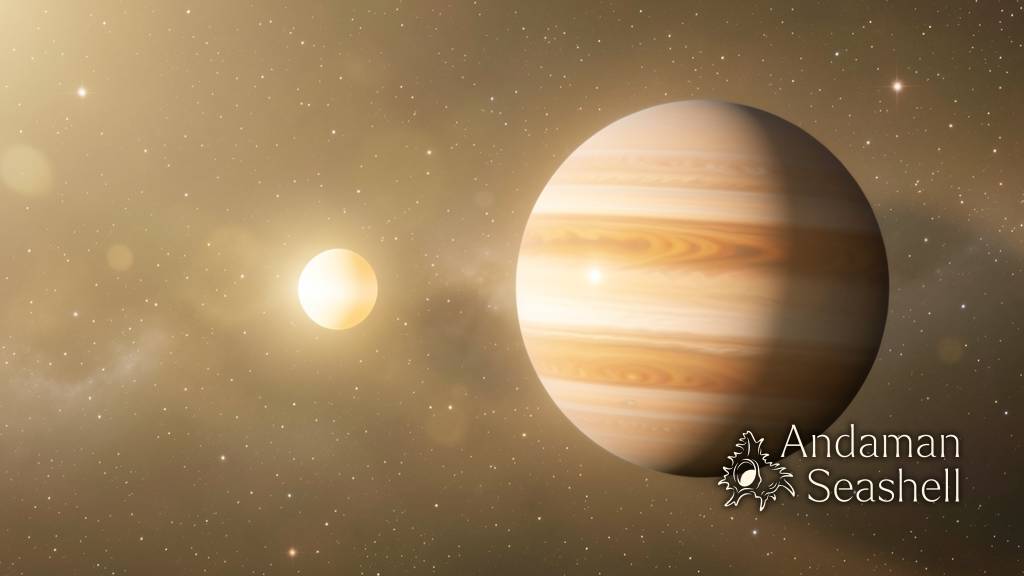
Next time you see a bright point in a space image, try this thought: somewhere near another tiny star, a giant planet may be crossing the light just enough for a telescope to notice. Webb noticed — and turned that shimmer into a story we can hold.


No comments yet. Be the first to share a thought.