



A giant star called IRS 3 is still making beautiful things in one of the Milky Way’s busiest neighborhoods. On 11 August 2026, ESA and the James Webb Space Telescope team shared a result that feels almost playful in the best way: Webb found oxygen-rich dust and a clear water signal in the star’s envelope even though IRS 3 sits only 0.55 light-years from Sagittarius A*, the supermassive black hole at our galaxy’s center [ref:1][ref:3].
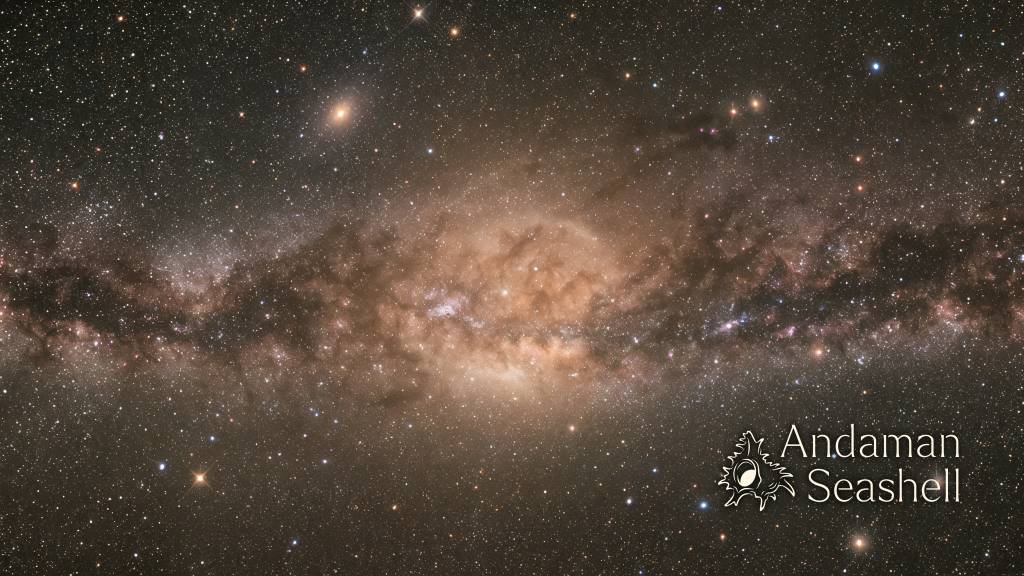
That is such a lovely cosmic surprise because galactic centers are intense places. Sagittarius A* lies about 26,000 light-years from Earth, in the direction of Sagittarius, and the region around it is crowded with stars, dust, and strong radiation [ref:4]. Yet IRS 3 has kept building a vast dusty cocoon of its own. Webb’s new look shows that the star is not merely surviving there. It is still enriching space with raw material that future stars and planets may one day use [ref:1].
Meet the star behind the story
IRS 3 is not a newborn star. It is an evolved giant in the asymptotic giant branch, or AGB, phase — a late chapter when a star becomes huge, cool, luminous, and begins shedding gas in powerful winds [ref:1][ref:3]. Astronomers have long noticed IRS 3 because it is one of the brightest mid-infrared sources in the galactic center and because its dusty envelope is unusually large [ref:1].
Webb gave researchers the most detailed mid-infrared look yet. Using MIRI, the Mid-Infrared Instrument, the team collected a continuous spectrum for IRS 3 and used it to identify what the dust is really made of [ref:1]. That matters because earlier work had suggested the star might be carbon-rich. Instead, the new data revealed two strong silicate signatures — one around 9.7 microns and another at 18.5 microns — showing that IRS 3 is oxygen-rich [ref:1][ref:3].
Why MIRI made the difference
MIRI is Webb’s only instrument that covers the mid-infrared range, from 5 to 28.3 microns, and ESA notes that it is cooled to about -266°C so its own heat does not drown out faint signals [ref:2]. In the IRS 3 study, the observations covered roughly 4.9 to 27.9 microns, giving astronomers the range they needed to read the chemistry of the star’s envelope in detail [ref:3].
That spectrum revealed more than dust. For the first time, the team found clear evidence of water in the envelope around IRS 3 [ref:1][ref:3]. In a region famous for harsh conditions, that is the line that makes this story sparkle. Water and oxygen-rich dust are both ingredients in the long recycling story of galaxies. They do not mean beaches or oceans are hiding near the black hole, of course. They mean chemistry is staying active where many readers might expect it to be shut down.
A shell 10,000 AU wide
The numbers behind IRS 3 are wonderfully dramatic. The team reconstructed a layered, shell-like dust envelope extending roughly 10,000 astronomical units from the star [ref:1][ref:3]. Temperatures appear to drop from about 1,200 Kelvin near the inner region to around 100 Kelvin farther out [ref:1]. The star itself is estimated to have about six times the Sun’s mass and an age of roughly 72 million years [ref:1][ref:3].
The paper also notes that the Webb observations were taken on 21 April 2025 as part of the MICONIC Guaranteed Time Observations programme, and the star seems to be losing mass at about 6 × 10^-5 solar masses per year, assuming a wind speed of 15 kilometers per second [ref:3]. Those are technical details, but they help show that this is an active system, not a frozen museum piece.
A cheerful lesson from the galaxy’s center
What makes this result so attractive is its mood. Black holes often get framed as the end of the story. IRS 3 offers a much better plot twist. Right next door to the Milky Way’s central giant, an aging star is still producing dust, still carrying water in its envelope, and still feeding the larger cycle that helps galaxies renew themselves [ref:1].
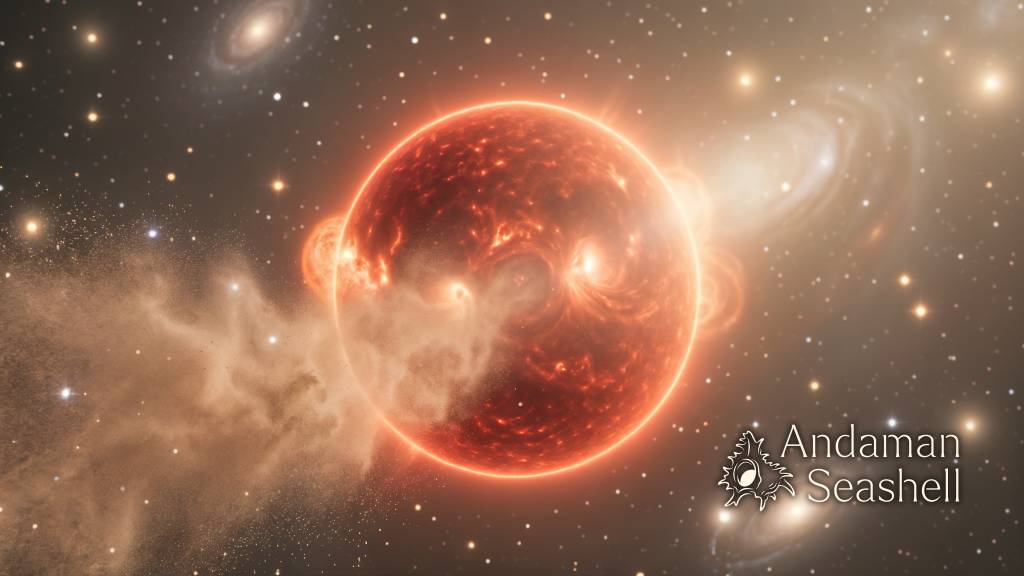
So if you needed one fresh reason to love infrared astronomy, this may be it: when Webb looks into a crowded, dusty, complicated place, it does not just find extremes. It finds continuity. A star near Sagittarius A* is still making tomorrow’s ingredients, and suddenly the center of the galaxy feels a little more alive, generous, and full of possibility [ref:1][ref:2].


No comments yet. Be the first to share a thought.