



A golden baby star glows inside a blue-violet cloud, and for a moment the universe looks as if it is celebrating with sparklers. On July 2, 2026, NASA shared a new James Webb Space Telescope view of FS Tau, a young star system in Taurus about 450 light-years from Earth, where newborn stars are lighting the gas and dust around them in infrared color [ref:1].
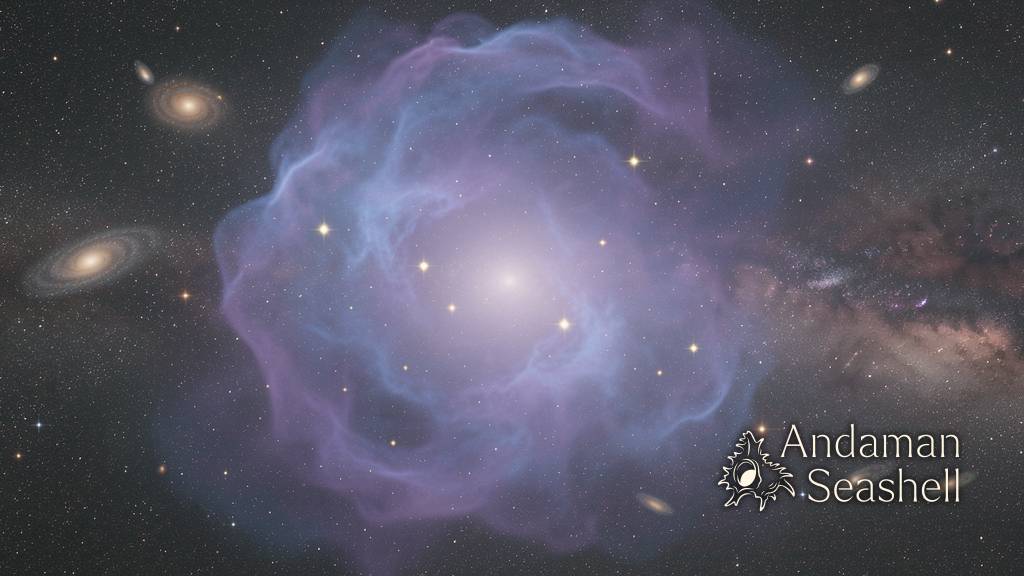
That is the lovely trick of Webb: it sees infrared light, which can slip through dusty places that ordinary visible light often cannot. So instead of a flat dark patch, Webb shows a nursery full of structure — transparent-looking clouds, bright young stars, orange wisps, and tiny background galaxies scattered like confetti [ref:2]. It is science, but it also feels like opening a window.
What is FS Tau?
FS Tau is not one neat star sitting alone. It is a young star-forming region, a place where gravity gathers gas and dust into dense pockets. Inside those pockets, protostars grow. A protostar is a baby star: hot, clumpy, and still collecting material from the cloud around it. It has not yet settled into the long, steady stage where it burns hydrogen in its core the way our Sun does.
The Webb release describes FS Tau’s protostars as only about 1 to 3 million years old [ref:1]. That sounds ancient until you compare it with our Sun, which is about 4.6 billion years old. If the Sun were a respected elder telling stories by the sea, these FS Tau objects would be bright-eyed children just learning how to shine.
Why the orange ribbons matter
Look closely at the image and the most exciting details are the outflows: thin orange filaments and wisps streaming away from young stars. These are not decorative fireworks. They are clues. As baby stars gather material, some gas is launched outward in narrow jets. Those jets push into the surrounding cloud, shaping it and revealing how the young star is growing.
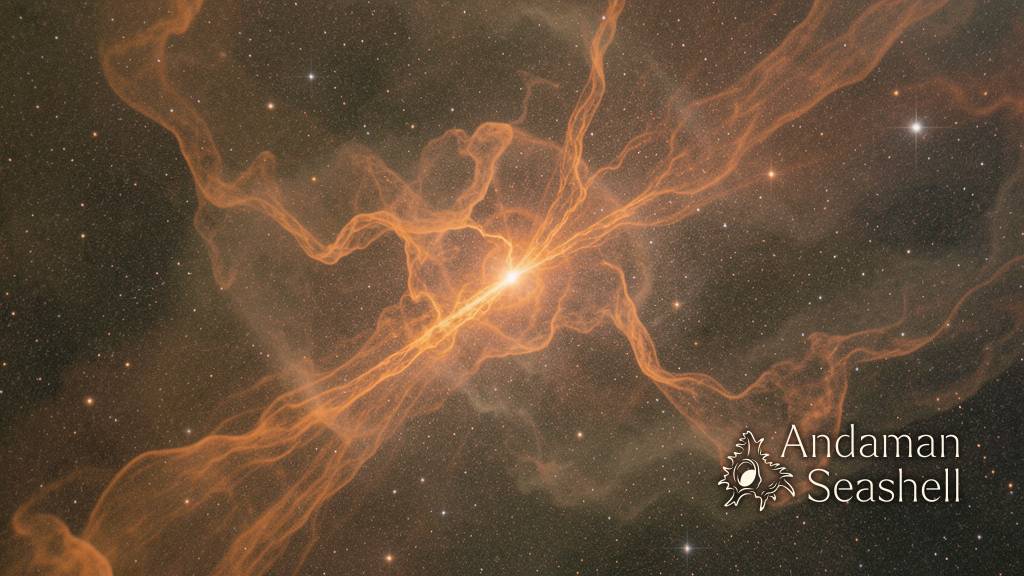
Astronomers love this because the outflows act almost like handwriting. Their shape, direction, and brightness can tell researchers about the protostar hidden inside the dust. Webb’s sharp infrared vision helps reveal features that were previously very hard to see through the thick material of the system [ref:2].
Here is a simple way to picture it: imagine blowing gently into a bowl of flour. The puff makes channels and swirls that show where the air moved. In FS Tau, the “flour” is cosmic dust and gas, and the “puff” comes from energetic young stars. The scale is enormous, but the idea is beautifully understandable.
Webb and Hubble: two amazing eyes
NASA also released a side-by-side comparison of FS Tau from Hubble and Webb [ref:3]. Hubble is brilliant at visible and ultraviolet light. Webb is built for infrared. Put them together, and the same region becomes richer: one telescope shows what shines in familiar light, the other reveals warmth and structure behind the dust.
That is one reason modern astronomy feels so exciting. Discoveries are not just about finding “new things.” They are about learning to see old things in better ways. FS Tau was already known to astronomers. Webb lets us read it with fresh clarity.
A stargazing thought for the Andaman coast
FS Tau is far too faint to see with your eyes from Phang Nga or Phuket. But the feeling it gives is wonderfully local: stand outside on a clear night, look at a bright star, and remember that every star had a beginning. The Moon over the Andaman Sea, the planets over Khao Lak, and the tiny points above a quiet street all belong to the same story of gas, dust, gravity, and light.
For families, this image is a perfect “tell me something amazing” moment. A child does not need advanced physics to understand the big idea: stars are born inside clouds; some are still growing; special telescopes can see the warm glow hidden inside those clouds.
Try this tonight
If the sky is clear, choose one bright star and imagine it as a grown-up version of the babies in FS Tau. Then ask three questions:
- What color does it look to your eyes?
- Is it steady, or does it twinkle?
- How many other stars can you see nearby?
That small act of looking is where astronomy begins. Webb may be working far from Earth, but its best gift lands very close to home: it helps us look up with better questions and a bigger smile.


No comments yet. Be the first to share a thought.