



A bright white star 63 light-years away has just offered astronomers a delightful new clue: a faint giant planet called Beta Pictoris d, found in one of the most watched young planetary systems in our sky. On 15 July 2026, NASA and the Space Telescope Science Institute shared how the James Webb Space Telescope helped reveal this quiet world by spotting the chemical fingerprint of its atmosphere [ref:1].
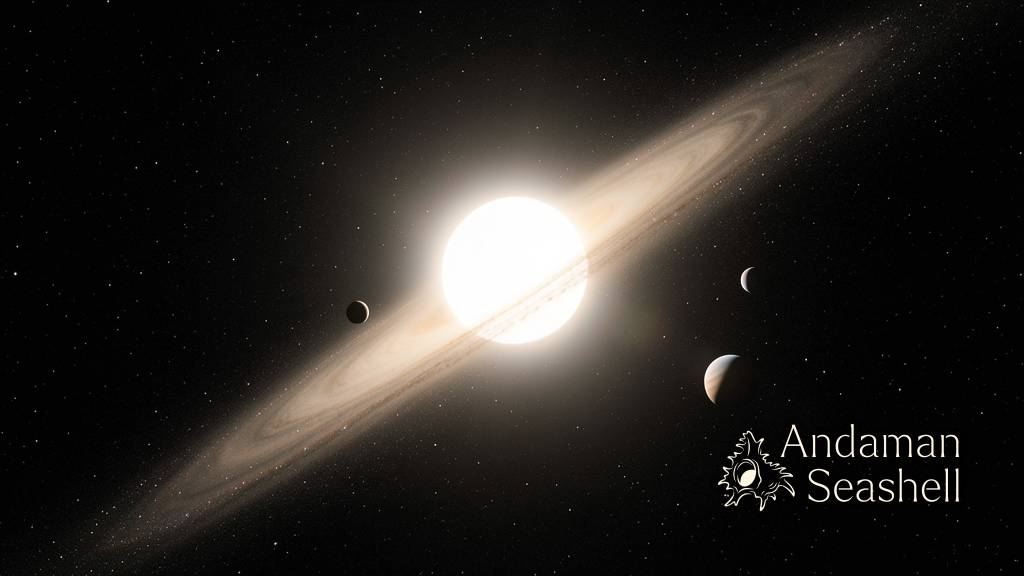
Think of it like beachcombing at night. Most shells are easy to miss until your torch catches the right shimmer. Beta Pictoris d was hiding near a brilliant star, alongside two brighter known planets, and Webb’s infrared instruments caught the shimmer that made it stand out.
A famous star family gets one more member
Beta Pictoris is already a favourite star system for planet scientists. Since astronomers identified its debris disk in 1983, it has become a kind of living classroom for how planetary systems grow. NASA says the system was already known to host Beta Pictoris b and Beta Pictoris c; the new planet makes it only the second system known to contain at least three directly imaged planets [ref:1].
That phrase, “directly imaged,” is the fun part. Most of the more than 6,000 confirmed exoplanets have been found indirectly, often by watching a star dim slightly when a planet passes in front of it. Direct imaging is different: astronomers try to separate a planet’s own tiny glow from the overwhelming brightness of its star. It is like spotting a firefly beside a lighthouse.
The Associated Press reported that fewer than 100 confirmed exoplanets have been detected through direct imaging, which makes Beta Pictoris d feel especially precious [ref:2]. The planet is also wonderfully young in cosmic terms because the whole system is about 20 million years old — a youngster compared with our Sun’s 4.5-billion-year neighbourhood.
Webb read the planet’s light like a secret code
Here is the clever bit: Webb did not simply take a pretty picture and circle a dot. STScI’s summary says the planet was uncovered through its atmospheric fingerprint, a new approach for this system [ref:1]. When light carries signs of molecules, astronomers can compare the pattern to what they expect from planetary atmospheres.
NASA’s exoplanet catalog lists Beta Pictoris d as a gas giant about 2.4 times Jupiter’s mass and about 1.26 times Jupiter’s radius. It orbits about 26 astronomical units from its star and takes 91 years to complete one trip around it [ref:3]. One astronomical unit is the average distance between Earth and the Sun, so this planet travels far out in its youthful star family.
A fun way to imagine that orbit: if Beta Pictoris d began a “year” when a grandparent was born, it might not finish that single lap until a grandchild was grown. Space time turns patience into a kind of poetry.
Two teams, one shared moment of discovery
The story becomes even more charming because two groups saw the planet independently. AP reported that a Scottish and German-led team used the European Southern Observatory’s Very Large Telescope in Chile, while a California-led team used Webb. They found the cold gas giant a few days apart late last year and kept their work separate to avoid bias [ref:2].
That kind of independent confirmation is one reason science feels so satisfying. Different tools, different teams, same hidden world. The result is not just “we found a planet,” but “the light agrees.”
For families on the Andaman coast, this is also a lovely sky lesson. Beta Pictoris is in the southern constellation Pictor, the Painter. You will not see the planet with your eyes from Phang Nga, but the idea is easy to carry outside: every star may have a story, and some stories need the right instrument, the right patience, and the right angle of light.

A small dot that makes the universe feel generous
Beta Pictoris d is not just a new name in a catalog. It is a reminder that discovery often begins with noticing what almost blends into the background. Webb’s infrared view, ground-based telescopes, archived data, and patient teams turned a faint clue into a world with size, orbit, and character.
That is the kind of wonder worth sharing at the shoreline. Pick up a shell and you can see growth rings. Look up at a star and, with the right science, you can find young planets still arranging themselves around it. The universe is generous with clues; we are getting better at reading them.


No comments yet. Be the first to share a thought.