



If you stand on a dark beach in Khao Lak tonight and look toward the southeastern sky after midnight, you might see a steady pale dot climbing above the horizon. That dot is Saturn — and circling it, 1.2 billion kilometres away, is a moon named Titan, which is currently hiding one of the most delightful mysteries in the solar system.
Titan, it turns out, shares a secret with Pluto. And the James Webb Space Telescope (JWST) just caught them both in the act.
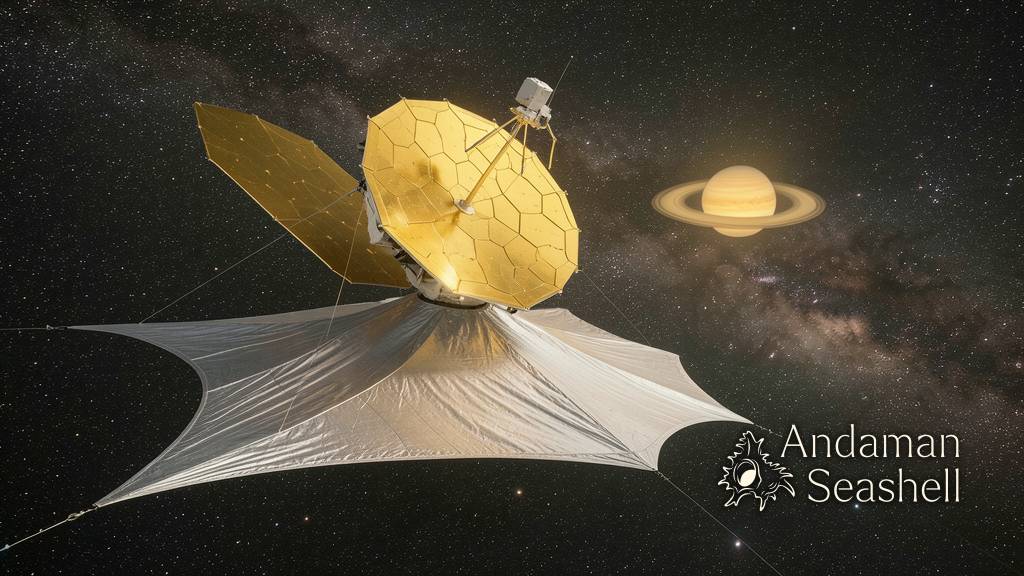
The Ghostly Note at 5.11 Micrometers
Here's what happened. Scientists using JWST's NIRSpec and MIRI instruments — two completely separate detectors — found a faint absorption line sitting at exactly 5.113 micrometers in infrared light bouncing off Titan's surface [ref:1]. An absorption line is like a missing note in a chord: certain wavelengths of light get swallowed by a specific molecule, leaving a dark gap that acts like a chemical fingerprint.
This particular fingerprint was strange enough on its own. But then the team checked Pluto's spectrum — and found the same gap, at essentially the same wavelength [ref:2].
That should not happen. Titan is a moon of Saturn with a thick, hazy nitrogen atmosphere, rivers of liquid methane, and surface temperatures around −179°C. Pluto is a dwarf planet five times farther from the Sun, with a whisper-thin atmosphere and a surface of frozen nitrogen at −230°C. They are about as different as two worlds can be.
Yet both carry the same chemical signature.
Why Scientists Are Thrilled, Not Stumped
When researchers led by planetary scientist Bézard and colleagues searched through every published laboratory spectrum of ices and organic compounds relevant to these worlds — ethane, acetylene, benzene, hydrogen cyanide, tholins, and dozens more — they found no match [ref:1]. None. The 5.11-micrometer note doesn't correspond to any known molecule in any tested form.
And here is the wonderful part: this is not a problem. This is an invitation.
The feature is about three times broader on Pluto than on Titan, which means the molecule is sitting in different chemical environments on each world. Think of it like the same bell ringing in two different rooms — same bell, different acoustics. On Pluto, the signal may have been shaped by billions of years of cosmic radiation bombarding the surface, breaking and recombining molecules into new forms.
Both worlds do share one important thing: nitrogen-rich chemistry with methane, bathed in ultraviolet light that cooks up complex organic molecules. Whatever is leaving this fingerprint, it seems to come from that same cosmic recipe — just cooked at wildly different temperatures.
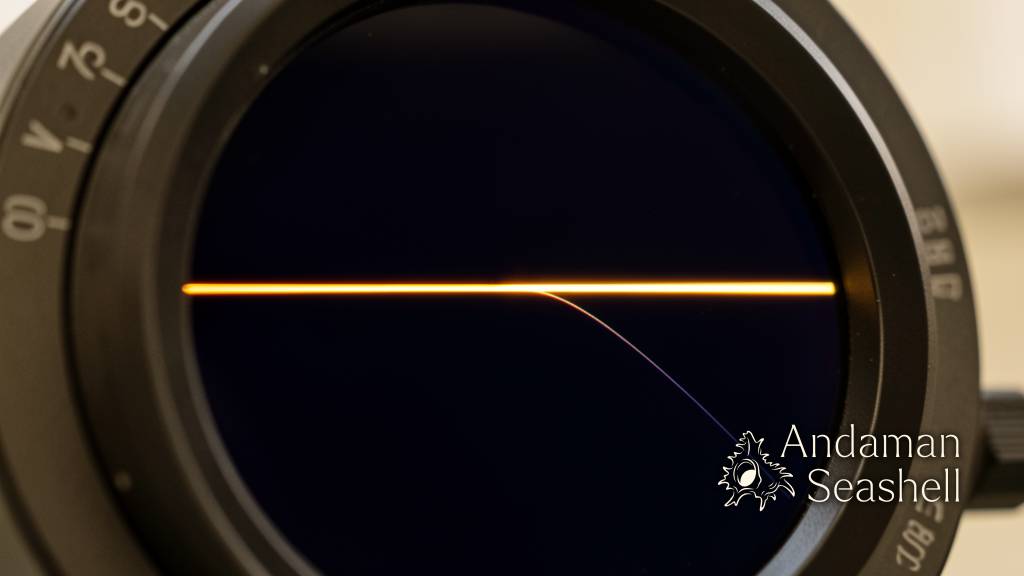
The Detective Work
The team ruled out every mundane explanation with meticulous care. It is not an instrument artifact — two independent JWST instruments saw it. It is not in the atmosphere — the feature weakens at the edge of Titan's disk, which is exactly what a surface signal does. It is not methane, or ethane, or any of the usual suspects. And when they checked Ganymede, another icy moon, the line was simply absent [ref:1].
The best candidates so far are exotic. Allenes — molecules built around a C=C=C backbone — have strong bands in this wavelength range. Benzene, mixed into the surface ice like food colouring in water, could shift its absorption to exactly 5.11 micrometers. But no one can say for certain yet, because the laboratory measurements needed to confirm these ideas at Titan and Pluto temperatures don't fully exist.
That gap between data and understanding is where the excitement lives.
What Comes Next
The good news is that this mystery has a timeline. JWST can make additional observations to map where on Titan the 5.11-micrometer signal is strongest, which would narrow the chemical suspects [ref:3]. New laboratory experiments can test candidate molecules under realistic conditions.
And then there is Dragonfly. NASA's nuclear-powered rotorcraft is scheduled to arrive at Titan in the mid-2030s, flying across its dunes and sampling surface material directly [ref:3]. It may not carry an infrared spectrometer precise enough to read this particular fingerprint, but it will tell us what Titan's surface is actually made of — and that context could crack the case.

The Joy of Not Knowing Yet
The next time you spot Saturn rising over the Andaman Sea, spare a thought for Titan. Somewhere on its surface — perhaps in a dried methane riverbed, perhaps on a plain of organic sand — there is a molecule that exists nowhere on Earth, that we have never seen in a laboratory, and that chose to appear on two worlds at opposite ends of the solar system.
We don't know what it is yet. And that, honestly, is the best part.


No comments yet. Be the first to share a thought.