



A museum drawer can sometimes feel like a tide pool in disguise. Open the tray holding one of the Smithsonian’s oddest shell specimens and you find a genuine eastern oyster fused to a set of 19th-century dentures, collected from the bottom of the Chesapeake Bay in 1898.[ref:1]
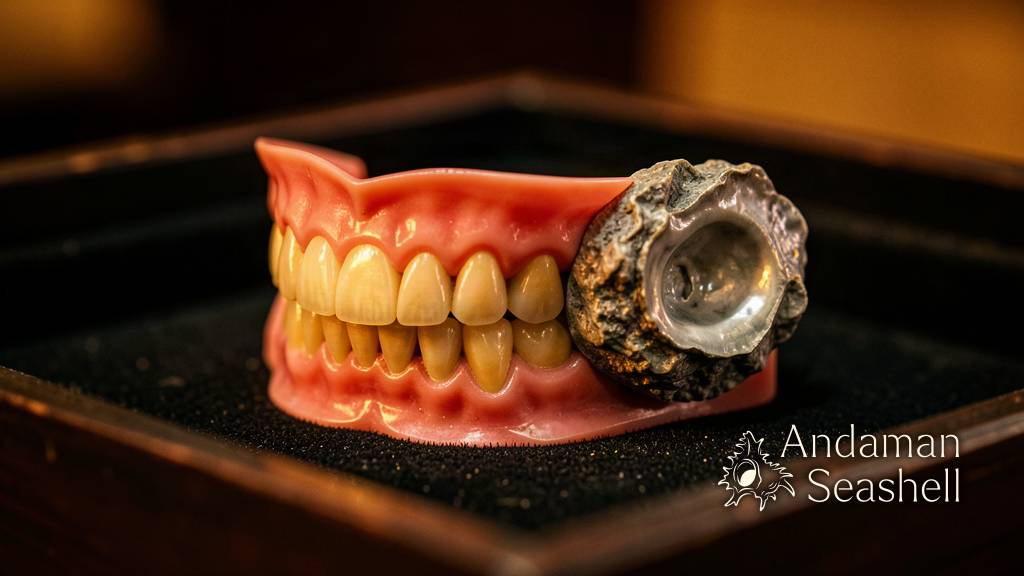
What makes the object wonderful is not only the surprise. It is also perfectly natural oyster behavior. As Smithsonian bivalve curator John Pfeiffer explains, a young oyster will settle on almost any hard surface it can find—bedrock, another oyster, a pipe, or in this case a lost set of false teeth.[ref:1] The animal produces an adhesive, cements itself in place, and then stays attached for the rest of its life.[ref:1] In one glance, the specimen turns shell biology into something you can instantly understand.
A shell story written on a hard surface
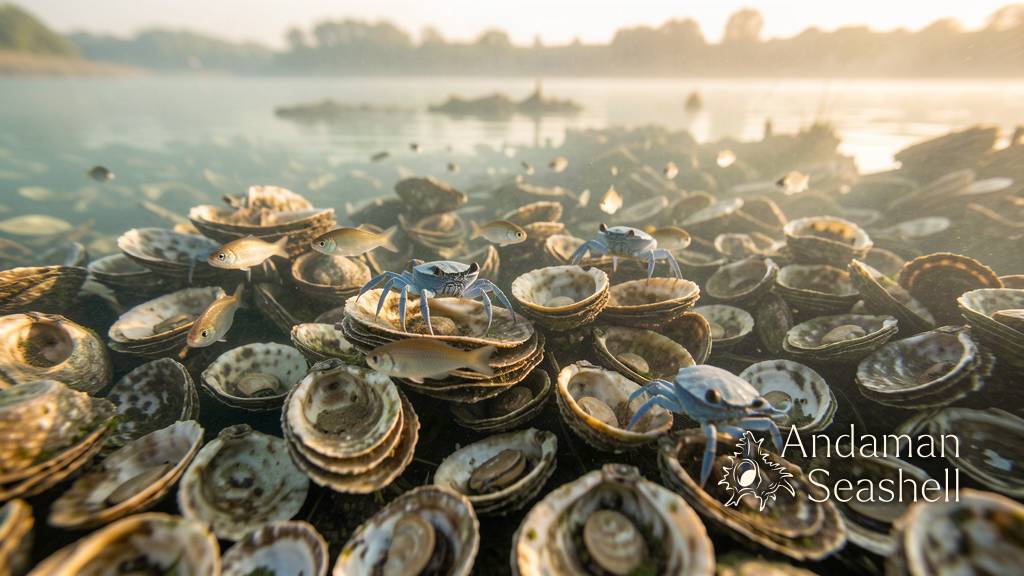
The species in the tray is the eastern oyster, Crassostrea virginica.[ref:3] Like many mollusks, it begins life as a free-swimming larva before settling down. Once attached, oysters grow into layered, irregular shells and often fuse shell-to-shell until whole reefs rise from the estuary floor.[ref:4] Mature eastern oysters can reach up to 8 inches long, and their clustered reefs become far more than piles of shell: they create three-dimensional habitat for fish, crabs, anemones, mussels, and many other small animals.[ref:3][ref:4]
That is why the denture oyster feels bigger than a curiosity. It hints at a time when the Chesapeake Bay held enough oysters, and enough hard structure, for a strange object dropped into the water to become part of a living reef story.[ref:1] Smithsonian Ocean describes those historic reefs as underwater cities built by eastern oysters, with cracks and ledges used by creatures from naked gobies to blue crabs.[ref:4]
From abundance to restoration
The same specimen also marks a turning point. The Smithsonian notes that by the time the dentures were dredged up in 1898, Chesapeake oyster numbers were already falling.[ref:1] Today, scientists estimate the Bay holds only about 1 to 2 percent of its historic native oyster population.[ref:3] That loss matters because oysters are not passive ornaments. They are working animals.
A single adult oyster can filter up to 50 gallons of water a day under the right conditions.[ref:3][ref:4] As they feed, oysters remove particles from the water and help improve clarity, which supports broader estuary life.[ref:2][ref:4] Their reefs also buffer shorelines and give juvenile marine animals places to hide and forage.[ref:2][ref:4]
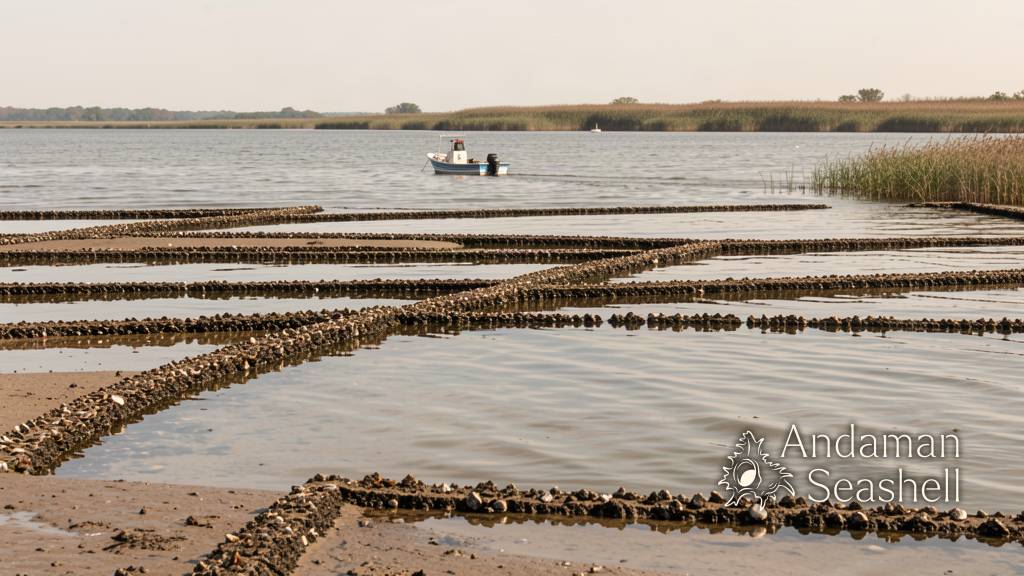
NOAA’s Chesapeake restoration updates show how seriously that role is now being taken. Across the Bay, partners have restored oyster reefs in all 10 tributaries selected for restoration work, plus a bonus tributary, for more than 2,400 acres of healthy reef.[ref:2] NOAA’s eastern oyster profile adds another useful scale comparison: nearly 1,400 restored acres equals more than 2 square miles, or about 1,055 football fields.[ref:3] Those numbers make the reef story feel physical again.
One tributary in particular shows what recovery can look like. In Harris Creek on Maryland’s Eastern Shore, NOAA reports roughly 343 acres of healthy oyster reef and 2.49 billion oyster seed planted as part of restoration work.[ref:2] Another NOAA feature describes Harris Creek as roughly 350 restored acres—about the size of the National Mall in Washington, D.C.[ref:5] On dense restored reefs in the Chesapeake, researchers found more than 5,000 macrofauna in a single square meter.[ref:5] That is the opposite of an empty seafloor.
Why the strange specimen matters now
The denture oyster does something good science writing always hopes to do: it shrinks a vast ecological story to the size of your hand. Instead of beginning with a chart, you begin with shell ridges gripping enamel. From there, the rest of the facts line up naturally. Oysters need hard surfaces. Oysters build reefs. Reefs hold communities. When those reefs disappear, the water and the food web change with them.[ref:1][ref:4][ref:5]
And when reefs come back, the gains are measurable. NOAA says restored reefs in Harris Creek can remove nitrogen equivalent to roughly 20,000 bags of fertilizer each year.[ref:5] That turns an old shell story into a present-day story of design, engineering, and patience.
So yes, the Smithsonian’s oyster with teeth is funny at first glance. But it also carries the exact lesson a shell can carry so well: hard beauty is usually the record of a living process. In this case, one small oyster attached itself to an unlikely object and accidentally preserved a whole estuary’s history—its abundance, its decline, and the careful work now helping that underwater architecture rise again.[ref:1][ref:2][ref:3]
References
- Smithsonian NMNH Voices — An Oyster With Teeth Reveals When Mollusks Covered the Chesapeake Bay (2026-08-05)
- NOAA Fisheries — Chesapeake Bay oyster reef restoration updates
- NOAA Fisheries — Eastern Oyster management and restoration
- Smithsonian Ocean — Oysters as a Keystone Species in the Chesapeake Bay
- NOAA Fisheries — Oyster Reefs Provide Habitat and Filter Water, Findings Show


No comments yet. Be the first to share a thought.