



Pick up a green mussel shell on a low-tide walk and the colour stops you mid-step: a deep, glossy emerald that looks far too deliberate to be an accident. A new study in the journal Scientific Reports has just explained where that green actually comes from — and for most green shells the answer is stranger than anyone guessed. When researchers shone laser light into fifteen rare blue and green shells, ten of the green ones gave back a reading nobody expected for something so vividly coloured: no paint at all. [ref:1]
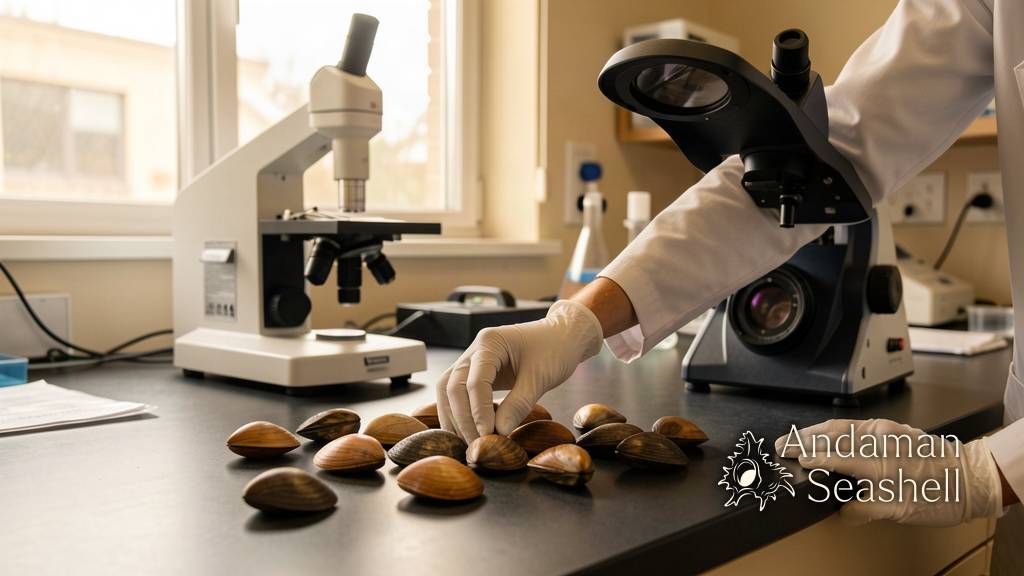
The tool at the heart of the story is Raman spectroscopy. Fire a gentle beam of laser light at a material and most photons bounce off unchanged — but a tiny fraction nudge the molecules as they scatter, losing or gaining a whisper of energy. Those shifts form a spectrum that acts like a chemical fingerprint: a carotenoid pigment announces itself with peaks at very specific wavenumbers, and the instrument can read them even at low concentrations. The team embedded cross-sections of each shell in resin and scanned them at two excitation wavelengths, 532 and 785 nanometres, layer by layer. [ref:1] [ref:2]
The shell list itself was ambitious. Fifteen species with rare green or blue shells were chosen to represent five of the six major lineages of the class Bivalvia — the clams, mussels, oysters and scallops — a class of roughly 10,000 accepted living species whose main branches parted ways back in the Ordovician period, about 485 million years ago. [ref:1]
Ten green shells, zero paint
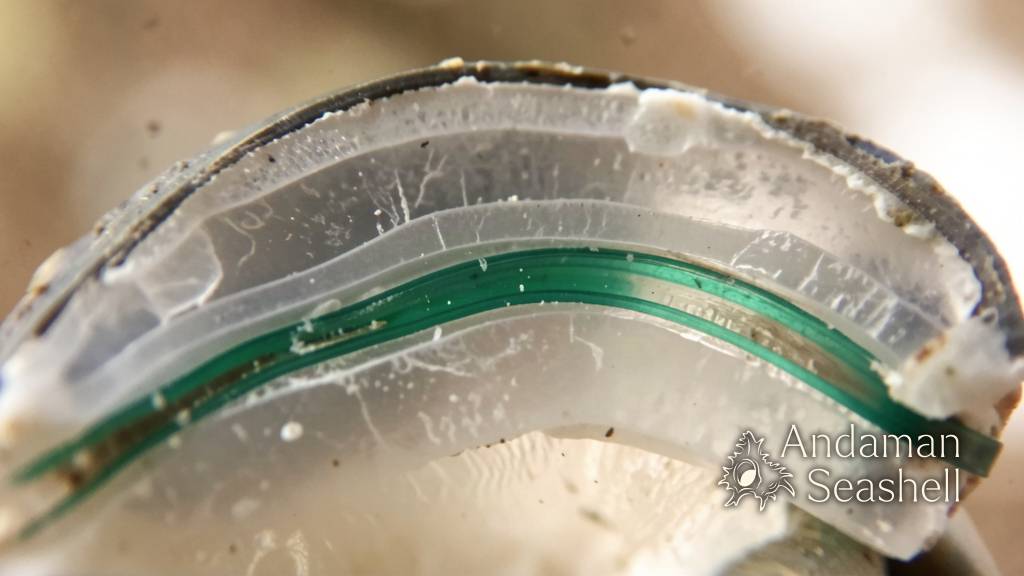
The first discovery was about location. In every species examined, green colour sat in thin organic layers — the periostracum, the skin-like coat over the shell's surface, or organic sheets interleaved inside it — and never in the chalky mineral matrix itself. [ref:1]
The second discovery was the showstopper. In ten of the green-shelled species, the spectra came back stubbornly quiet: no clear pigment peaks at either laser wavelength. The most exciting explanation is structural colour — the same trick a butterfly wing or a peacock feather plays, where nano-scale architecture bends and diffracts light itself, no pigment required. Until now, structural colour was known from the shells of only one bivalve genus, Perna — the green mussels — whose periostracum contains protein nanofibres that diffract light into green iridescence. Ten more species showing no detectable pigment suggests structural green may be quietly common across the bivalve family tree. [ref:1]
Blue is dinner, rearranged
Blue shells told the opposite story. In the two blue species examined, the colour spread diffusely through the calcareous shell, and both carried clear carotenoid signatures — but not the same one. In the freshwater bivalve Mutela legumen, peaks appeared at 1128 and 1514 cm⁻¹; in the marine mussel Septifer bilocularis, different peaks at 1090 and 1478 cm⁻¹. Two different pigments, converging on the same rare colour. [ref:1] [ref:2]
Here is the delightful part: animals cannot make carotenoids from scratch. Only plants and fungi can, so a bivalve's blue begins as dinner — plankton and plant matter that are normally yellow, orange or red. To end up blue, the shellfish appears to chemically modify its dietary pigments, likely by binding them with a protein. A blue shell is, quite literally, a recoloured salad. [ref:1]
Why a shell bothers
Why invest in rare colour at all? The leading idea is camouflage — green that matches sunlit seagrass and algae. The researchers make a testable prediction: green structural-colour bivalves should turn out to live in the top 200 metres of the ocean, the sunlit photic zone where green light actually matters, with the architecture in pteriomorph mussels evolving through small changes in the size of light-bending vacuoles. Bivalves already flirt with light elsewhere — scallops such as Argopecten irradians have blue eyes built from protein nanospheres, and giant clams like Tridacna maxima shimmer with guanine platelets in their mantle. [ref:1] [ref:2]
The study also settles a seven-year-old puzzle. Back in 2019, Raman work on bivalve pigments already noticed that green shells refused to give a pigment signal, and proposed the shells might contain strange, weakly detectable pigments. The new results push the answer further: in many green shells, the missing signal probably means there is nothing to detect — the colour is the architecture. [ref:3]
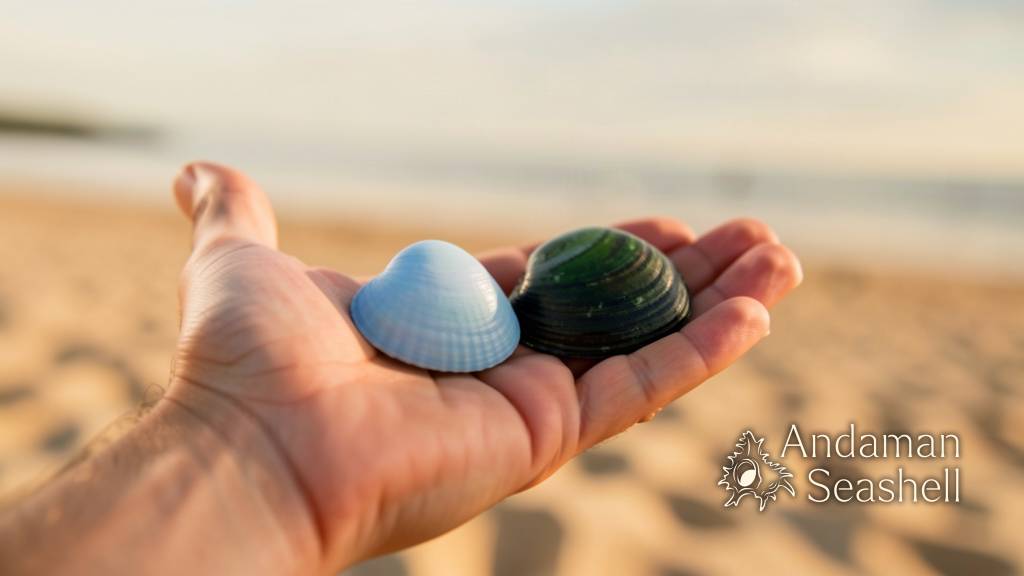
So the next time a green mussel shell catches your eye, turn it in the light and remember: you may be looking at a natural diffraction grating, a tiny piece of optical engineering grown by an animal with no blueprint — while its blue cousin down the beach carries the memory of every meal it has ever eaten. Two colours, two completely different kinds of chemistry, and one still-open question that scientists are already lining up to answer: how many more shells are wearing light instead of paint?
References
- Scientific Reports — Raman spectroscopic insights into rare blue and green shell colouration in bivalve molluscs
- bioRxiv preprint — Rare shell colours in bivalves reveal multiple evolutionary pathways to blue and green colouration
- Journal of Raman Spectroscopy — Colour in bivalve shells: resonance Raman spectroscopy (Wade et al. 2019)


No comments yet. Be the first to share a thought.