



In the summer of 2019, a university student on a recreational dive off northern Taiwan noticed a tiny speck crawling on a moss-like crust that covered a reef rock. He could not have known it then, but that speck was about to begin a seven-year journey through a Facebook conversation, a DNA sequencer, and finally the pages of a scientific journal — emerging as Thecacera sesama, a sea slug smaller than a grain of rice and the first new member of its genus described by science in almost three decades [ref:1].
A speck with five gills
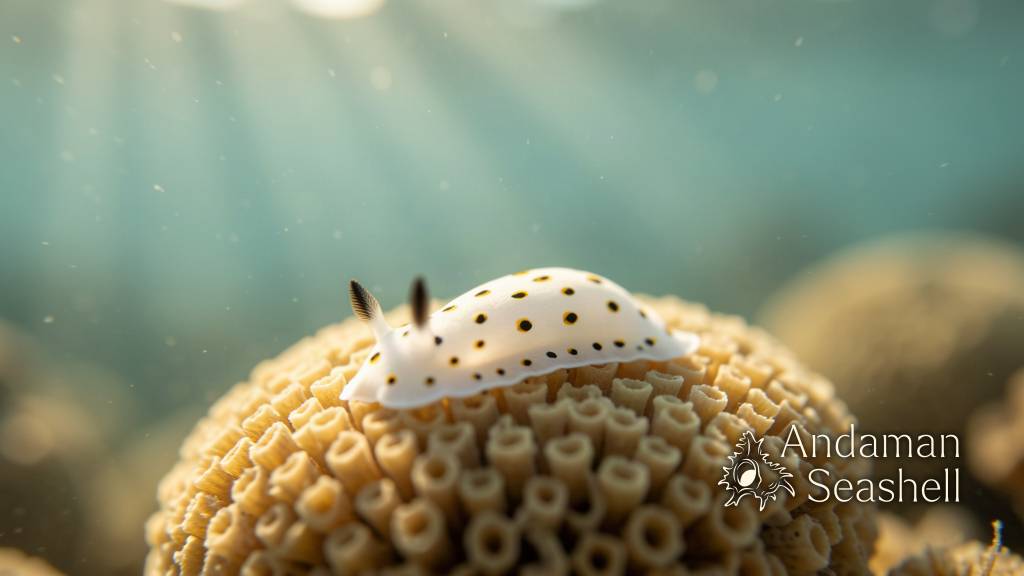
Under a magnifying glass, the little slug is unmistakably its own creature. Its body is translucent white, scattered with numerous small, round black pigment spots and a smaller number of larger yellow ones — the exact pattern that reminded Taiwanese divers of a sprinkle of sesame [ref:1]. Like its relatives in the genus Thecacera, it carries five feathery gills at its rear, and it stops growing at under three millimetres long — small even by nudibranch standards [ref:1].
The single specimen that anchors the formal description — the holotype — measures just 2.02 millimetres preserved. It was collected on 14 June 2025 at a depth of 23 metres, off the Northern Coastal Highway near Ruifang District, New Taipei City, sitting on a bryozoan encrusting the reef [ref:1]. A creature this size doesn't announce itself; it waits to be noticed.
Seven years from lucky glance to Latin name
The story begins with Ho-Yeung Chan, then an undergraduate, who first encountered the slug during that casual dive in 2019 [ref:2]. He didn't realise he was looking at a species unknown to science until he shared it with a sea-slug expert — known online as "Hsini Lin teacher" — on Facebook. That single message set the identification in motion [ref:2].
From there, researchers from National Taiwan Ocean University, the National Museum of Natural Science and National Taipei University of Education combined classic morphology with molecular phylogenetics, publishing the formal description in the open-access journal ZooKeys on 11 May 2026 [ref:3]. Remarkably, it is the first formal description of a new Thecacera species in nearly thirty years, bringing the total number of valid species in the genus to seven [ref:1].
What the DNA said
Looks can deceive in the sea-slug world, so the team barcoded two mitochondrial genes — cytochrome c oxidase I (COI) and 16S rRNA. The result was decisive: T. sesama sits as a sister species to Thecacera picta, separated by a COI divergence of 14.17% — a genetic distance far beyond the noise of ordinary variation, and confirmation that this sesame-flecked speck is a lineage of its own [ref:1].
That number is also a quiet lesson in humility. Two slugs can share a colour scheme and a genus yet have travelled separate evolutionary roads for millions of years. Without the DNA, the sesame slug might have remained forever filed under "probably pennigera, small specimen" [ref:1].
A whole life on a moss animal
Thecacera sesama keeps life admirably simple. The researchers observed just four primary behaviours: feeding, searching, mating, and laying eggs — all on bryozoans, the tiny colonial "moss animals" it grazes [ref:2]. Intriguingly, the particular bryozoan the slug calls home may itself be a species new to science, meaning one discovery could quietly contain another [ref:2].
Reaching it at all takes patience. Off Keelung, summer typhoons and winter monsoon waves — with sea temperatures often dropping below 16°C — squeeze the diving season for nudibranch research into roughly four months a year [ref:2]. Every sighting of a three-millimetre animal is a small triumph of timing and sharp eyes.
The smallest name on the reef
Nudibranchs, the research team notes, are key players in the marine food web — vivid, colourful, and often maddeningly difficult to spot with the naked eye [ref:2]. Each one formally named is a piece of the ocean's inventory properly labelled, and the sesame slug's name carries something extra: it honours the word Taiwanese divers themselves invented for it. A nickname spoken on dive boats became sesama, written permanently into Latin [ref:2].
And the shelf is far from empty. Because so many nudibranchs are tiny, the researchers believe T. sesama is just the beginning for Taiwanese waters [ref:2]. Somewhere on a reef, another speck is waiting for its lucky glance — and perhaps, one day, its own name.


No comments yet. Be the first to share a thought.