



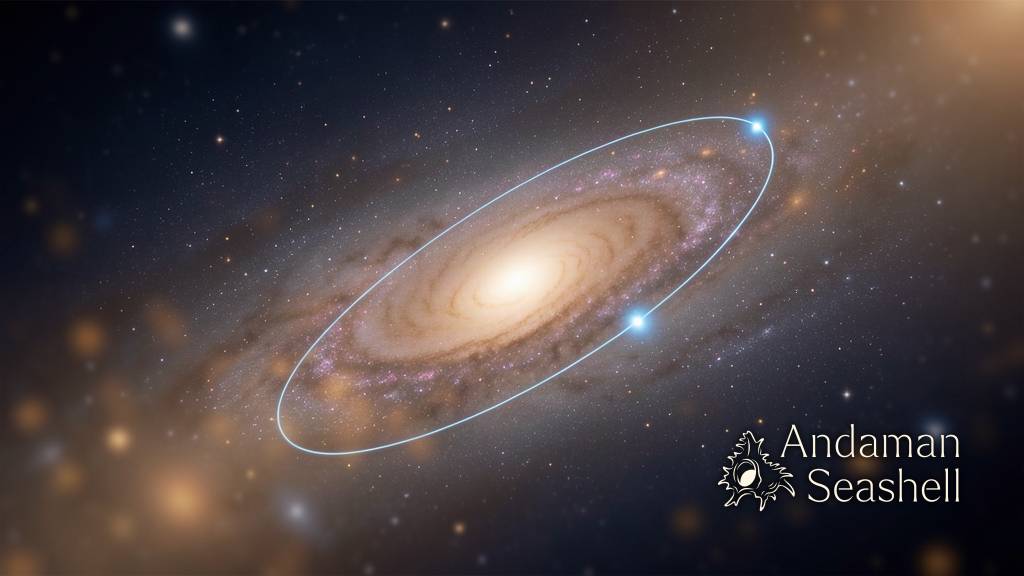
A single faint star is suddenly giving astronomers one of the most exciting views in the Milky Way. S301, a newly studied star circling the black hole Sagittarius A* at our galaxy’s centre, whips through space at about 25,000 kilometres per second and loops around the black hole in only 8.7 years.[ref:1][ref:2]
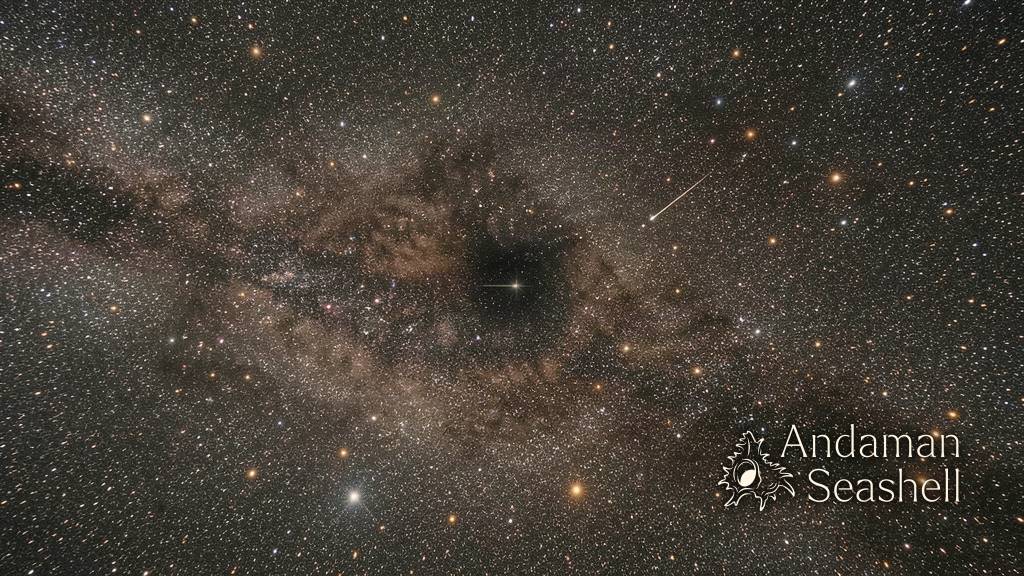
That combination of speed and closeness is what makes the story so joyful for science. S301 is now the fastest known star in the Milky Way, and it also passes closer to Sagittarius A* than any other star yet tracked.[ref:1][ref:3] Instead of being just another beautiful point of light, it has become a remarkably precise test particle — the sort of celestial marker astronomers dream about when they want to study gravity in its most extreme form.
Why this star feels special right away
Sagittarius A* is the supermassive black hole at the centre of our galaxy, with a mass of about 4 million Suns.[ref:1][ref:2] Astronomers have watched stars circle it for decades, but S301 stands out because its path is unusually tight and lopsided. At closest approach, the star comes within about 1.78 billion kilometres of the black hole — roughly 12 times the Earth-Sun distance, or only about 20% farther out than Saturn is from the Sun.[ref:1] For something orbiting a black hole, that is wonderfully close.
The numbers stay impressive from every angle. The Nature paper describes S301 as a faint main-sequence star with a K-band magnitude of 19.3, discovered in 2023.[ref:2] ESO says it appears about two billion times fainter in the sky than Betelgeuse, which helps explain why finding it took such patient instrumentation and years of tracking.[ref:1] This is not a giant beacon blazing in easy view; it is a delicate signal teased out of one of the busiest, brightest regions in the galaxy.
The instrument work behind the discovery
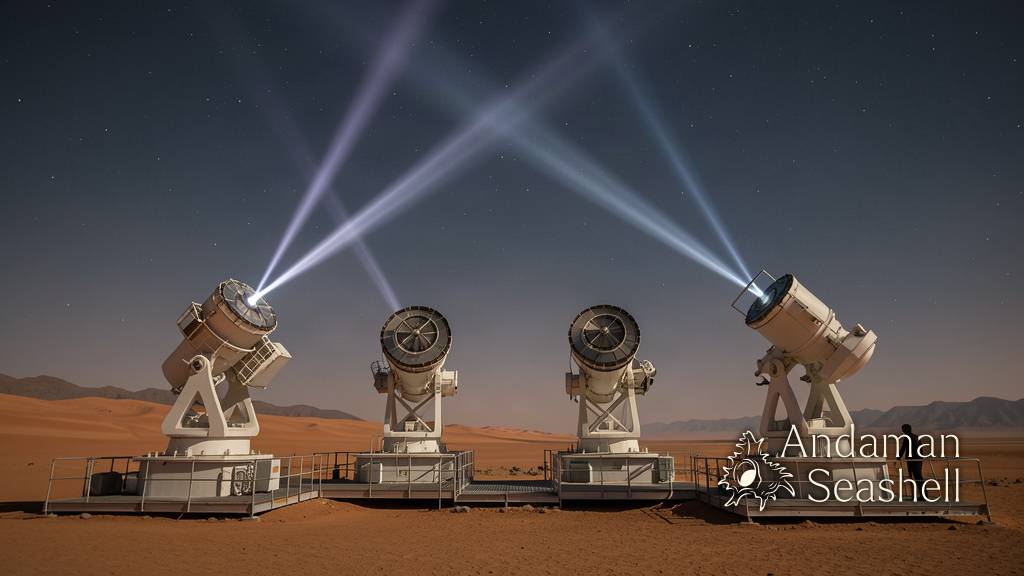
Astronomers tracked S301 using the European Southern Observatory’s Very Large Telescope Interferometer at Paranal in Chile, working with the GRAVITY instrument and its upgraded GRAVITY+ mode.[ref:1][ref:2] One lovely engineering detail here is that the VLTI combines light from four 8-metre telescopes, creating a virtual telescope with about 15 times the spatial resolution of a single 8-metre telescope.[ref:1] That boost is exactly what lets researchers separate faint stars in the crowded neighbourhood around Sagittarius A*.
The team first caught sight of S301 in spring 2023, then traced its orbital history back to 2017.[ref:1] Monthly observing campaigns between March and September, adding up to roughly 80 to 100 hours of observing time per year, helped refine the orbit further.[ref:2] Those details matter, because S301 is not interesting only for where it is today. It is interesting because its future path can be measured with enough precision to test ideas that have usually stayed more theoretical than direct.
What S301 can teach about a spinning black hole
Einstein’s general relativity predicts that a spinning black hole drags spacetime around with it.[ref:1][ref:2] Astronomers already know Sagittarius A* has an accurately measured mass, and earlier work with another star, S2, revealed relativistic effects such as gravitational redshift and Schwarzschild precession.[ref:2] But measuring spin directly has been much harder.
S301 may change that timetable in a very cheerful way. Because the star moves so fast — more than 8% of the speed of light at peak, or about 100,000 times faster than a commercial plane — its orbit is especially sensitive to the black hole’s spin.[ref:1][ref:3] Researchers now hope that by following S301 through its next close passage in 2031 and by observing at least two full orbits, they can directly determine the spin of Sagittarius A* within about the next decade.[ref:1][ref:3]
There is even a dramatic origin story behind the orbit. The paper suggests S301 was probably once part of a binary system that wandered too near Sagittarius A* and was torn apart by the black hole’s tidal forces — a process called the Hills mechanism.[ref:1][ref:2] S301 stayed captured, while its former companion may have been flung away at such high speed that it could leave the galaxy altogether.[ref:1]
A small star with a big future
What makes this discovery so attractive is its scale contrast. S301 is tiny compared with the black hole it circles, faint enough to challenge elite instruments, yet precise enough to help test one of the deepest ideas in physics.[ref:1][ref:2] In space stories, wonder often comes from giant explosions or glowing nebulae. Here it comes from accuracy: a faint star, a tight ellipse, four telescopes working as one, and a decade-long promise of better answers.
If all goes well, the next years of observations will turn S301 from a thrilling discovery into a measuring tool for the Milky Way’s central black hole itself. That is a beautiful kind of progress: the universe does not just surprise us with something fast and bright, it hands us a better ruler.[ref:1][ref:2]


No comments yet. Be the first to share a thought.