



A silver-white telescope stood upright inside a clean room at NASA’s Kennedy Space Center in late June, looking less like a machine and more like a giant eye about to blink awake. Engineers had rotated the Nancy Grace Roman Space Telescope from horizontal to vertical, a practical move for inspections and testing — and a wonderfully visual sign that one of astronomy’s next great observatories is getting close to the sky [ref:1].
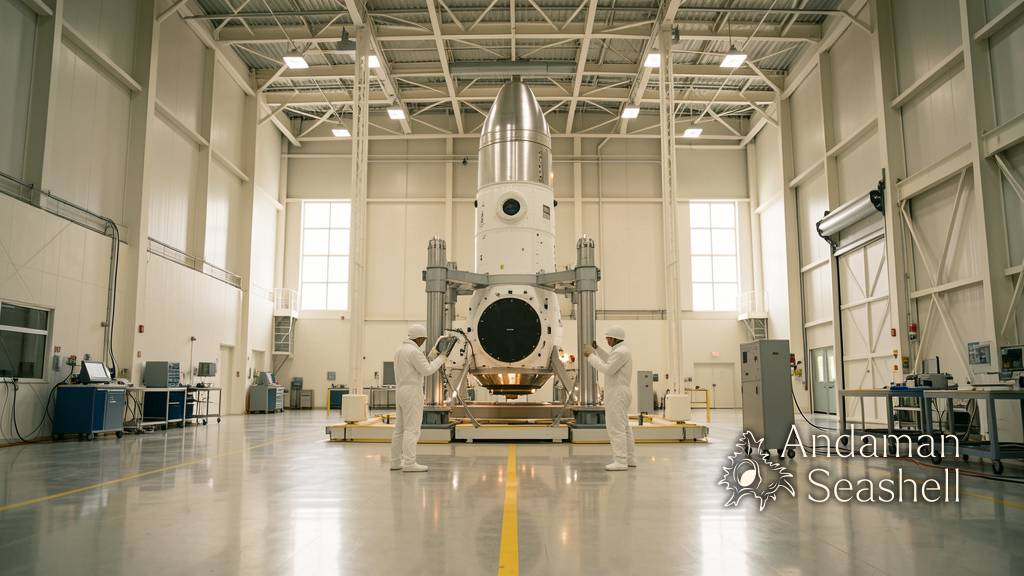
NASA and SpaceX are targeting no earlier than August 30, 2026, for Roman’s launch on a Falcon Heavy rocket from Launch Complex 39A in Florida [ref:2]. That date is not just for rocket fans. It marks the beginning of a mission designed to give astronomers a much wider, faster way to explore the universe — a little like swapping a keyhole view for a picture window.
Meet the wide-eyed cousin of Hubble
Here is the fun comparison: Roman’s primary mirror is 2.4 metres across, the same size as Hubble’s main mirror, but Roman’s field of view is at least 100 times larger [ref:1]. Imagine Hubble taking a gorgeous close-up portrait of one shell on a table. Roman can keep that sharpness, then pull back to see the whole tray sparkling at once.
That bigger view matters because the universe is not a single object waiting politely in the middle of the frame. Galaxies are scattered across huge patches of sky. Stars brighten and dim. Exoplanets reveal themselves in tiny flickers. To catch those patterns, you need patience, precision, and a camera that can survey wide cosmic neighborhoods again and again.
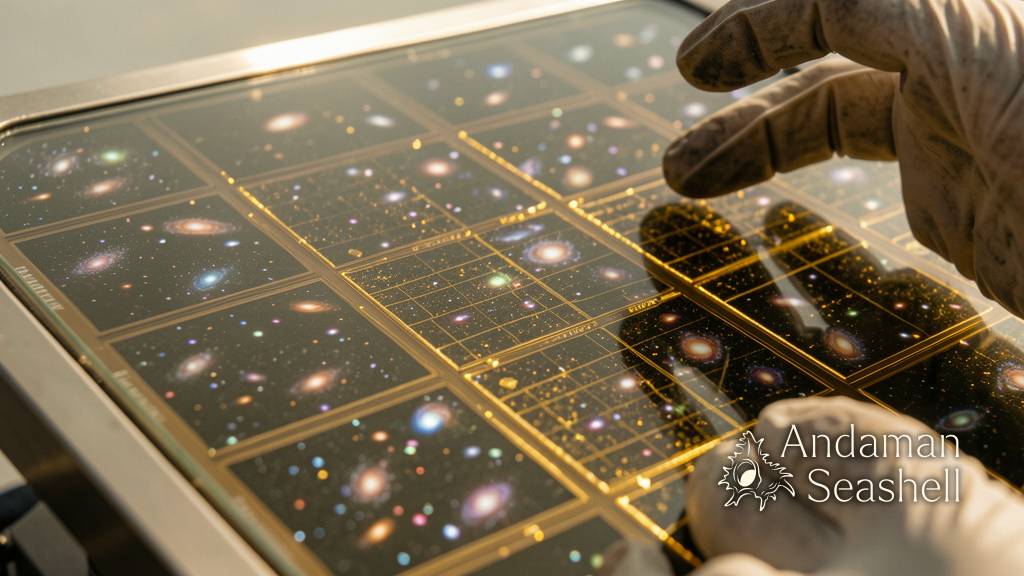
ESA’s Roman factsheet describes the Wide Field Instrument as a 300-megapixel visible and near-infrared camera, paired with a technology-demonstration coronagraph that can block starlight to help reveal faint planets near other stars [ref:3]. The mission is planned to operate around the Sun-Earth L2 region, a stable observing neighborhood also used by major space observatories.
What Roman will look for
Roman is built for big questions that sound like they belong in a children’s wonder book, except they are real science. Why is the universe’s expansion speeding up? How is matter arranged across cosmic time? How many faraway worlds are hiding in the crowded star fields toward the centre of our Milky Way?
One NASA feature explains that Roman’s exoplanet work could reveal around 100,000 worlds, dramatically expanding the current catalogue of known planets beyond our solar system [ref:4]. Many of those detections will come through microlensing, a method that watches how gravity from a star and its planets briefly magnifies light from a more distant star. It is like spotting an invisible glass bead because it bends the light behind it.
Roman will also help astronomers study dark energy — the name scientists give to the mysterious something associated with the universe’s accelerating expansion. The article does not need to make dark energy sound gloomy. Think of it instead as one of the universe’s grand open questions, the kind that invites better maps, sharper measurements, and more beautiful data.
Why this is exciting from any coast
You will not need a telescope in Phang Nga to enjoy Roman’s discoveries. The observatory will work far beyond Earth’s atmosphere, and its images and survey results will travel back as data for scientists to transform into maps, catalogues, and new questions. Still, there is a lovely Andaman connection: anyone who has watched the Moon pull the tides or seen the Milky Way over a quiet shoreline already knows that the sky and sea are part of the same sense of scale.
On an evening when the clouds part, try this simple thought experiment. Hold one hand up to the sky and cover a small patch with your fingertip. Somewhere behind that tiny patch are stars, galaxies, and possible planets Roman may help us understand more clearly. The magic is not that the universe becomes smaller. It is that our tools become more generous.
A telescope named for a sky-builder
Roman is named for Nancy Grace Roman, NASA’s first chief astronomer, often called the “mother of Hubble.” That makes the mission feel like a beautiful continuation: Hubble taught generations to love deep-space portraits; Roman is preparing to add the wide mural.
By the time Falcon Heavy lifts Roman from Florida, the most exciting part will still be ahead. The launch is the doorway. The real gift is years of panoramic discovery — galaxies gathered like beads, planets found by delicate flickers, and a wider window for every curious person who has ever looked up and whispered, “What else is out there?”


No comments yet. Be the first to share a thought.