



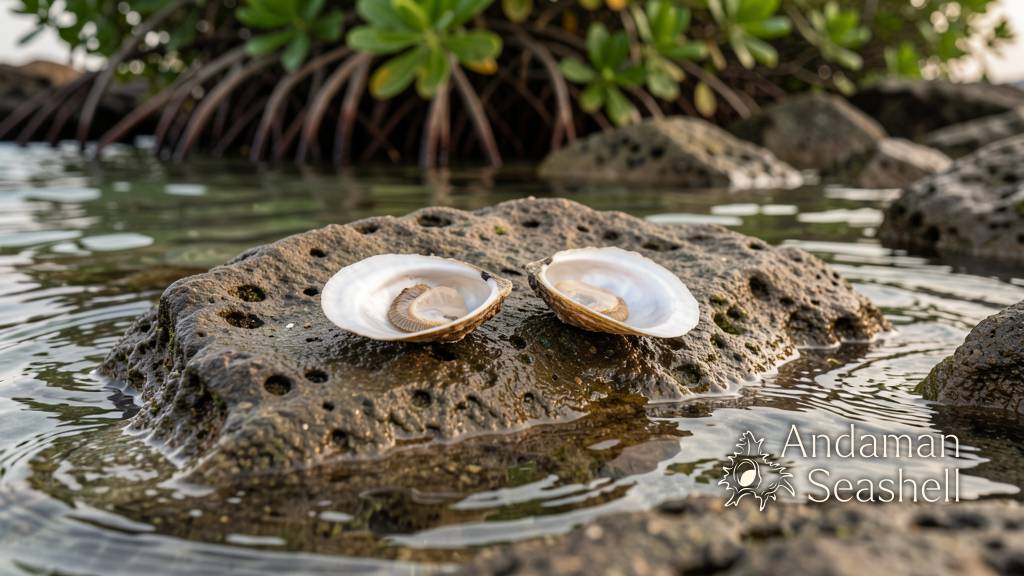
Hold a pearl oyster shell up to the afternoon light and turn it slowly. Pink spills into green, green melts into blue, blue flashes violet — the entire visible rainbow rolls across the surface like oil on water. Here is the astonishing part: not one of those colors comes from pigment. There is no dye, no ink, no colored molecule anywhere in that shell. Every hue you see is created by architecture.
Welcome to one of nature's most elegant optical tricks: structural color. And the Andaman coast — home to pearl oysters, abalone, and dozens of nacreous (mother-of-pearl) mollusks — is surrounded by it.
How a Mollusk Builds a Rainbow, Tile by Tile
The story begins inside the animal. A mollusk like the pearl oyster Pinctada maxima — a species found throughout the Indo-Pacific, including the waters off Phang Nga — has a thin tissue layer called the mantle. This mantle secretes the shell material, and in nacreous species it works with extraordinary precision.
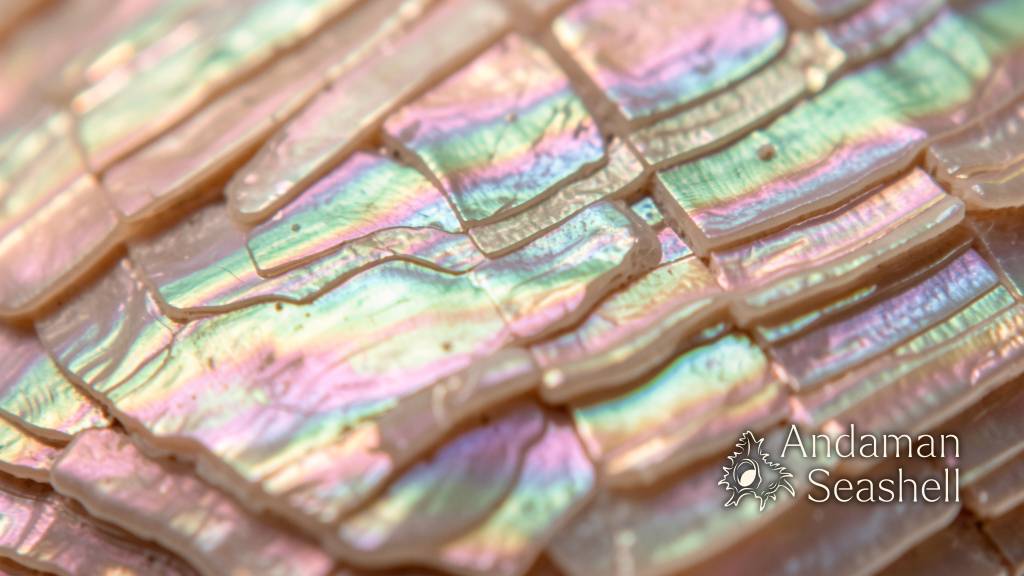
Instead of depositing shell in a random lump, the mantle lays down microscopic hexagonal tiles of aragonite, a crystal form of calcium carbonate. Each tile is staggeringly small — roughly 5 to 15 micrometers across, thinner than a human cell. Between every tile sits a thin film of organic mortar — proteins and a silk-like polymer called chitin [ref:1].
The result is a brick wall: millions of crystalline tiles stacked in layer upon layer, each one separated from its neighbors by a hair's width of biological glue. We call this material nacre, or mother-of-pearl. And it is the spacing of those layers — not any pigment — that creates the shimmer.
The Physics of the Shimmer
When light hits the surface of nacre, something remarkable happens. Some light bounces off the top layer of aragonite tiles. But some light passes through, hits the layer below, and bounces back from there too. Now you have two reflected light waves emerging from the same surface, but having traveled slightly different distances.
When those waves meet again, they interfere with each other. If the crests align, the color brightens — constructive interference. If a crest meets a trough, that wavelength cancels out — destructive interference. Because the tile spacing is so uniform, different wavelengths (different colors) interfere differently depending on the angle you view from. Tilt the shell, and the path lengths change, the interference pattern shifts, and the color slides from pink to green to blue [ref:2].
This is called thin-film interference, and it is the same principle behind soap bubbles and oil slicks. The difference is that a soap bubble lasts seconds. A nacreous shell has been doing this for millions of years.
The Andaman Coast's Living Jewels
You do not need a microscope to witness this. Walk the intertidal rocks at low tide around Koh Yao Yai or the shores of Phang Nga Bay, and you will find pearl oysters, turban shells (Turbo species), and chambered nautiluses — all producing nacre. The green-lipped mussel Perna viridis, common in Andaman waters, lines its shell with a thin but genuine layer of nacre.
Each species tweaks the recipe. Pearl oysters build thick, mirror-smooth nacre — the kind that becomes jewelry and souvenirs. Abalone, found in warmer Andaman shallows, creates one of the most vivid nacres on Earth, with tile layers that curve and overlap to produce an almost psychedelic range of colors.
The precision is astonishing. Studies of nacre's crystal architecture have measured tile thickness variations of less than a few nanometers across entire shells [ref:3]. That is a construction tolerance that human engineers struggle to match — and the mollusk achieves it underwater, at ambient temperature, using nothing but calcium carbonate and protein.
From Seashell to Materials Science
Here is where the story gets even more delightful. Scientists have spent decades studying nacre not just for its beauty but for its toughness. The brick-and-mortar architecture makes nacre roughly 3,000 times more crack-resistant than pure aragonite crystal alone. A crack that would shatter a solid crystal gets deflected, slowed, and stopped by the soft organic layers between tiles [ref:3].
This discovery has inspired an entire field called biomimetics — designing human-made materials that copy nacre's architecture. Engineers have created nacre-inspired ceramics, body armor concepts, and even transparent tough glass, all based on the blueprint that a pearl oyster perfected long before humans existed.
The Craft Connection
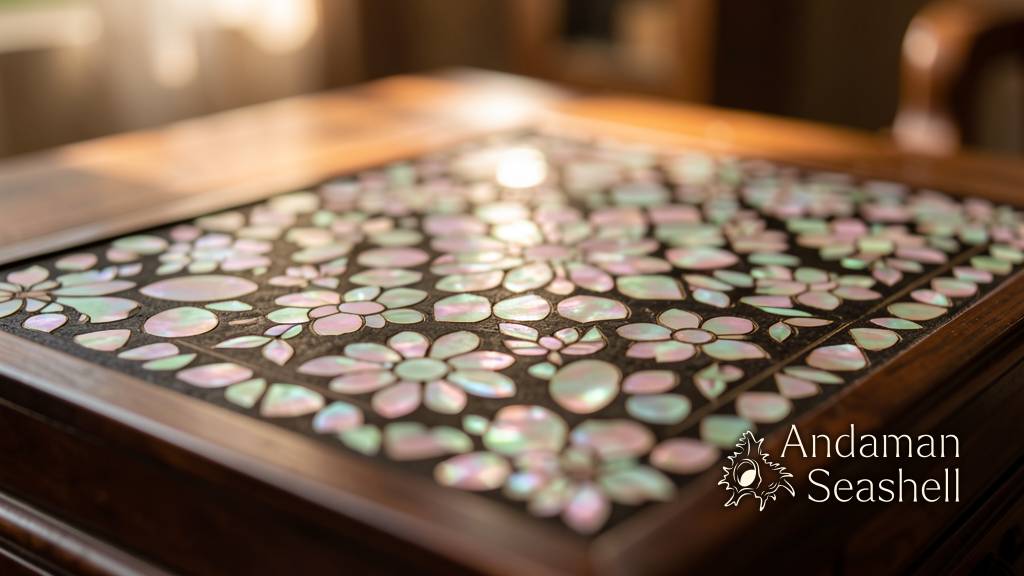
In southern Thailand, mother-of-pearl inlay has been a decorative craft for centuries. Artisans cut thin slices of nacreous shell, shape them into floral and geometric patterns, and set them into lacquered wood. The same structural color that evolved for shell protection becomes, in human hands, a medium of beauty.
So the next time you pick up a pearl or turn a nacreous shell in your hand, remember: you are holding something that contains no color at all — and yet contains every color. It is pure physics, crystallized by a living animal, one tile at a time. That a creature with no brain, no eyes, and no knowledge of optics can build one of the most beautiful structures on Earth is, quite simply, a wonder worth celebrating.
References
- Marie B, Le Roy N, Marin F. 'Basic concepts of biomineralization and the biological matrix.' Frontiers in Bioscience, 2012.
- Sun J, Bhushan B. 'Nacre: Structural and mechanical properties and biomimetic designs.' Royal Society of Chemistry, 2012.
- Wegst UGK, et al. 'Bioinspired structural materials.' Nature Materials, 2015.


No comments yet. Be the first to share a thought.