



Pick up almost any seashell from the Andaman coast and turn it over. If you're lucky, the inside glows — a shimmering band of pink, green, and blue that shifts as you tilt it in the sunlight. That luminous layer has a name: nacre, or mother-of-pearl. And the story of how a humble oyster builds it is one of the most astonishing feats of engineering in the natural world.
The Same Mineral as Chalk — Transformed
Here is the first surprise: nacre is roughly 95 percent aragonite, a form of calcium carbonate. It is the same family of mineral as the chalk you write with, or the limestone cliffs around Phang Nga Bay. On its own, aragonite is brittle — it shatters easily. But inside an oyster shell, it becomes something extraordinary [ref:1].
Nacre is 3,000 times tougher than aragonite alone. That is not a typo. The same mineral, arranged differently, becomes one of the most resilient materials biology has ever produced — nearly as strong as silicon, yet silky, smooth, and iridescent [ref:2].
How does the oyster pull this off? The secret lies in architecture at a scale too small for the human eye.
Brickwork at the Nanoscale
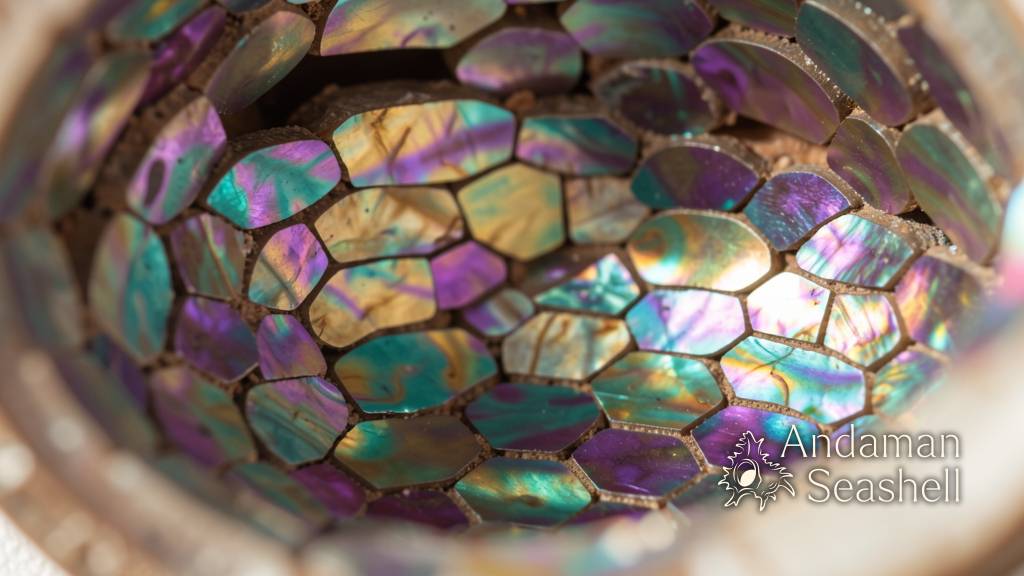
Under a microscope, nacre looks like a meticulously laid brick wall. Tiny hexagonal tablets of aragonite — each about 10 to 20 micrometres wide and just half a micrometre thick — are stacked in neat parallel layers. Between each tablet sits a thin film of organic material: elastic proteins related to chitin and silk [ref:3].
This "brick-and-mortar" arrangement is the key. When a crack tries to travel through nacre, it hits a soft organic layer and gets deflected sideways instead of punching through. The crack loses energy at every boundary. It is the same principle engineers use in bulletproof glass and composite aircraft wings — except the oyster perfected it millions of years before we did.
In 2015, physicist Pupa Gilbert at the University of Wisconsin–Madison caught the exact moment nacre begins to form. Her team discovered that the oyster first deposits amorphous calcium carbonate — a formless, jelly-like precursor — on the growing shell surface. This material rapidly dehydrates and crystallizes into aragonite. The surprise was in the atoms: calcium atoms change from being bonded to six neighbouring oxygen atoms to nine, a fundamental shift in atomic symmetry [ref:4].
"Amazing chemistry happens at the surface of forming nacre," Gilbert said. "It is how the atoms are arranged that matters."
A 2021 study in Nature Physics added another layer of wonder: the earliest nacre layers contain spiral defects — microscopic spirals spinning in opposite directions. When oppositely spinning spirals meet, they merge and cancel each other out, leaving the later layers perfectly ordered. The oyster builds chaos first, then resolves it into harmony [ref:3].
Our Own Pearl Oyster: Pinctada phuketensis
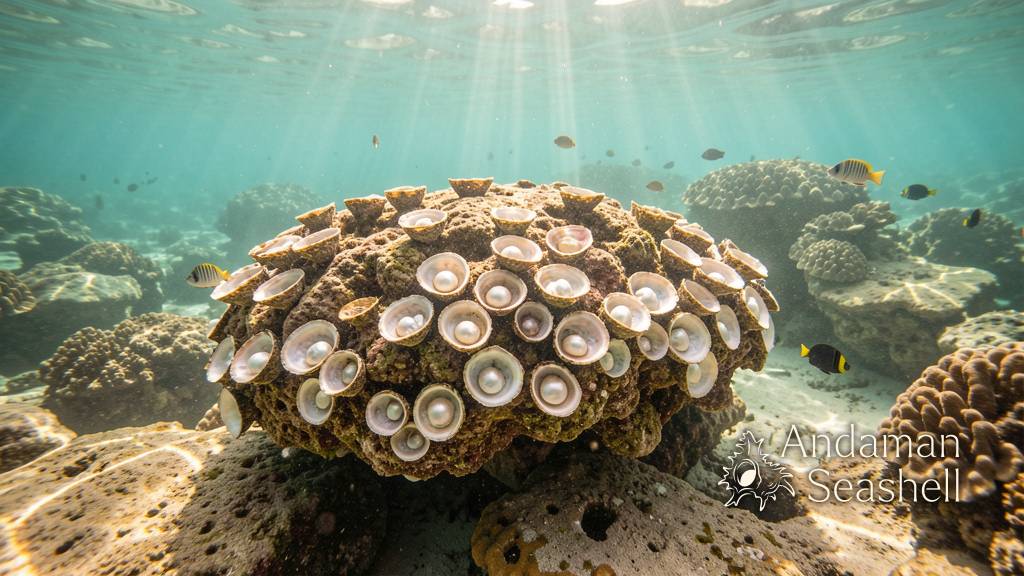
The Andaman Sea is home to a remarkable diversity of pearl oysters in the genus Pinctada — roughly 20 species worldwide, several of them found in Thai waters. But in 2022, researchers made a discovery that put Phuket on the malacological map.
A team led by Narongrit Muangmai of Kasetsart University collected 15 pearl oyster specimens from around Dok Mai Island, off the east coast of Phuket. Several looked different from any known species. Genetic and morphological analysis confirmed it: they had found a species entirely new to science. They named it Pinctada phuketensis [ref:5].
The new oyster is small — shells up to about 8 centimetres tall — and lacks the hinge teeth found in its relatives. It resembles the famous Akoya pearl oyster of Japan but is genetically distinct. Its discovery underscores how much remains unknown about the marine biodiversity of the Andaman coast, even in waters regularly visited by divers and fishers [ref:5].
From Shell to Treasure
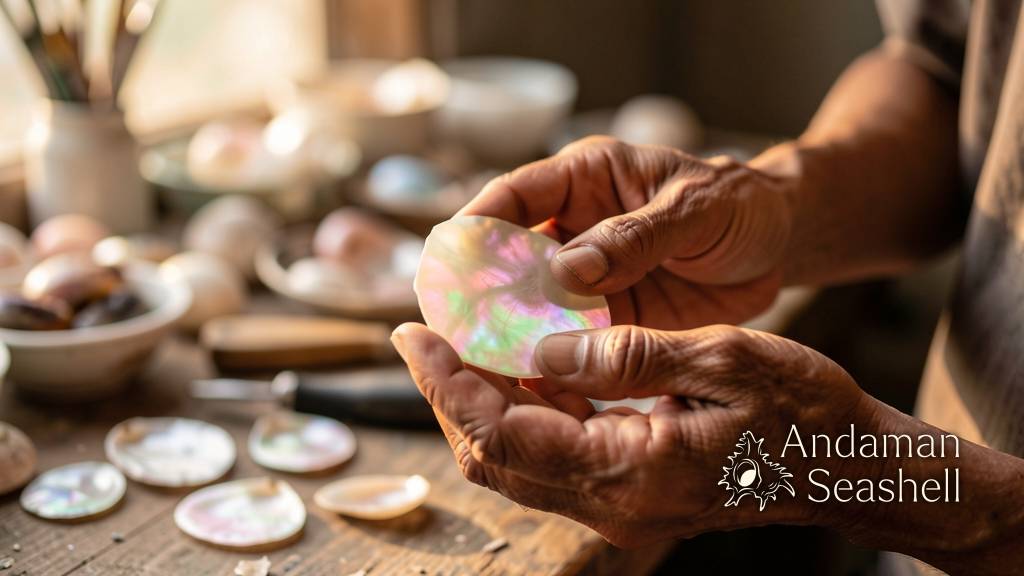
For thousands of years, people along the Andaman coast have worked with mother-of-pearl. Artisans cut and polish nacre into jewellery, inlay, buttons, and decorative objects — the same craft traditions that continue today in workshops from Phuket's Old Town to the market stalls of Takua Pa. Each piece carries that iridescent glow, a rainbow trapped in stone by an animal no bigger than your palm.
The applications stretch far beyond craft. Because nacre is both beautiful and exceptionally tough, materials scientists are studying it to develop stronger bone implants, more durable ceramics, and environmentally friendly building materials. The oyster's blueprint — soft layers between hard ones — has inspired a new generation of composites that mimic its architecture [ref:2].
The Wonder You Are Holding
The next time you pick up a shell on a Phang Nga or Phuket beach, pause before you put it in your pocket. That shimmering interior was built atom by atom, tablet by tablet, by an animal that knew nothing of engineering but mastered it anyway. The rainbow on its surface is not pigment — it is structural colour, light waves interfering with each other across layers thinner than a human hair.
And somewhere in the Andaman Sea, perhaps on a reef near Dok Mai Island, a Pinctada phuketensis oyster is still building — laying down another microscopic brick in a wall that will outlast us all.
That is not just a shell. That is a masterpiece.


No comments yet. Be the first to share a thought.