



On May 15, 2026, NASA’s Psyche spacecraft swept past Mars and caught the planet as a glowing crescent — red dust, blue atmospheric haze, and one tiny explorer using the moment to keep sailing deeper into the solar system. The flyby brought Psyche within 2,864 miles, or 4,609 kilometres, of Mars’ surface, close enough for its cameras to collect a rare view and for Mars’ gravity to give the mission exactly the nudge it needed [ref:1].
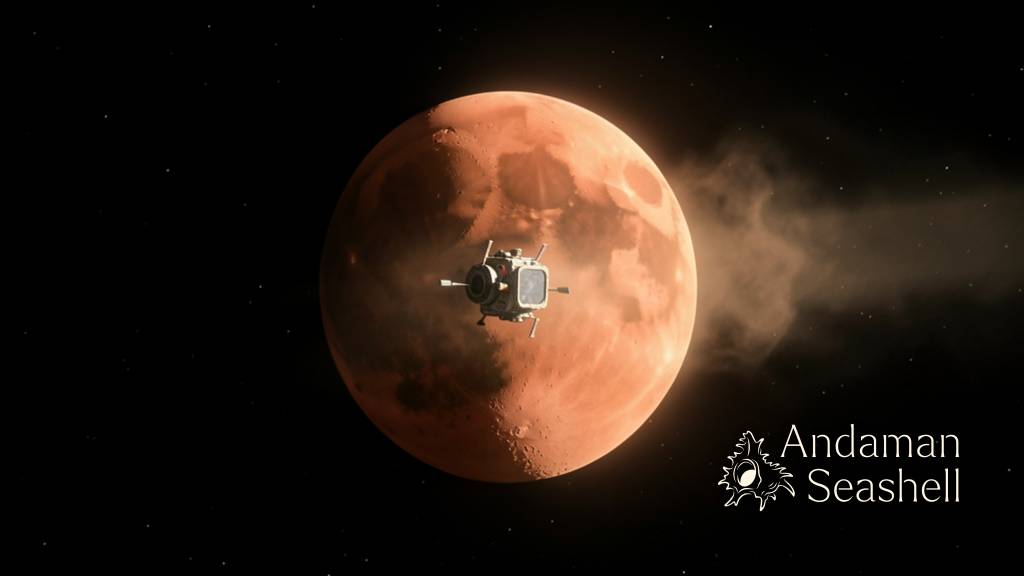
Here is the cheerful part: Psyche did not stop at Mars. It used Mars like a cosmic turning point. By carefully passing through the planet’s gravity field, the spacecraft gained about 1,000 miles per hour and shifted its orbital plane by about 1 degree relative to the Sun, according to NASA’s Jet Propulsion Laboratory [ref:2]. That small-sounding angle matters. Across interplanetary space, one degree can be the difference between wandering wide and arriving neatly at a tiny target millions of kilometres away.
A gravity assist is space travel’s clever shortcut
A gravity assist is not a bounce, and it is not a push from an engine. It is more like joining a moving current. Imagine a boat in the Andaman Sea reading a tide channel: if the timing is right, the water’s own movement helps carry the boat with less effort. In space, the “current” is a planet moving around the Sun. Psyche flew behind Mars in just the right way to borrow a little of that motion.
The spacecraft still follows strict physics; nothing magical is being added for free. Mars changes Psyche’s path while Psyche also gives an almost unimaginably tiny tug back to Mars. Because Mars is so massive, the planet does not noticeably change, while the spacecraft receives a useful new route. For young readers, that is a wonderfully shareable fact: space missions can steer by using planets as partners.
Mars became a practice field
The flyby also gave the mission team a beautiful rehearsal. In the days around closest approach, Psyche powered up its instruments, including imagers, magnetometers, and a gamma-ray and neutron spectrometer, to calibrate them before the asteroid encounter. The multispectral cameras captured thousands of Mars images, including a thin crescent and surface views that help the team test image-processing tools planned for asteroid Psyche [ref:2].
One image showed Mars’ south polar cap, described by JPL as more than 430 miles, or 700 kilometres, across. Another view showed wind streaks in the Syrtis Major region extending about 30 miles, or 50 kilometres. These are not only pretty postcards from another world. They are practice frames, helping scientists understand how Psyche’s cameras behave when light scatters through a dusty atmosphere and across textured planetary surfaces.
There is also a lovely human detail inside the numbers. Don Han, Psyche’s navigation lead at JPL, said the team confirmed the speed boost and orbital shift by analyzing radio signals through NASA’s Deep Space Network. That means the spacecraft’s path was checked through careful listening — Earth receiving tiny changes in signal tone from a traveler far away.
Why visit a metal asteroid?
Psyche is heading to an asteroid also called Psyche, located in the main asteroid belt between Mars and Jupiter. NASA describes it as about 173 miles, or 280 kilometres, across at its widest point. The spacecraft is expected to arrive in 2029, then orbit the asteroid in a series of paths that let it map the object and gather science data [ref:1].
The reason scientists are excited is simple and grand: asteroid Psyche may be rich in metal, and it could offer clues about the interior of rocky planets. We cannot visit Earth’s core directly. But if Psyche is related to the metallic core of an early planet-building object, studying it up close could feel a little like finding a natural museum piece from the solar system’s childhood.
A small lesson for looking up
From Phang Nga, this mission is not something we can see with our eyes like the Moon over the bay. But it still belongs to the same habit of wonder. The same sky that pulls our tides also holds Mars, Jupiter, and the quiet route between them. When we watch a boat read the current, a shell reveal its pearly layers, or a spacecraft read the gravity of Mars, we are seeing one idea repeat at different scales: careful timing can turn a journey into art.
Psyche’s Mars flyby is a bright little lesson in patience. The spacecraft did not rush in a straight line. It curved, listened, photographed, adjusted, and continued. Somewhere beyond Mars, a metal world is waiting to be understood — and thanks to one graceful planetary assist, Psyche is on its way.


No comments yet. Be the first to share a thought.