



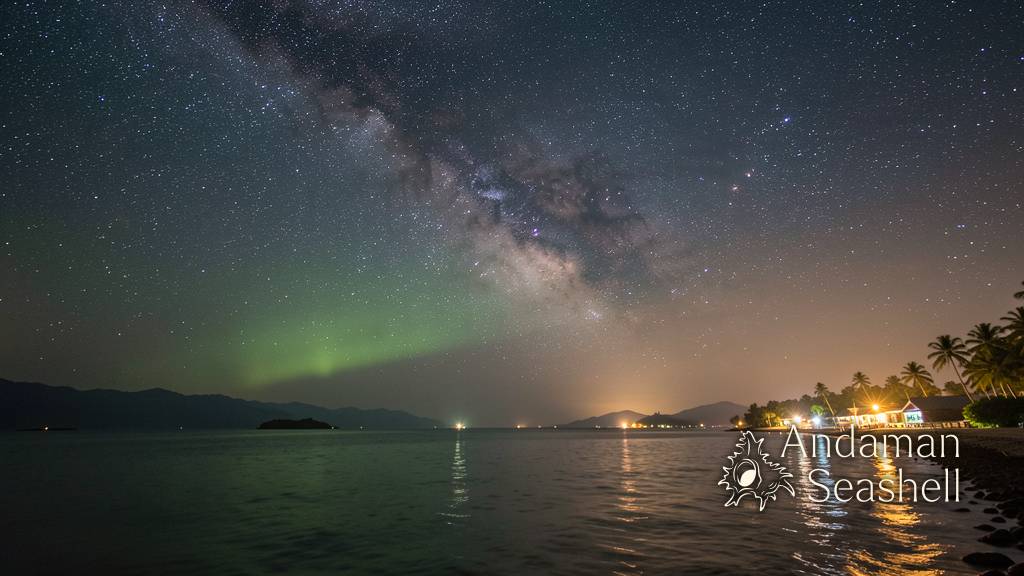
If you stand on a dark beach in Khao Lak tonight and let your eyes adjust, you can count five planets without a telescope. Venus glows white in the west after sunset. Jupiter sits like a steady beacon. Mars blushes red. Saturn shines pale gold. Mercury flits near the horizon at dawn.
Somewhere far beyond all of them — far beyond Pluto, far beyond anything your eyes can reach — there may be a ninth planet. Or there may not be. And that uncertainty is the most exciting thing happening in astronomy right now.
The Greatest Treasure Map Ever Drawn
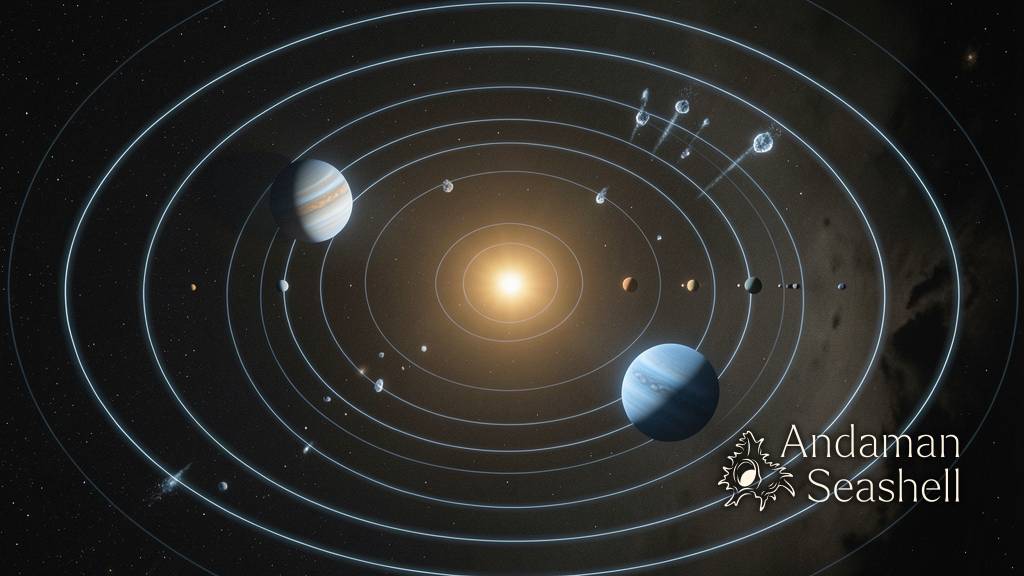
In 2016, two astronomers at Caltech — Konstantin Batygin and Mike Brown — noticed something strange about a handful of objects at the very edge of the Solar System. These icy worlds, drifting in the darkness beyond Neptune, all had orbits that tilted and clustered in the same direction. It was as if something massive and invisible was herding them.
That "something" became Planet Nine: a hypothetical world five to ten times the mass of Earth, orbiting the Sun at a distance so vast that a single lap takes thousands of years [ref:1].
Think of it like this: if you shrank the Solar System so that Neptune sat at the edge of a dinner plate, Planet Nine would be somewhere out in the next room — or maybe the next house. The search area is staggering.
A New Clue That Made the Mystery Deeper
Here's where the story gets beautiful — and a brand-new discovery made it even more so.
In June 2026, astronomers announced that a trans-Neptunian object called 2023 KQ14 — discovered by the Subaru telescope on Maunakea, Hawaii — is forcing a rethink of the Planet Nine theory. But not in the way you might expect [ref:1].
2023 KQ14 is a "sednoid," a rare class of object that orbits so far from the Sun that Neptune's gravity barely touches it. Its closest approach to the Sun is about 71 astronomical units (AU), and its farthest point reaches roughly 433 AU. For context, Neptune sits at about 30 AU, and Pluto averages about 39 AU [ref:1].
The key finding? 2023 KQ14's orbit is more stable than expected. It's the fourth sednoid ever discovered, and all four show remarkably calm, steady orbits. If a massive planet were lurking nearby and tugging on these objects, their paths should be more chaotic. The stability suggests that if Planet Nine exists at all, it must be even farther away than anyone thought — more than 500 AU from the Sun [ref:1].
How Far Is "Far"?
Let's make those numbers tangible.
One astronomical unit (AU) is the distance from the Earth to the Sun — about 150 million kilometres. Neptune is 30 of those. The new minimum for Planet Nine is at least 500 AU.
NASA's New Horizons spacecraft, the fastest thing humans have ever launched, flew past Pluto at about 16 kilometres per second. At that speed, reaching 500 AU would take roughly 118 years [ref:1].
Why This Is the Best Kind of Science
Here's the part that fills me with wonder: none of this means science has failed. It means science is working exactly as it should.
Every new object astronomers discover beyond Neptune is a clue. Some clues point toward Planet Nine. Others push it farther away. But each one sharpens the picture. The map isn't shrinking — it's getting more detailed, more honest, more alive [ref:2].
Mike Brown, one of the original Planet Nine proposers, put it plainly in 2024: "I think it is very unlikely that P9 does not exist. There are currently no other explanations for the effects that we see" [ref:1]. He and his team are still searching, still refining, still excited.
That's the thrill of a treasure hunt where the treasure might be a whole planet — and the map keeps getting better.
The View From Here
Tonight on the Andaman coast, the sky is wide and dark and full of the same stars that astronomers in Hawaii and Chile are studying through their telescopes. The difference is scale, not wonder.
When you look up and see Jupiter hanging steady above Phang Nga Bay, remember: beyond that bright dot, beyond Saturn's gold, beyond even Pluto's distant path, there is a frontier we're only beginning to map. And every night, the map grows.
The next time you're on a dark beach in Phang Nga, give your eyes ten minutes to adjust. Count the planets. Then let your imagination travel past all of them — past Neptune, past the sednoids, into the cold and ancient dark where a hidden world may be waiting.
That's not a mystery to solve. That's a universe to wonder at.


No comments yet. Be the first to share a thought.