



A tiny new mark on the Moon has given scientists a beautifully clear fresh page to read. After a Falcon 9 upper stage struck the lunar surface on 5 August 2026, NASA’s Lunar Reconnaissance Orbiter came back with close images that turned one recent impact into a friendly, visual lesson in how crater science works [ref:1][ref:2].
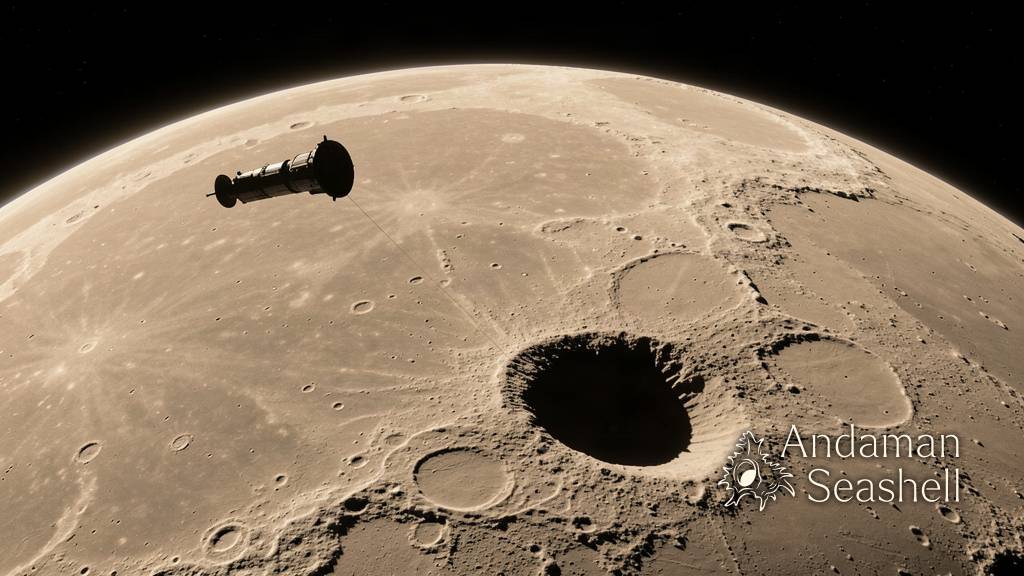
The new crater is small by lunar standards, but wonderfully rich in detail. NASA measured it at about 60 feet wide — roughly 18 metres — and less than 10 feet deep, or under 3 metres, using shadow measurements from multiple views [ref:1][ref:3]. For anyone who loves the Moon, that is the exciting part: even a compact crater can tell a big story when the lighting, angles, and timing are just right.
A fresh crater with a very recent timestamp
This impact is unusually easy to place on a calendar. The used Falcon 9 upper stage hit the Moon at 6:35 UTC on 5 August 2026 after a January 2025 launch that sent Firefly Aerospace’s Blue Ghost 1 toward the Moon [ref:1][ref:3]. NASA had already predicted the stage would come down near the Einstein and Bell craters, and the agency confirmed there was no danger to Earth [ref:3].
Because the Moon has no atmosphere to slow incoming objects, impacts happen all the time. NASA noted that a meteoroid with roughly the same energy strikes the Moon about every six days [ref:3]. What makes this case special is not the force alone, but the chance to know almost exactly when, where, and with what kind of object the impact happened.
Why NASA had to wait six days for the perfect look
The Moon may feel close in the night sky, but getting a precise picture of one small spot is still a choreography problem. LRO circles the Moon from pole to pole every two hours, passes about 60 miles above the surface, and travels at about 1 mile per second while the Moon slowly rotates underneath it [ref:1]. That meant the spacecraft had to wait until the crater site turned into view, which took six days.
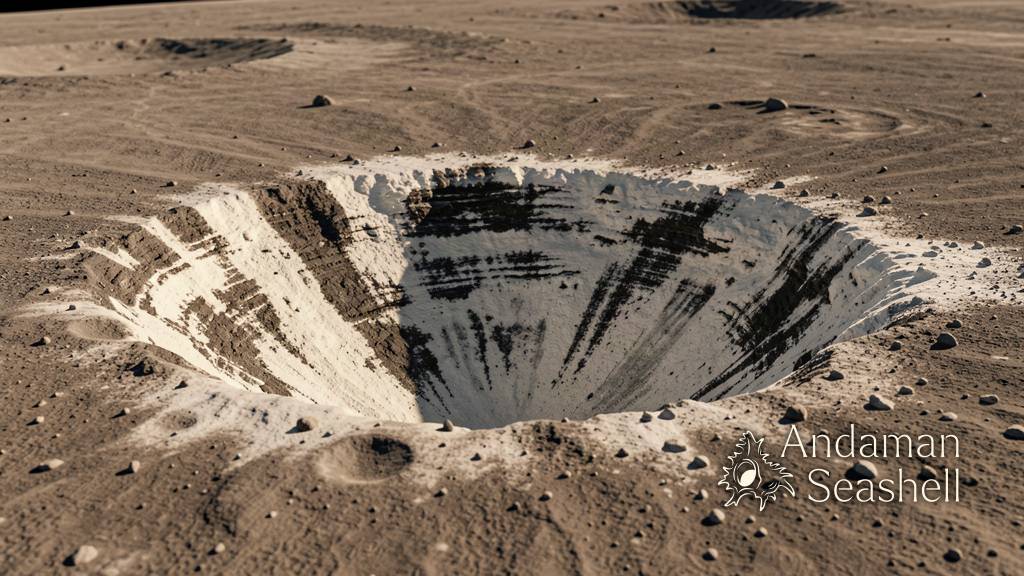
Then came the aiming challenge. Engineers tilted the orbiter repeatedly so its camera could point toward the target on each pass [ref:1]. NASA said that if the timing had been off by only 10 seconds, the crater would have drifted about 10 miles off center [ref:1]. On 11 August, the LROC team collected five images about 117 minutes apart, then added a sixth oblique view 13.5 hours later [ref:2]. That sequence let researchers compare the crater under a range of phase angles from 105° down to 37° [ref:2].
The Moon’s soil wrote two different colors into the story
One of the prettiest results is the contrast between dark and bright ejecta around the crater. The darker streaks came from older, weathered surface material altered over long periods by solar wind, galactic cosmic rays, and micrometeorite impacts [ref:1][ref:2]. The brighter material near the rim came from fresher subsurface regolith excavated from deeper below [ref:1][ref:2].
LROC adds another lovely detail: the uppermost weathered layer is roughly 50 centimeters thick, so the mixed ejecta pattern shows the rocket first throwing out mature surface soil and then blasting up younger material from beneath it [ref:2]. In other words, the crater is not only a hole. It is a quick cross-section of lunar history.
The crater also carries a distinct V-shaped ejecta pattern on its south side. LROC says that shape is consistent with a low-angle impact, and estimates the booster struck at about 31° from horizontal [ref:2]. That matters because the Falcon 9 stage was not a simple natural rock. A mostly empty rocket body with a heavy engine at one end may splash its energy into the ground differently from an ordinary meteoroid [ref:2].
A global teamwork story, not just a Moon story
Finding the crater was a shared achievement. Independent astronomers first tracked the stage with public data, NASA’s Center for Near Earth Object Studies refined the impact zone, and South Korea’s Danuri orbiter used its LUTI camera to image the site only a few hours after the crash [ref:1][ref:2]. NASA said Danuri’s result showed the prediction was accurate to about 0.6 miles, and the final crater coordinates were updated to 19.4759°N, 266.7138°E at an elevation of 511 metres [ref:1].
That is why this small crater feels so satisfying. It is a real-time reminder that the Moon is still an active laboratory for careful seeing. A single 18-metre scar, photographed from about 90 to 96 kilometers up, has already taught scientists more about imaging strategy, impact geometry, and the hidden layers inside lunar soil [ref:1][ref:2][ref:4]. For readers on Earth, it also offers a lovely thought the next time the Moon rises: even now, new details are waiting there for someone patient enough to look from the right angle.


No comments yet. Be the first to share a thought.