



A tiny bright mark on the Moon has become one of the most satisfying space close-ups of August. When NASA’s Lunar Reconnaissance Orbiter finally caught the fresh crater left by a Falcon 9 upper stage, the result was more than a headline image. It was a beautifully sharp demonstration of how modern lunar science works: wait for the light, line up the pass, and read the surface carefully enough that a new scar only 60 feet wide can tell a much bigger story.[ref:1]
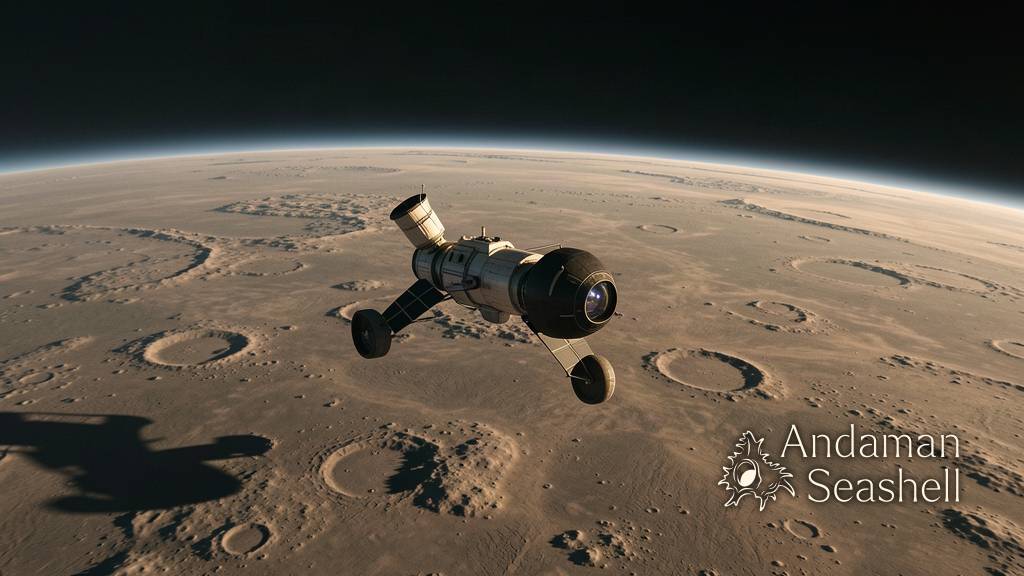
A six-day wait for one clear look
The crater itself formed on 2026-08-05, after a Falcon 9 upper stage from Firefly’s Blue Ghost 1 launch in January 2025 struck the Moon.[ref:2] NASA’s first detailed imaging came between 2026-08-11 and 2026-08-12, six days later, when LRO passed over the area with its Narrow-Angle Camera.[ref:1] That gap of nearly a week was not hesitation. It was geometry.
LRO circles the Moon from pole to pole every two hours, but the Moon rotates slowly underneath it, so the spacecraft has to wait until the exact spot turns back into view.[ref:1] During those passes, LRO was about 60 miles above the surface and moving at roughly 1 mile per second.[ref:1] At that speed, even a tiny timing miss matters: NASA said a shutter fired just 10 seconds early or late would have pushed the target about 10 miles off center.[ref:1]
That is part of what makes the pictures feel so delightful. They are not lucky snapshots. They are the reward for orbital patience, precise navigation, and a camera system able to notice very fine detail on a world that is still constantly changing in small ways.
What the crater revealed
Under different lighting angles, the new crater gave scientists several clues at once. The rim measured about 60 feet, or 18 meters, across.[ref:1] Based on the shadow length, the crater appears to be less than 10 feet deep.[ref:1] Before the impact, NASA had estimated a crater about 60 feet wide and 12 feet deep, so the real result turned out to be a little shallower than the early forecast.[ref:2]
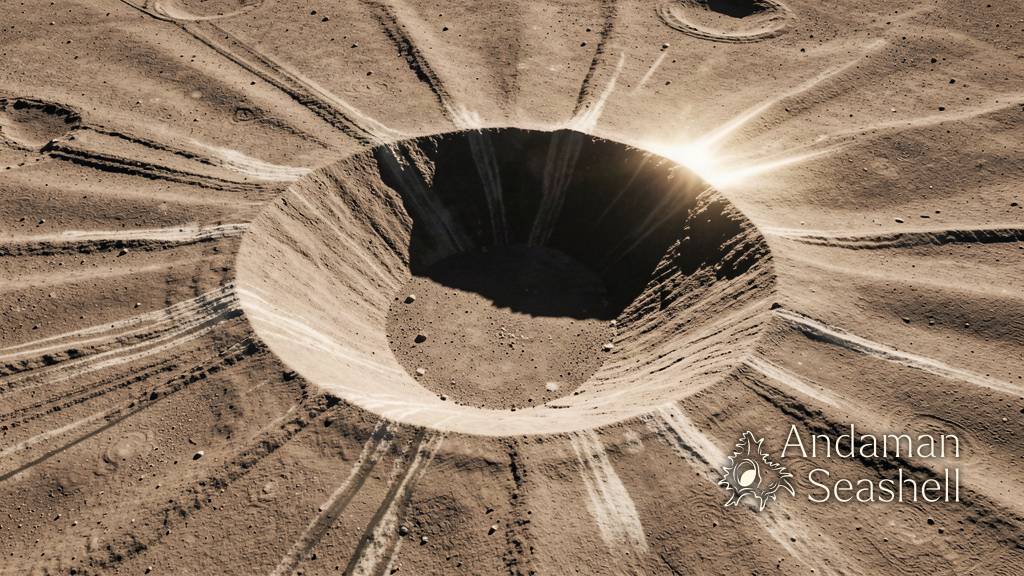
LRO could see this because its Narrow-Angle Camera can resolve features as small as 3 feet, or about 1 meter, wide.[ref:1] That level of sharpness helps explain why the fresh rays around the crater are so interesting. The brighter streaks near the rim are newly excavated material from deeper below the surface, while the darker streaks are older dust and rocks that had already been altered by solar wind, galactic cosmic rays, and micrometeorite impacts.[ref:1] NASA said some of that weathered material was thrown up from about 1.5 feet below the lunar surface.[ref:1]
In other words, the crater is not just a dent. It is a quick cross-section through the Moon’s upper skin, with sunlight acting like a highlighter pen.
A teamwork story in orbit
Another charming part of the story is how many people and tools had to line up to find one small point on the Moon. Independent astronomers first tracked the object’s path using public data.[ref:2] NASA’s Center for Near Earth Object Studies refined that trajectory and passed the prediction to the Korea Pathfinder Lunar Orbiter, better known as Danuri.[ref:1]
Danuri’s high-resolution LUTI camera then photographed the site only a few hours after impact, and the prediction landed within about 0.6 miles, or 1 kilometer, of the real crater.[ref:1][ref:3] After that, Danuri shared coordinates that helped NASA tighten LRO’s follow-up imaging plan. The updated crater center was placed at 19.4759°N, 266.7138°E, at an elevation of 511 meters.[ref:1]
That chain of work turns a small lunar mark into something wonderfully modern: a shared science exercise between observers on Earth and orbiters from two countries. Even the prediction maps were impressively narrow, with impact ellipses about 2.1 miles long and 0.4 miles wide.[ref:1]
Why this matters beyond one crater
The Moon is hit by natural meteoroids all the time, and NASA noted that an impact with similar energy happens there about every six days.[ref:2] What makes this event useful is not drama but clarity. Scientists could anticipate it, compare before-and-after images, and test how well their tools predict impacts, read ejecta, and spot subtle changes in texture.[ref:1][ref:2]
That is the quiet joy of this story. A used rocket stage left behind a fresh lunar mark, and scientists turned it into a precise lesson in timing, light, geology, and teamwork. For anyone who loves space, that is a lovely reminder that discovery is not always a giant new world. Sometimes it is a small bright crater, a camera aimed at exactly the right second, and the patience to notice what the Moon has just revealed.


No comments yet. Be the first to share a thought.