



In the shallows of Phang Nga Bay, where the water runs warm and the mangrove roots tangle into the mud, a pearl oyster is doing something it has done for sixty million years. It is building a shell — layer by microscopic layer — and in that shell is a material that has fascinated every coastal culture the Andaman Sea has ever known.
It is called nacre, or mother-of-pearl, and the Thai south produces some of the most vivid examples in Southeast Asia. The colour tells you where it came from: a golden-purple iridescence that shifts when you turn it, warm tones that factory-made materials cannot replicate. Every piece carries the record of the tide, the mineral content of the water, and the years the oyster spent quietly building.
How nacre forms, one layer at a time
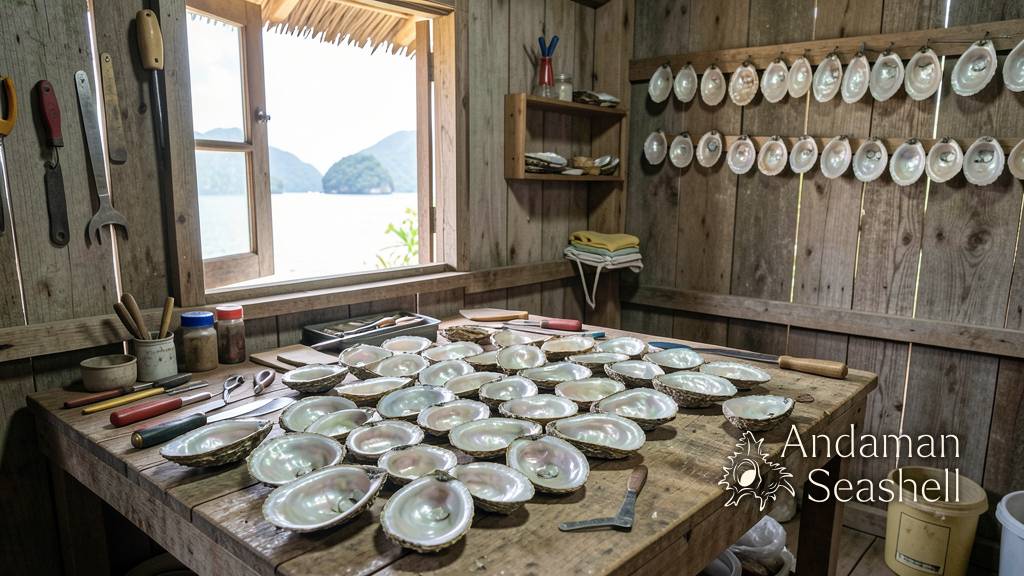
An oyster does not decide to make something beautiful. It makes nacre the same reason it makes everything — to protect itself. When a foreign particle enters the shell, the oyster's mantle tissue secretes thin layers of calcium carbonate and a protein called conchiolin. Each layer is only a few hundred nanometres thick — thinner than a wavelength of light [ref:1]. The result is a composite material harder and more resilient than the raw mineral alone, and the layered structure is exactly what gives nacre its shimmering optical effect, technically called structural colour.
It takes an oyster three to five years to build a shell thick enough that a craftsperson can work with the inner layer. In the warm, mineral-rich waters of Phang Nga Bay, where rivers carry calcium from limestone karsts into the sea, that growth can happen slightly faster than in nutrient-poor waters elsewhere. This is one reason the Andaman coast has historically been a source of prized nacre — the geology quite literally feeds the shell [ref:2].
From shell to keepsake: the artisan's hands
There is no shortcut for the human side either. In small workshops scattered along the Phang Nga–Phuket coast, artisans take raw oyster shells and turn the inner nacre layer into objects that people carry home and keep for decades.
The process begins with cutting. Using a fine hand saw or a small rotary tool, the artisan slices the shell into workable pieces, following the natural curve of the nacre. The raw edges are rough and chalky — nothing like the finished surface. Next comes grinding, where the piece is shaped against a series of progressively finer abrasives. Water runs constantly over the work surface to keep the nacre from cracking under heat. Finally, there is the polish: a felt wheel, a touch of polish compound, and the surface transforms from matte white to that deep, shifting iridescence.
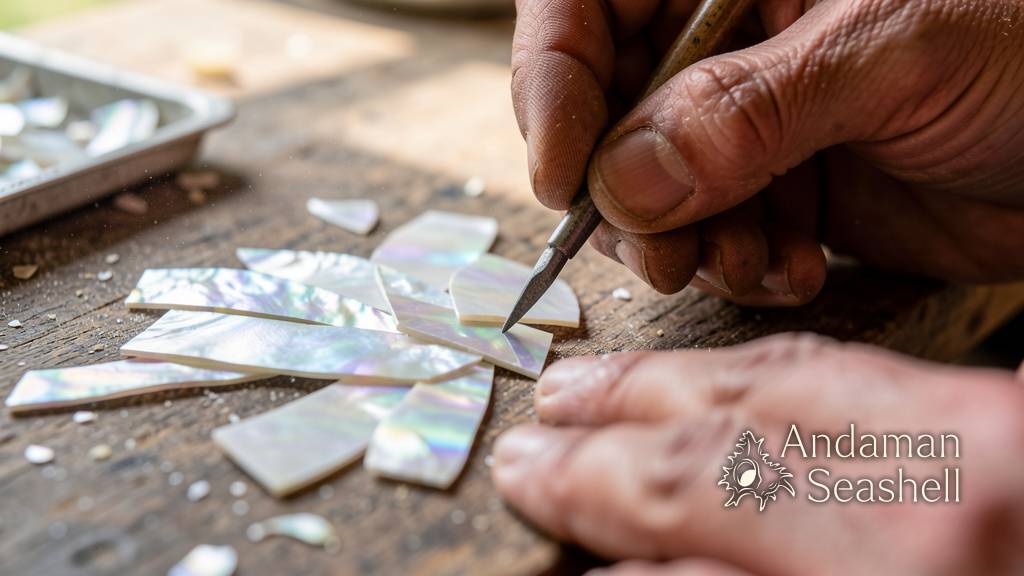
What makes hand-shaped nacre different from machine-cut pieces is not just the technique — it is the judgement. An experienced artisan reads each shell individually, finding the area where the nacre is thickest and the colour is most even, and cutting around the flaws rather than through them. A machine does not do this. A machine cuts the same way every time, and that sameness is visible in the finished object as a kind of flatness — technically perfect, emotionally inert.
Why a shell souvenir carries more than you think
When someone picks up a mother-of-pearl box or a polished shell fragment in a shop, they are holding two stories compressed into one object. The first is geological: years of tidal rhythm, mineral deposition, and the patient biology of a living creature. The second is human: the hands that cut, ground, and polished it, the knowledge passed between generations of coastal craftspeople, and the community whose livelihood depends on keeping that craft alive.
This is the difference between a souvenir and a keepsake. A souvenir is bought as a reminder. A keepsake is kept because it carries something a mass-produced object cannot — the texture of a specific place, worked by specific hands, at a specific moment in time. The Andaman pearl oyster does not produce identical shells. Every nacre surface is unique, shaped by the particular conditions of the water where it grew. No two polished pieces will ever catch the light in quite the same way [ref:3].
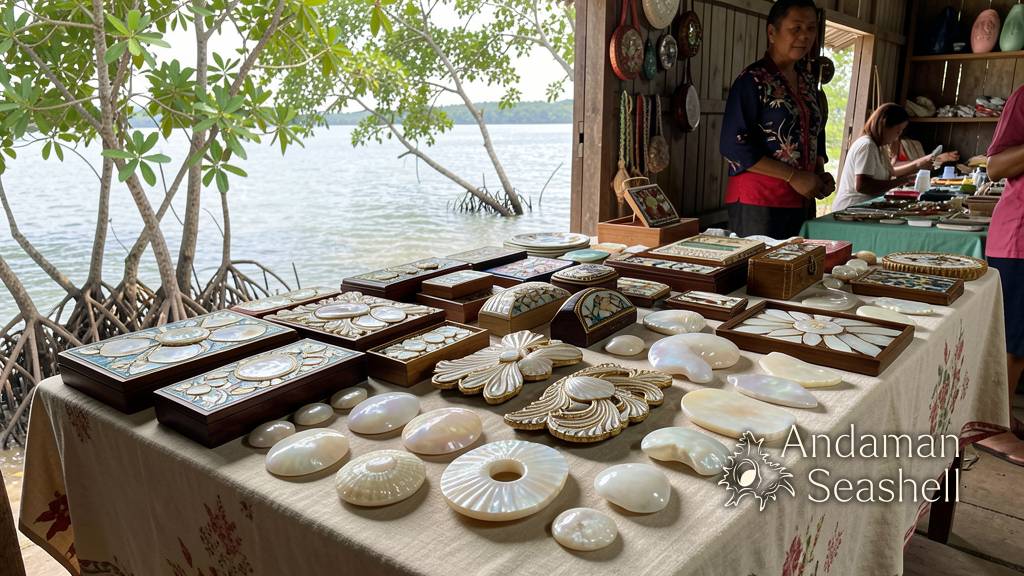
The next time you turn a piece of mother-of-pearl in your hand and watch the colour shift from gold to violet, remember that the shimmer is not paint, not dye, not a coating. It is the architecture of the shell itself — hundreds of layers of mineral and protein, each thinner than a human hair, stacked by an animal that never knew it was making something beautiful. The artisan's job was simply to reveal what was already there.


No comments yet. Be the first to share a thought.