



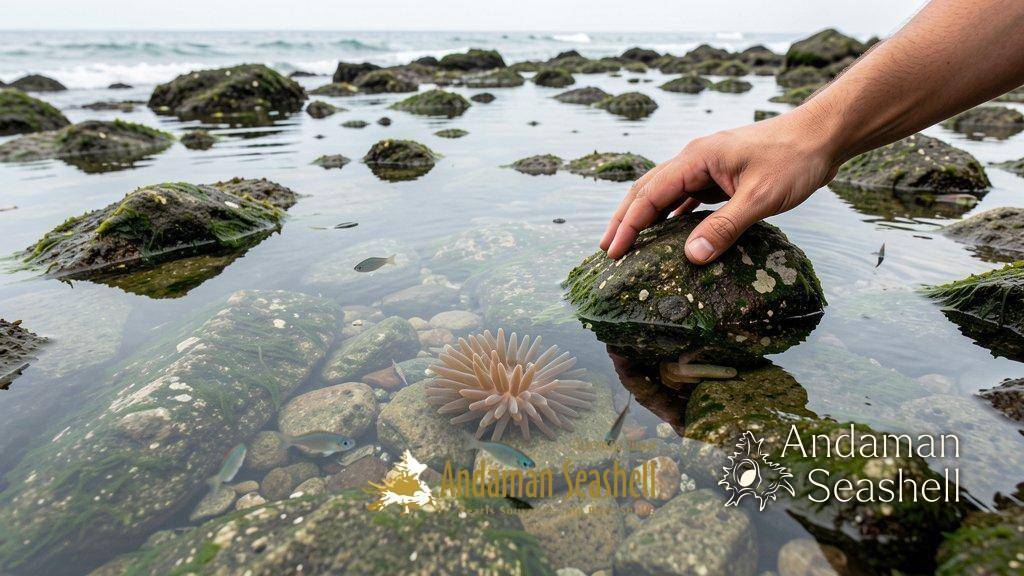
Lift the slab of limestone at the waterline on a Phang Nga shore at low tide and three things happen at once. A hermit crab — Calcinus laevimanus, the left-handed hermit most common on Andaman reefs — pulls back into its borrowed shell. What looked like a stone clamps down: it is a chiton, a living armour plate that has clung to these rocks since before the dinosaurs. And a sea anemone, grey-green and half-open, folds inward like a slow fist closing.
You are looking at a tide pool. And it is far more alive than it looks.
A pool is a daily stress test
A tide pool is a pocket of seawater left behind when the tide retreats. What makes it extraordinary is not the water but the schedule. Every six hours or so, the pool is cut off from the ocean, then reconnected. In that window its temperature can swing five degrees or more. Its salinity shifts as fresh water evaporates under the sun or rain dilutes it. Oxygen drops as the trapped animals and algae respire [ref:1].
Every creature in that pool has evolved to survive a cycle that would kill most ocean animals. The hermit crab can seal its shell against drying. The chiton's grip is strong enough to hold a thin film of moisture against its gills for hours. The anemone simply folds shut and waits. These are not accidents of design; they are precise, tested answers to a daily interrogation [ref:1].
What you are actually seeing
When you crouch beside a Phang Nga tide pool and let your eyes adjust, the surface resolves into a community. A juvenile fish — too small for the open reef, sheltering in the shallows — darts between stones. A sea cucumber, the reef's slow vacuum cleaner, inches along the bottom, processing sand for organic matter. Tiny snails graze algae off the rocks in invisible file lines. Hermit crabs of three or four species negotiate for the best shells [ref:2].
None of these animals are decorative. Each one is doing a job — recycling nutrients, cleaning surfaces, predating, sheltering. Remove one species and the pool's balance shifts. That is what makes tide pools so valuable to marine biologists: they are small enough to study in detail, complex enough to model a reef, and sensitive enough to show stress before the open ocean does.
Why the pool is a window onto the reef
A healthy tide pool is clear, smells of clean salt, and supports a visible mix of species — grazers, predators, filter feeders, shelterers. A degraded one is murky, covered in thick algae, and dominated by one or two hardy species at the expense of everything else. That shift is one of the earliest visible signs of broader reef stress, often appearing in the shallows before it shows on the deeper reef [ref:1].
So when you look into a tide pool and see diversity — a hermit crab, an anemone, a chiton, a juvenile fish, all sharing the same shallow bowl — you are looking at a system that works. The pool is telling you that the water is clean, the food web is intact, and the reef it connects to is holding.
How to look without breaking what you find
The rule is simple. Step lightly. If you lift a rock to see what is underneath, put it back exactly as you found it — the creatures beneath it depend on that specific shade and moisture. Do not collect shells from a living pool; the hermit crab you displace may not survive the search for a new home. Touch gently, or not at all. The pool is not a display case; it is a living room, and you are the visitor.
The Andaman coast's tide pools are free, open, and everywhere — every rocky shore from Phang Nga to Phuket has them. They ask nothing of you except attention. Give them that, and they will show you more life in a square metre than most people see in a full day on the open sea [ref:2].


No comments yet. Be the first to share a thought.