



A small travel telescope on a balcony, a pair of binoculars on a beach mat, and one curious child asking “which bright dot is that?” — July 2026 is offering a wonderfully simple way to turn an ordinary night into a family sky lesson.

NASA’s monthly skywatching guide points to four cheerful highlights this July: a predawn meeting of the Moon and planets, a chance to look for Comet 10P/Tempel 2 around the New Moon, especially dark nights for the Milky Way, and Saturn’s rings appearing unusually thin through a telescope [ref:1]. For the Andaman coast, that means the best plan is wonderfully low-tech: check the weather, find a safe open view, let your eyes adjust, and bring curiosity.
Start before sunrise: the Moon as your sky guide
The easiest July scene begins before dawn. NASA describes an early morning “hangout” with the Moon and planets, which is perfect for new skywatchers because the Moon acts like a friendly pointer. Instead of trying to memorize a whole star map, you can begin with the Moon, then notice the bright planet-like lights nearby.
Here is the fun part to tell children: planets do not twinkle the same way stars often do. Stars are so far away that their light arrives as a tiny point, easily jiggled by Earth’s air. Planets are closer and appear as small disks, so their light often looks steadier. That one observation can make the sky feel suddenly readable.
If you are watching from Phang Nga, Phuket, Khao Lak, or another coastal spot, choose a safe place with a clear eastern view. You do not need a dramatic cliff or a perfect postcard beach. A quiet balcony, a pier area with open sky, or a garden away from bright lamps can be enough. The goal is not performance; it is noticing.
Around the New Moon: try the comet game
NASA highlights Comet 10P/Tempel 2 as a binocular target around July 14, when the New Moon gives darker skies [ref:1]. A comet in binoculars will not look like a blazing movie object. It may look like a small fuzzy patch, and that is exactly the magic: you are seeing sunlight reflecting from dust and ice travelling through the solar system.
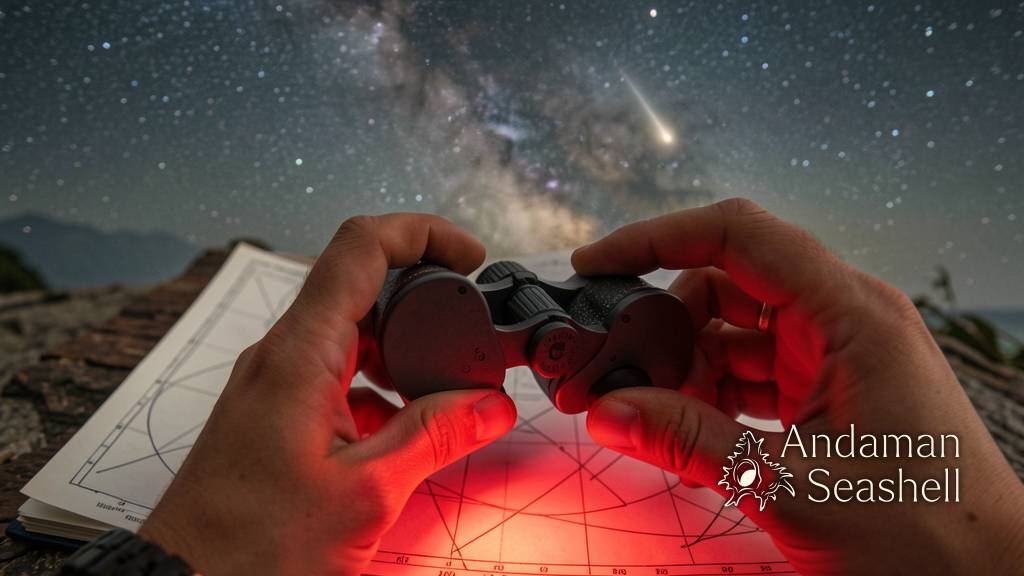
Comet 10P/Tempel 2 is a periodic comet, meaning it returns on a predictable orbit rather than appearing as a one-time surprise. That makes it a lovely teaching moment. The solar system is not a flat poster; it is a moving family of planets, moons, asteroids, and icy visitors following paths around the Sun.
The New Moon also gives the Milky Way a better chance to show itself under genuinely dark skies. The Royal Observatory Greenwich’s 2026 astronomy overview reminds readers that the year is full of accessible sky events, from meteor showers to planetary views [ref:2]. July’s darker nights are a nice invitation to look for the Milky Way’s pale river of stars, especially if clouds part and nearby lights are low.
A simple observing rhythm works best: spend ten minutes letting your eyes adjust, use binoculars slowly, and sweep the sky in small sections rather than darting around. If you do not find the comet, you still win. You have learned the patient pace of skywatching, and you have probably found star clusters, bright stars, or the soft glow of the Milky Way along the way.
Save a telescope night for Saturn’s thin rings
Later in July, Saturn becomes the showpiece for anyone with access to a small telescope. NASA notes that Saturn’s rings are tilted at a very shallow angle from Earth’s point of view, so they look unusually thin [ref:1]. They are not going away; our viewing angle is changing as Saturn continues its long orbit around the Sun.
That single fact is beautiful because it turns Saturn from a picture into a moving world. Saturn takes almost 30 Earth years to orbit the Sun. About every 15 years, our view lines up with the ring plane, making the rings appear edge-on or nearly edge-on. Imagine holding a dinner plate flat in front of your face, then slowly turning it sideways until it becomes a slender line. Saturn is doing that on a cosmic scale.
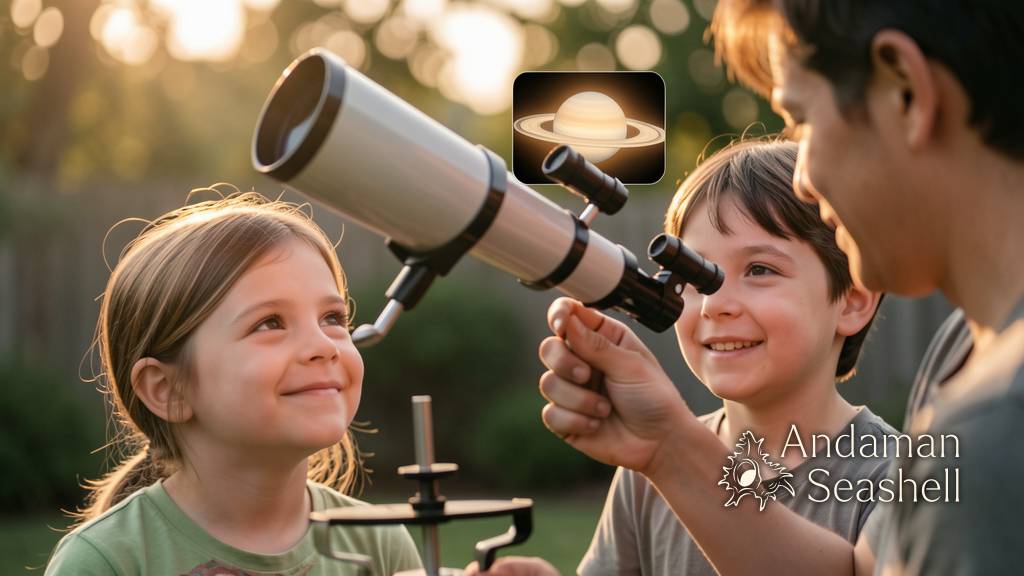
For families, Saturn is one of the most rewarding “first telescope” objects. Even when the view is tiny, it is unmistakable: a golden planet with a graceful ring system. This July, the slender-ring view adds a special twist. You are not just seeing Saturn; you are seeing geometry, motion, and time.
A tiny July sky plan
Try this friendly sequence:
- Before dawn: look for the Moon near bright planets.
- Around July 14: use binoculars under dark skies for Comet 10P/Tempel 2.
- On clear, moonless nights: look for the Milky Way away from bright lights.
- Later in the month: ask a local astronomy friend, school, or club if they have a telescope night for Saturn.
The best souvenir from July’s sky might not be a photo. It might be a sentence a child remembers: “Saturn’s rings looked like a thin golden line.” Or: “A comet looked like a tiny soft cloud.” That is how the universe becomes personal — one patient look, one bright dot, one shared discovery at a time.


No comments yet. Be the first to share a thought.