



On a clear July evening, a child on the Andaman coast can point a pair of binoculars above the palm line and discover that the sky is not empty at all — it is layered with planets, star clouds, and one very famous ringed world changing its angle like a cosmic seashell.

NASA’s July 2026 skywatching notes are especially friendly for families because they include three easy ideas: look for the Milky Way around the dark nights near the new moon, notice a predawn meetup of the Moon and planets, and, if someone has a small telescope, peek at Saturn’s rings while they look unusually thin from Earth [ref:1]. Timeanddate also lists the July 2026 new moon on July 14 and the full moon on July 29, which makes the middle of the month a useful planning window for darker skies [ref:2].
The new moon is the sky’s dimmer switch
The easiest skywatching trick is not buying equipment. It is choosing the right night. When the Moon is new, its bright face is not lighting the evening sky, so faint things become easier to see. For Andaman families, that means the nights around July 14 are the best moment this month to step away from bright lamps and let the eyes adjust.
Give your eyes 15 to 20 quiet minutes. Put the phone away, or switch it to a red-light mode if you have one. Face the darkest part of the sky you can find. The Milky Way will not look like a glossy space poster; to the unaided eye it is usually a soft, pale river of light. That softness is part of its charm. Every misty patch is the combined glow of countless distant stars, crowded together along the flat disk of our home galaxy.
From the Andaman coast, the most important ingredient is simple: a safe open view and patience. A beach, a hill viewpoint, a resort garden with low lights, or a quiet family balcony can all work if the horizon is open and the sky is clear.
A predawn lineup for early risers
NASA’s July guide also points skywatchers toward a morning scene: the Moon sharing the predawn sky with planets [ref:1]. This is a lovely one for early risers because you do not have to stay up late. Make tea, step outside before sunrise, and scan the brightening sky for the Moon first. Planets often look steadier than stars, shining like calm beads rather than twinkling sparks.
A good family game is to ask: “Which bright point does not twinkle much?” That simple question teaches a real sky skill. Stars are so far away that their tiny points of light shimmer as Earth’s atmosphere moves. Planets are closer and show a slightly wider disk, so they often appear steadier to our eyes.
Saturn’s rings are doing a magic trick
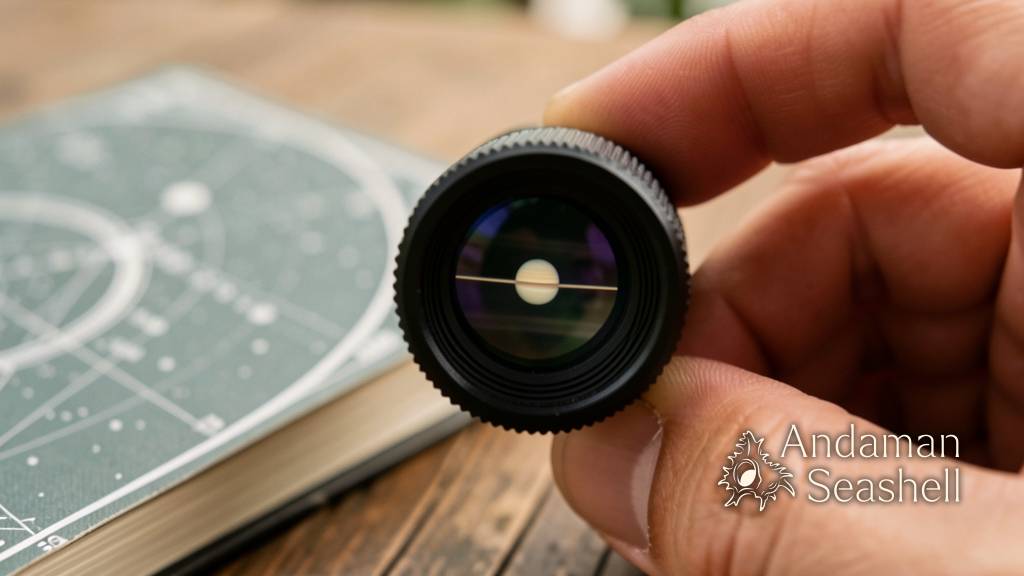
The most delightful July telescope target is Saturn. NASA notes that Saturn’s rings are tilted at a very shallow angle from our point of view, making them appear unusually thin [ref:1]. The rings are not vanishing; Earth is simply seeing them closer to edge-on as Saturn continues its long orbit around the Sun.
Here is the fun comparison: imagine holding a bracelet flat in front of your face. You see its full circle. Now turn it slowly until you are looking at the edge. The bracelet becomes a skinny line. Saturn’s rings can play a similar visual trick because our viewpoint changes over time. NASA explains that roughly every 15 years — about halfway through Saturn’s nearly 30-year trip around the Sun — the rings appear edge-on from Earth [ref:1].
That makes this month a beautiful “tell your friends” moment. Even a modest telescope can turn Saturn from a bright dot into a tiny world with a strange, elegant line across it. For children, it is one of the best first telescope views in astronomy: simple, unforgettable, and real.
A gentle Andaman sky plan
Try this three-step plan on the next clear evening near the dark-moon window:
- Start wide: look without tools and let your eyes adjust.
- Add binoculars: sweep slowly along the Milky Way’s pale band.
- Finish with a telescope: if available, give Saturn the final “wow” moment.
Bring a small mat, water, and a light jacket if the breeze picks up. Keep torches pointed down. If clouds arrive, treat them as part of the evening; the Andaman sky often opens in pockets, and a patient family can catch a bright planet between passing clouds.

The sweetest part of July skywatching is that it turns ordinary time into shared discovery. A new moon becomes an invitation. A planet becomes a question. A thin ring around Saturn becomes proof that the solar system is moving, tilting, and showing us fresh angles all the time. Look up for a few minutes, and the Andaman night becomes a map you can read together.


No comments yet. Be the first to share a thought.