



A child on the Andaman coast can make July feel enormous with almost nothing: a beach mat, a pair of binoculars, and one patient adult willing to wake before sunrise. This month, NASA’s skywatching guide points to three beautiful sky moments — a Moon-and-planets meetup on July 11–12, dark nights around the July 14 new moon for Milky Way watching, and Saturn’s rings looking unusually thin through a telescope [ref:1].
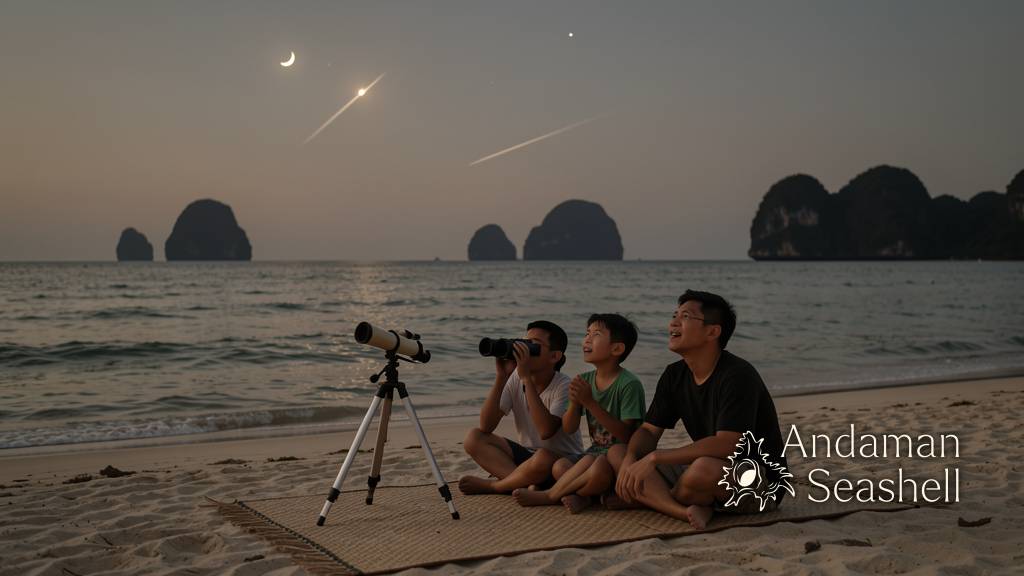
That is the charm of skywatching. You do not need a grand observatory to begin. You need a safe, dark viewpoint, a little weather luck, and the habit of noticing what the sky is already offering. From the Phang Nga and Phuket coast, where open sea gives the horizon breathing room, July becomes a friendly invitation: look east before dawn, look up after the sky turns fully dark, then save one evening for Saturn.
The predawn postcard: Moon, Mars, and Saturn
NASA highlights the mornings of July 11 and 12 as a lovely time to look east-southeast before sunrise. The waning crescent Moon appears near Mars and Saturn, making a simple three-object scene that is easy for beginners to spot [ref:1]. Think of it as a sky postcard: the Moon is the bright signature, Saturn is the calm golden dot, and Mars adds its warmer color nearby.
For families, this is a perfect first lesson in sky geometry. The objects are not truly close together in space; they only appear near one another from our point of view on Earth. That “nearby” look is called a conjunction in everyday skywatching language. It is a reminder that the sky is not a flat ceiling. It is a moving, layered map, and Earth is part of the dance.
Try this: step outside about an hour before sunrise, choose a place with a clear eastern view, and let your eyes adjust for a few minutes. Binoculars can make the Moon’s edge look crisp, but the main arrangement should be visible to the unaided eye if the sky is clear.
The new-moon window: a darker stage for the Milky Way
The second gift arrives around July 14, when the Moon is new. NASA notes that those darker nights are the best time this month to look for the Milky Way from a dark location away from bright lights [ref:1]. Timeanddate’s July 2026 moon guide also lists the new moon on July 14 at 09:43 UTC, with the full moon later on July 29 [ref:3].
The reason is wonderfully simple: moonlight is beautiful, but it also brightens the sky. Around new moon, the Moon stays mostly out of the night sky, so faint star clouds have more contrast. The Milky Way is not a painted stripe; it is our own galaxy seen from the inside. When you look at that pale band, you are looking through the crowded disk of stars, gas, and dust where our Sun lives.
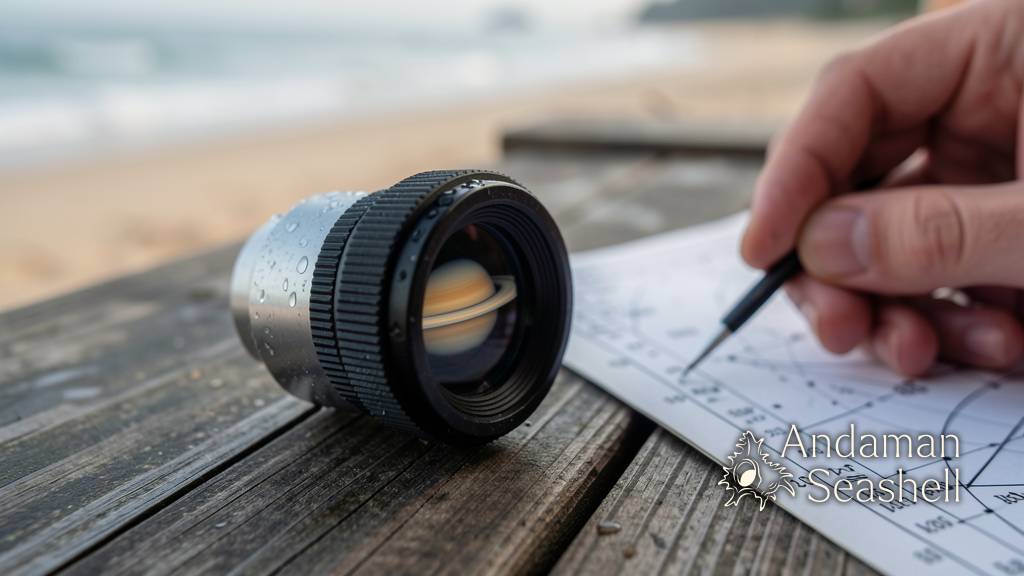
From the Andaman coast, choose a safe place with less direct lighting, face the darker part of the sky, and give yourself time. NASA suggests starting once the sky is fully dark, about 45 to 60 minutes after sunset [ref:1]. Put the phone away between checks. Your eyes are better instruments when you give them a quiet few minutes.
Saturn’s rings, seen almost edge-on
The month’s most elegant telescope treat is Saturn. Later in July, NASA says Saturn is rewarding for telescope users because its rings are still tilted at a very shallow angle from our viewpoint, making them look unusually thin [ref:1]. The rings are not vanishing; our perspective is changing as Saturn continues its long orbit around the Sun.
This is a beautiful science idea for children: the solar system changes not only because planets move, but because our viewing angle changes too. NASA explains that roughly every 15 years — halfway through Saturn’s almost 30-year orbit — the rings appear edge-on from Earth and can seem to become extremely slim [ref:1]. A small telescope may show Saturn as a tiny golden oval with a fine line through it. Bigger telescopes show more, but even a modest glimpse can feel like meeting a famous planet in person.
EarthSky’s July sky guide also points skywatchers toward the July 14 new moon and planet visibility, making this a strong month for building a small observing habit [ref:2]. You can keep it simple: one morning for the Moon and planets, one dark night for the Milky Way, one telescope session for Saturn.
A gentle Andaman sky plan
Here is a practical plan for a warm, low-pressure July sky week:
- July 11–12, before sunrise: look east-southeast for the waning crescent Moon near Mars and Saturn.
- Around July 14: use the new-moon darkness for a Milky Way attempt from a safe, darker location.
- Later in July: find a telescope view of Saturn and notice how slim the rings look.
- Any night: bring a mat, water, insect repellent, and a red-light setting if your phone has one.

The loveliest part is that July does not ask you to become an expert. It asks for attention. Look up once, then again. Notice how the Moon changes shape, how planets hold steady compared with twinkling stars, how the Milky Way appears only when the night grows generous and dark. On the Andaman coast, where the tide keeps time below and Saturn keeps time above, that is more than enough to begin.


No comments yet. Be the first to share a thought.