



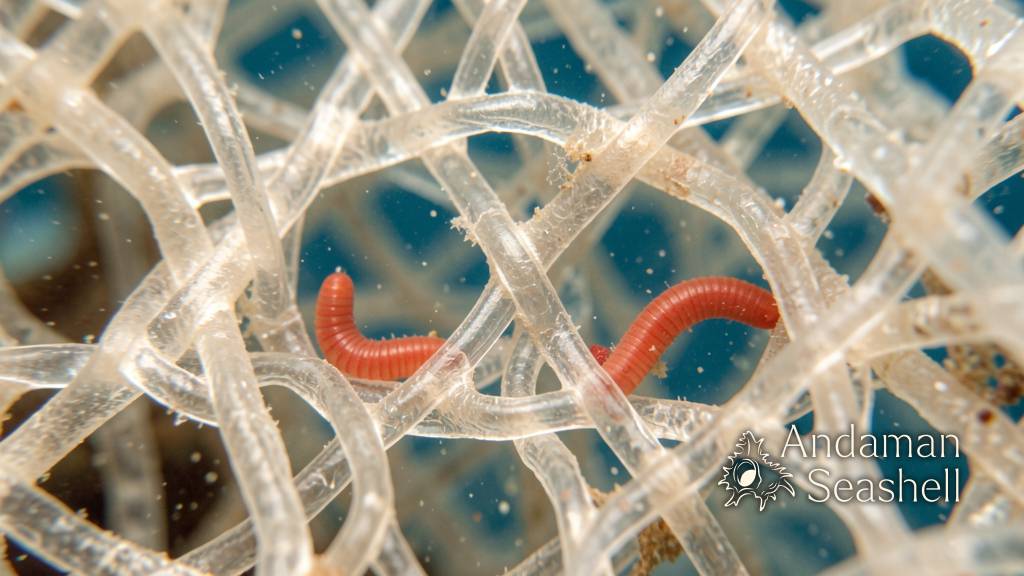
A soft beam from the submersible Shinkai 6500 lands on a glass sponge hundreds of metres below Japan, and the animal glows like a tiny crystal house. Inside its delicate silica frame, researchers found two newly described polychaete worms — small, bright proof that the deep sea can be full of architecture, partnership, and surprise [ref:1].
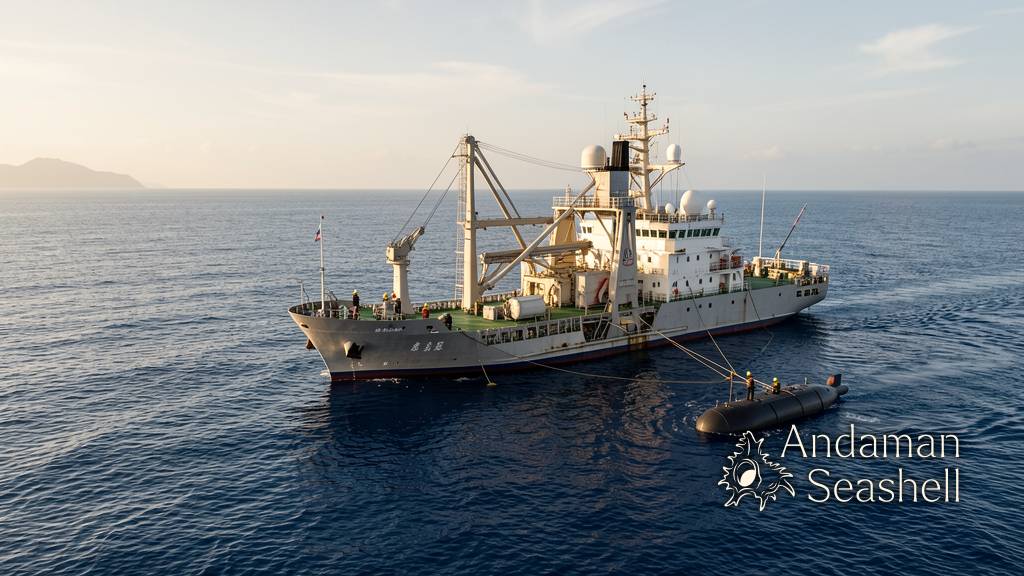
The discovery comes from the June 2025 Ocean Census expedition to Japan, carried out with the Japan Agency for Marine-Earth Science and Technology, known as JAMSTEC. The voyage used the research vessel Yokosuka and the human-occupied submersible Shinkai 6500, collecting 528 specimens from the Nankai Trough and the Shichiyo Seamount Chain. After taxonomists gathered at JAMSTEC headquarters in October 2025, the project confirmed 38 new species and identified 28 more possible new species [ref:2].
For a reader on the Andaman coast, the scene is easy to love. We know that a shell on a table can hold a story of tides, minerals, and living craft. This Japanese discovery offers the same feeling at a much larger scale: one small structure opens a doorway into an entire hidden neighbourhood of ocean life.
What is a glass sponge?
Glass sponges are deep-sea animals that build skeletons from silica, the same basic material used to make glass. Instead of a smooth windowpane, imagine a living lattice: thin mineral ribs woven into a rigid, translucent body. Water moves through the sponge, food particles are filtered, and the inner spaces become shelter for other creatures.
That is why the phrase “glass castle” works so beautifully. It is not just a pretty nickname. In the Shichiyo Seamount Chain, researchers found two new worm species, Dalhousiella yabukii and Leocratides watanabeae, living symbiotically inside a glass sponge. The sponge provides a structured home; the worms show how evolution can solve a shelter problem with astonishing elegance.
The cold seeps that changed the species count
The same wider effort also made the Nankai Trough feel newly abundant. Cold seeps are places where methane-rich fluids emerge from the seafloor. Around those seeps, special communities can grow because microbes convert chemical energy into food-web energy — a deep-sea version of a market forming around a reliable source of nourishment.
A study led by JAMSTEC researcher Chong Chen, published in Ecosphere, documented 80 seep-associated animal species in the Nankai Trough. Earlier records listed 14 species from these habitats, so the new survey represents a five-fold increase in known biodiversity [ref:3]. The list included molluscs, annelid worms, arthropods such as crabs and shrimp, ribbon worms, sea stars, anemones, hydroids, and bryozoans.
The important word is “known.” The animals were there before humans counted them. What changed was the quality of looking: better vehicles, careful specimen handling, imaging, preservation, DNA work, and taxonomists with the patience to compare tiny features. Discovery is often not a shout; it is a slow, well-lit table where someone notices the detail that matters.
Why this matters from the Andaman Sea
Phang Nga Bay and the Andaman Sea are not Japan’s deep seamounts, yet the emotional lesson travels well. Coastal people understand that the ocean is layered. A visitor sees a bright surface. A fisher reads currents. A shell artisan notices growth lines and nacre. A marine biologist sees relationships: host and guest, mineral and animal, chemistry and life.
The Japan expedition celebrates that layered way of seeing. It also reminds young ocean lovers that “marine science” is not only dolphins and coral reefs. It can be a tiny worm, a sponge skeleton, a submersible window, and a scientist saying, with great care, “this one is new to science.”
For Andaman Seashell readers, that is a perfect souvenir of knowledge. The next time you hold a shell up to the light, remember the glass sponge far offshore from Tokyo. Both are ocean-made structures. Both turn minerals into beauty. Both invite us to look closer before we think we have seen everything.
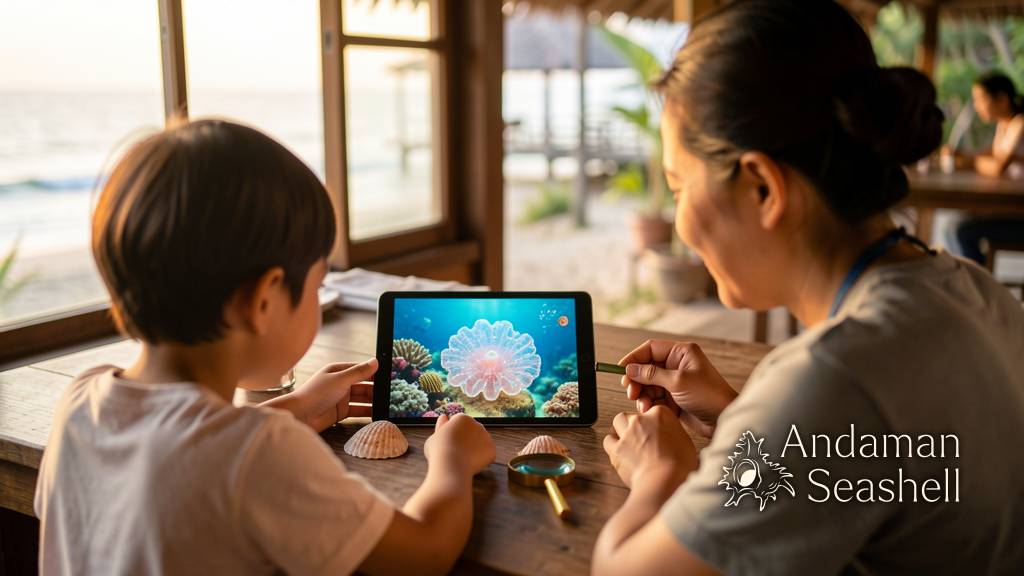
The deep sea is not distant when curiosity connects it to the shore. It is part of the same blue planet, patiently adding new chapters for anyone willing to lean in, learn the names, and feel delighted by the small lives inside the larger sea.


No comments yet. Be the first to share a thought.