



On a clear evening in Phang Nga, a child can point at one bright dot and ask a perfect question: “How do scientists know what is hiding beside a star?” This week, Hubble gave families a beautiful answer from Omega Centauri, a glittering star city about 18,000 light-years away: watch the star carefully, year after year, until its tiny motion tells the story [ref:1].
A star city with a new clue
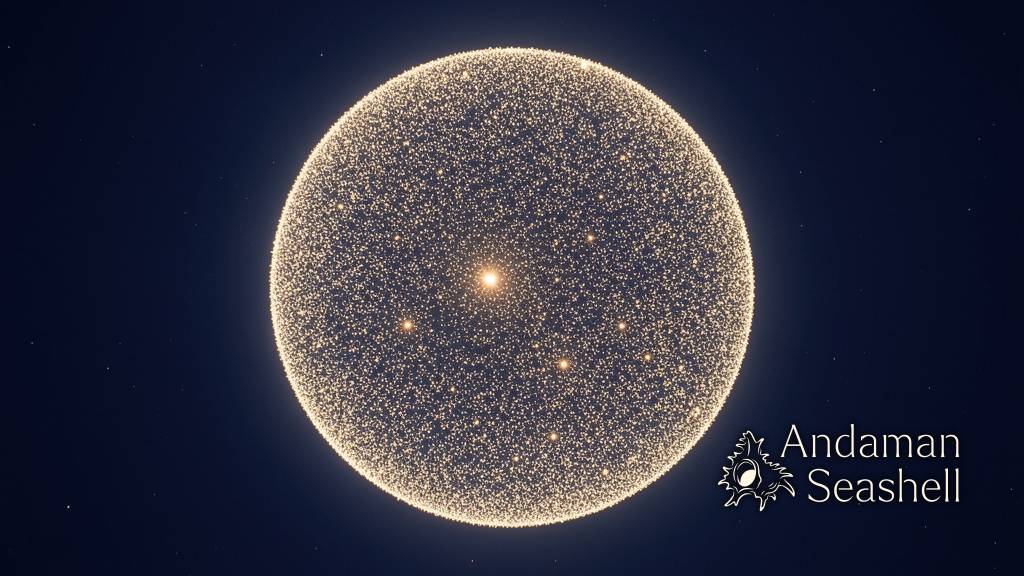
Omega Centauri is not a single star. It is a globular cluster, a great round swarm of about 10 million gravitationally bound stars, packed together like lanterns in a festival sky [ref:2]. Astronomers have studied it for decades because it is one of the most impressive star clusters near our part of the Milky Way. Hubble had already helped scientists find evidence for a larger, intermediate-mass black hole near its centre, but models suggested the cluster should also contain many smaller stellar-mass black holes.
On 13 July 2026, ESA/Hubble and NASA shared a fresh piece of that puzzle. By studying more than 20 years of Hubble archive data, with supportive observations from the James Webb Space Telescope, researchers located the first stellar-mass black hole detected inside Omega Centauri. Its name is oMEGACat BH-2 — a very catalogue-like name for a very elegant discovery [ref:2].
The clue was a graceful wobble
The trick is called astrometry. That simply means measuring the exact positions and movements of stars over time. Imagine placing a tiny pearl on a dark blue cloth, checking its position every year, and noticing that it does not travel in a straight line. Something you cannot see may be guiding its motion.
That is what the team saw in a visible main-sequence star in Omega Centauri. The star is orbiting an invisible companion heavy enough to be a black hole. The measurements were so precise that ESA/Hubble described them as down to a fraction of a pixel on Hubble and Webb’s detectors [ref:2]. For readers who love beachcombing, it is a little like noticing that one grain of sand has shifted while the whole shoreline sparkles around it.

Why oMEGACat BH-2 is exciting
A stellar-mass black hole is the compact leftover from a massive star. It does not shine like a normal star, so scientists usually find it by its effects: motion, X-rays, radio signals, or the behaviour of a companion star. In this case, the companion star became the helpful storyteller.
The visible star is about 0.78 times the Sun’s mass. The hidden companion was calculated at about 4.46 solar masses, too heavy to be a neutron star, which helped the team identify it as a black hole [ref:2]. The pair also has a wonderfully slow dance: the visible star orbits oMEGACat BH-2 once every 94 years. According to the release, that makes it the longest-period black hole binary system known to date [ref:2].
That long orbit gives scientists a clue about how the pair formed. The star and black hole probably did not begin life together. In a crowded cluster like Omega Centauri, they may have met later, drawn into a partnership by gravity. It is a reminder that the universe is not only wide; it is also full of meetings, patterns, and patient timing.
A discovery children can retell
Here is the shareable version: Hubble and Webb did not “see” the black hole directly. They watched a star move. Its path showed that an invisible, heavy companion was nearby. That hidden companion is now called oMEGACat BH-2, the first stellar-mass black hole detected in Omega Centauri.
The best part is that the discovery came from archive data. Hubble has been observing the universe since 1990, and its stored observations are still giving scientists new treasures. It feels familiar to anyone on the Andaman coast who has ever opened an old shell box, map, or family photo and noticed a detail they missed before.
Tonight, if clouds leave a window over Phang Nga, look up for a minute. You will not see Omega Centauri’s newest clue with your eyes alone, but you can carry the idea with you: sometimes the universe speaks in tiny motions, and patient looking turns those motions into wonder.



No comments yet. Be the first to share a thought.