



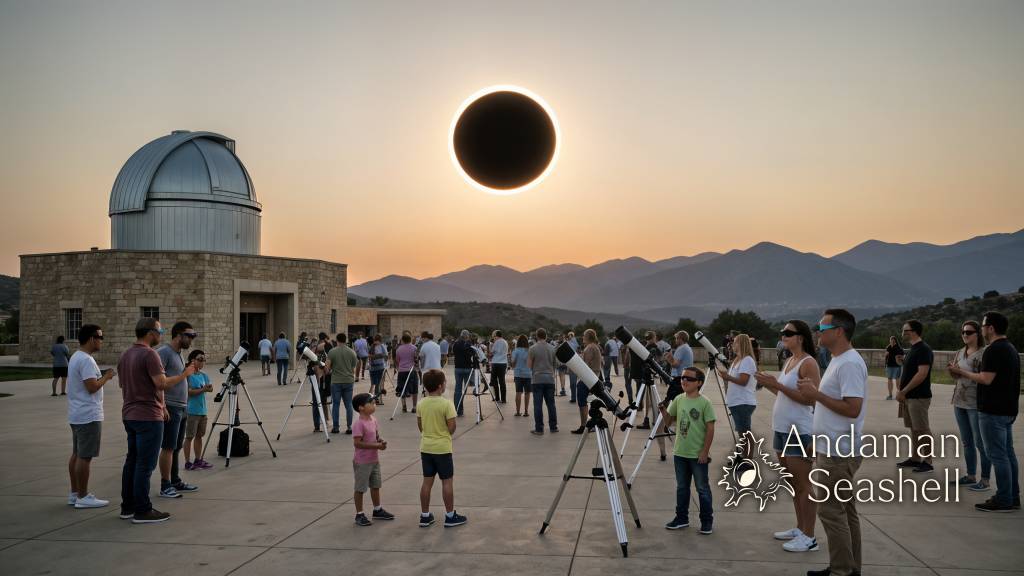
A bright summer afternoon over Spain turned briefly into another world on 12 August 2026, when the Moon covered the Sun and let the corona flare into view. The path of totality crossed Greenland, Iceland, Spain and a small part of northeastern Portugal, turning one of astronomy’s rarest spectacles into a shared European moment of wonder.[ref:1] In Javalambre, ESA’s official broadcast captured 1 minute and 21 seconds of totality as the landscape dropped into shadow and the Sun’s white halo took center stage.[ref:4]
Why this eclipse felt so special
For Spain, this was not just another sky event. ESA noted that it was the first total solar eclipse visible from mainland Spain since 1905, and also the first in a remarkable trio of Spanish eclipses scheduled between 2026 and 2028.[ref:1] That long gap helps explain why the atmosphere felt so joyful: millions of people were not just watching science happen, they were welcoming back a celestial guest that had taken more than a century to return.
The practical geography mattered too. Spain offered the largest area of totality in Europe, with the shadow crossing the country from west to east before continuing over the Balearic Islands.[ref:1] ESA built public programming around that advantage, from its live stream at the Observatorio Astrofísico de Javalambre in Teruel to a free event in León, where families could explore tactile models, sensors, and eclipse demonstrations before looking up.[ref:1][ref:4]
A natural eclipse, and a scientific festival around it
The eclipse was beautiful on its own, but it also became a rich science field day. According to AP, U.S. college teams launched more than 60 high-altitude balloons from Spain and Iceland to measure how the brief cooling and darkening affect Earth’s atmosphere.[ref:2] Southwest Research Institute scientist Amir Caspi also chased the eclipse in a NASA high-altitude plane traveling 460 miles per hour, or 740 kilometers per hour, extending totality to nearly three minutes in the air while four cameras recorded the corona in nine wavelengths.[ref:2]
That is part of what makes eclipses so loved by solar scientists. A total eclipse gives a direct view of the corona — the Sun’s outer atmosphere — which is strangely hotter than the solar surface itself.[ref:2] Even a short interval of darkness can reveal structure, motion and plasma behavior that are usually hidden by the Sun’s overwhelming brightness.
How Proba-3 turns minutes into hours
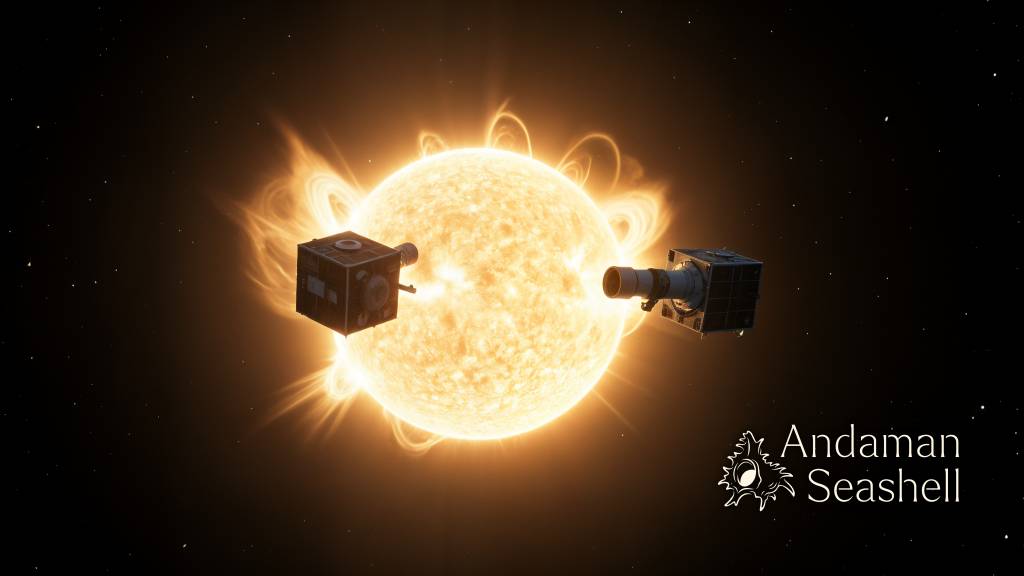
Now comes the elegant sequel. ESA’s Proba-3 mission is built around two small, cube-shaped satellites, each less than 5 feet, or 1.5 meters, across, flying in formation about 492 feet apart — roughly 150 meters.[ref:5] One spacecraft acts like a tiny Moon, blocking the Sun, while the other points its telescope toward the corona.[ref:5] To make that work, their alignment has to stay accurate within about a millimeter — roughly the thickness of a fingernail.[ref:5]
That precision is the real marvel. Natural totality is brief; Proba-3 is designed to create it on demand. AP reported that the mission has already produced more than 60 simulated total solar eclipses, with the longest lasting 5 hours and 38 minutes.[ref:2] Over its two-year mission, scientists expect nearly 200 artificial eclipses and more than 1,000 total hours of totality.[ref:5] That is a stunning upgrade from nature’s usual rhythm, where total solar eclipses happen somewhere on Earth roughly every 18 months and deliver only a few minutes at a time.[ref:5]
What makes Proba-3 especially clever is that the occulting disk and the observing telescope are not mounted on the same spacecraft. They fly on two separate satellites, letting scientists look closer to the Sun’s edge than older designs usually allow.[ref:5] In other words, it is not trying to replace the emotional thrill of a real eclipse. It is taking the same beautiful geometry and turning it into a patient scientific tool.
A better way to remember the week the sky went dark
The nicest thing about this story is that it offers both feelings at once. Europe’s 12 August eclipse gave people the human version: glasses lifted, daylight dimmed, and a minute of collective silence under a darkened Sun.[ref:4] Proba-3 gives researchers the longer version: repeated, carefully controlled windows into one of the most mysterious layers of our star.[ref:5]
That combination makes the week feel bigger than a single event. The eclipse was not only a performance in the sky. It was also a reminder that wonder and engineering can work together beautifully — one giving us the gasp, the other giving us the time to understand why the gasp happens at all.[ref:1][ref:5]
References
- ESA — Join ESA for a total solar eclipse on 12 August 2026
- AP — Get ready for a solar eclipse, meteor shower and planet parade in Europe
- ESA — How ESA mimics and models the 2026 total solar eclipse
- ESA — A look back at the 2026 total solar eclipse
- AP — Solar eclipse on-demand: How two satellites are mimicking totality in space


No comments yet. Be the first to share a thought.