



A research submersible drifting above the Diamantina Zone did not just find old bones. It found a long, quiet corridor where ancient whale fossils and living deep-sea communities still share the same seafloor — a discovery that makes the deep ocean feel both older and more alive at once.[ref:1]
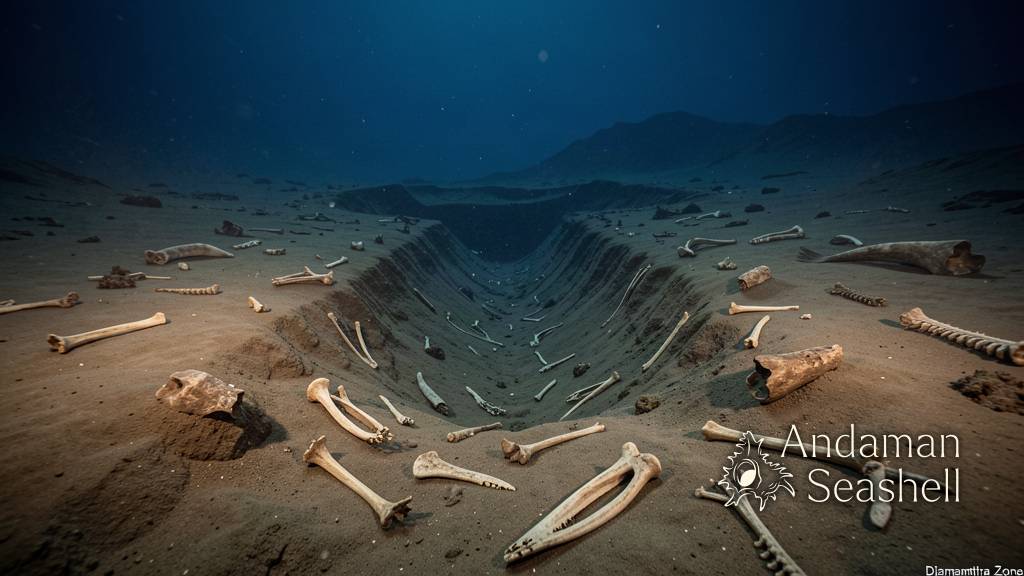
In a study published on 2026-06-10, researchers reported a whale necropolis stretching about 1,200 kilometres across the southeastern Indian Ocean, at depths from 4,616 to 7,001 metres.[ref:1] Along that route, the team recorded 476 fossil cetaceans and five active whale falls, showing that the site is not only a fossil archive but also a living habitat.[ref:1]
Where the surprise appeared
The first major clue arrived during the 2023 expedition, when the human-occupied vehicle Fendouzhe explored the Diamantina Zone from the research vessel Tansuoyihao.[ref:1] After an initial find, the team completed 32 seafloor dives between 8 February and 17 March 2023 to map what they had discovered.[ref:1] One of the first fossil finds lay near Dordrecht Deep at 7,002 metres, partially buried in soft sediment and lightly coated with iron-manganese oxides.[ref:1]
That depth matters because most previously recorded whale falls were shallower than 4,000 metres, and the deepest active whale-fall site documented before this had been 4,204 metres in the Southwest Atlantic.[ref:3] The Diamantina discovery pushes the known depth range dramatically deeper and shows that whale-fall ecosystems can remain active close to 7 kilometres below the surface.[ref:3]
A neighbourhood built from bone
Whale falls are special because one sinking carcass can feed an entire miniature community. At the Diamantina site, the active whale falls were all in the sulfophilic stage, when bones are covered with microbial mats and bone-boring worms and still release chemistry that supports life.[ref:1] The deepest active whale fall there consisted of three elongated beaked-whale vertebrae at 6,789 metres.[ref:1]
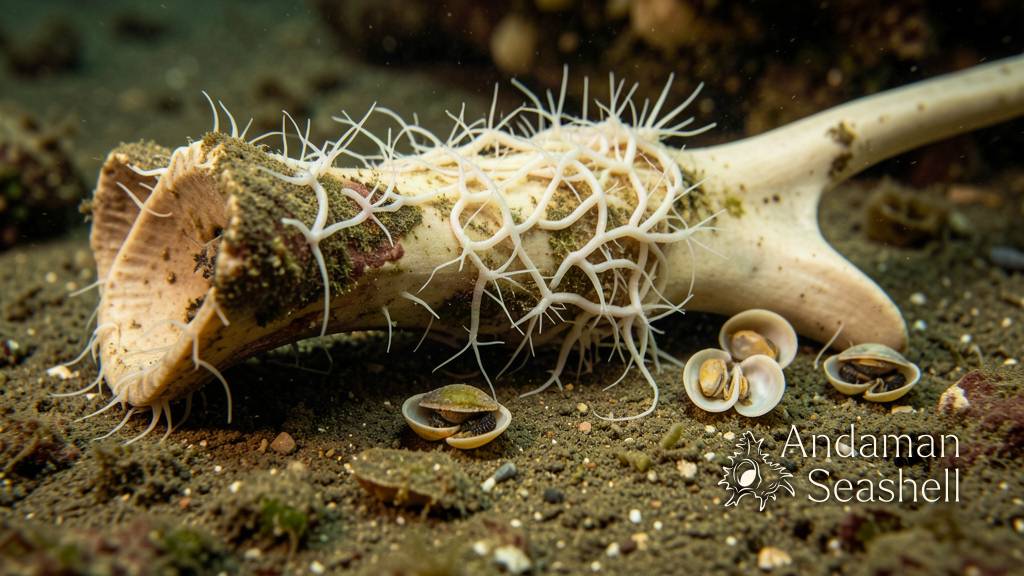
Another standout specimen was a five-metre Antarctic minke whale, Balaenoptera bonaerensis, found at 5,610 metres and identified through ear-bone anatomy and genetic analysis.[ref:1] CNN reported that one 5-metre carcass hosted 26 invertebrate species, including brittle stars, bone-eating worms, tubeworms, sea anemones, and tiny amphipods.[ref:2] Across the five active whale falls, the Nature paper documented 35 recognized macrofaunal taxa, with local densities reaching up to 2,840 individuals per square metre.[ref:1]
Some residents seem especially tuned to this unusual habitat. Researchers noted three brittle-star species found only on whale bones, and they also recorded a sea daisy, Xyloplax sp., on a whale fall for the first time — the deepest known occurrence of that genus.[ref:3] That helps scientists think of whale falls not as isolated curiosities, but as stepping stones that may connect life across cold seeps, vents, wood falls, and other chemical-rich deep-sea habitats.[ref:3]
A fossil archive with names, dates, and distance
The site is also rich in whale history. From 43 recovered fossils, the team identified five beaked-whale species, including Andrews’ beaked whale (Mesoplodon bowdoini) and the strap-toothed whale (Mesoplodon layardii), plus the sei whale (Balaenoptera borealis).[ref:4] They also identified a newly described extinct species, Pterocetus diamantinae.[ref:2]
Strontium isotope dating showed that whale-fall events in the Diamantina Zone go back at least 5.3 million years to the Early Pliocene.[ref:1] The researchers think the setting itself helps explain the accumulation: the zone’s V-shaped topography can funnel sinking carcasses onto the trench floor, while very low sedimentation rates leave bones exposed for exceptionally long periods.[ref:1] CNN also noted that some parts of the necropolis reached densities of about 760 remains per square kilometre, leading to an estimate of more than 10 million whale remains across the area.[ref:2]
Why this matters beyond one trench
What makes this story so enjoyable is its double scale. On one level, it is wonderfully precise: three vertebrae at 6,789 metres, a five-metre minke whale at 5,610 metres, and a 1,200-kilometre map of bones and life.[ref:1] On another, it opens a bigger picture of how the deep ocean stores carbon, preserves evolutionary history, and gives scavengers and chemosynthetic communities a place to gather over immense spans of time.[ref:3]
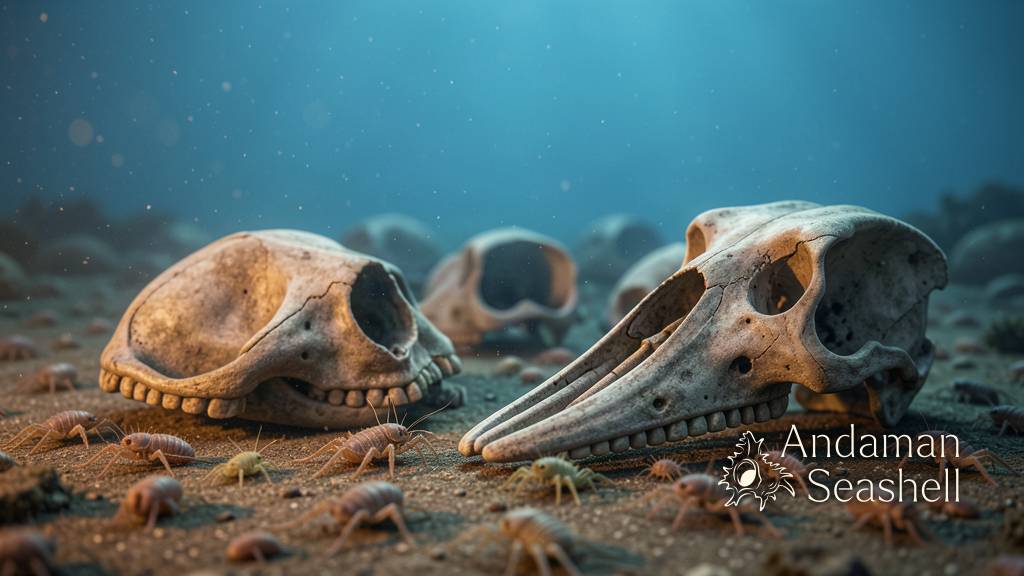
The Diamantina Zone now looks less like an empty abyss and more like a patient library of the sea — one where ancient beaked whales, living worms, brittle stars, and future discoveries are all shelved together on the ocean floor. For readers who love the moment when science makes the unseen world feel vivid, this may be one of the most beautiful deep-ocean findings of the year.[ref:1]


No comments yet. Be the first to share a thought.