



When our Sun was still a wisp of gas and dust waiting to ignite, the ice inside comet 3I/ATLAS was already ancient. Already billions of years old. Already carrying a chemical recipe from a corner of the galaxy we had never been able to touch — until now.
A team led by Dr. Martin Cordiner at NASA's Goddard Space Flight Center used the James Webb Space Telescope to study this comet as it passed through our solar neighbourhood, and the results, published in the journal Nature on 22 June 2026, are enough to make you dizzy with wonder [ref:1]. The ice warming off 3I/ATLAS contains about thirty times more deuterium — heavy hydrogen — than any comet born in our own solar system. That single detail is a timestamp. It tells us this object's original ice was laid down in a very cold, very early, very distant place, long before the Sun, the Earth, or the beaches of Phang Nga existed [ref:2].
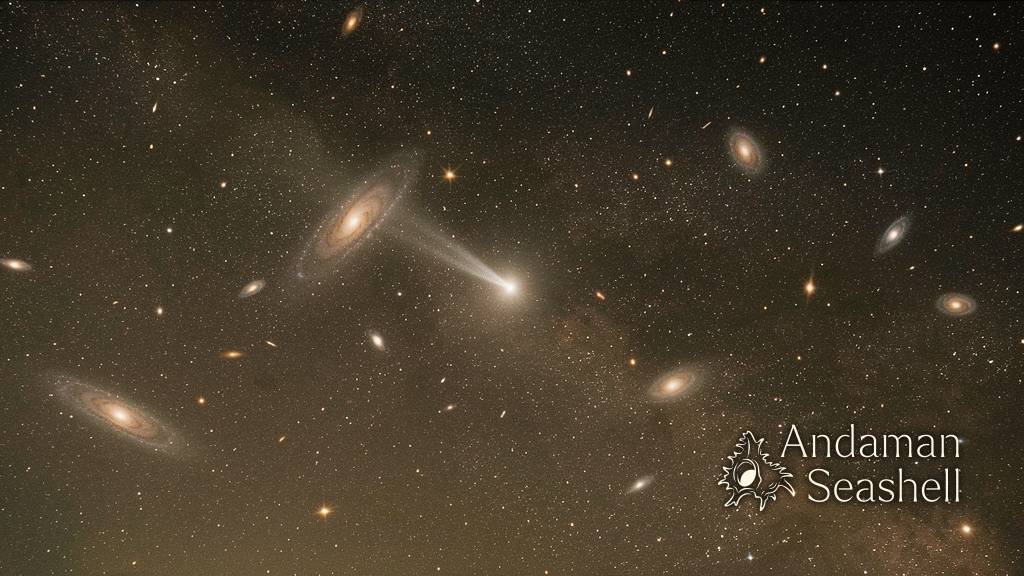
A visitor from cosmic noon
3I/ATLAS is only the third confirmed interstellar object ever detected — something that formed around another star and then drifted through the empty dark for billions of years before wandering into our neighbourhood. Its name comes from the Asteroid Terrestrial-impact Last Alert System (ATLAS), the survey telescope that first spotted it in July 2025 [ref:3].
Here is the number that should stop you for a second: scientists estimate the comet's original ice could be 10 to 12 billion years old. Our solar system, by comparison, is about 4.5 billion years old. The Sun is middle-aged. This comet's ingredients are senior citizens of the cosmos.
They were likely forged during a period astronomers call cosmic noon — the era, roughly 10 billion years ago, when star formation across the Milky Way was at its absolute peak. Galaxies were blazing with new suns, and the raw atoms that would eventually build planets, oceans, and life were being manufactured in stellar furnaces and scattered across space.
The heavy-water fingerprint
The Webb telescope trained its Near-Infrared Spectrograph on 3I/ATLAS in December 2025, watching the comet as it moved away from the Sun after its closest approach. The warmth had converted ancient ice into a glowing cloud of gas — perfect for reading its chemistry.
What it found was a double anomaly. First, that extraordinary deuterium enrichment, roughly thirty times what we see in solar-system comets. Deuterium is hydrogen with an extra neutron, making "heavy water" — and heavy water forms most readily in extremely cold environments. Second, a strikingly low ratio of carbon-13 to carbon-12. Over successive generations of stars, stellar systems gradually become enriched in carbon-13. A comet poor in carbon-13 is like a page written in very old ink [ref:1].
A complementary study led by Dr. Cyrielle Opitom at the University of Edinburgh, using the European Southern Observatory's Very Large Telescope, confirmed the finding through carbon and nitrogen isotopes measured in the comet's cyanide gas [ref:4].
Why this matters beyond the laboratory
As co-author Dr. Stefanie Milam put it: "So far, we know of only one place in the vast cosmos where chemical ingredients led to life: our solar system, our Earth." Studying an object like 3I/ATLAS is a step toward answering whether the conditions for life are rare, or simply different [ref:1].
And here is a quiet thought for the next time you walk an Andaman beach. The calcium carbonate in a seashell under your foot was forged in that same broad cosmic story — atoms cooked inside ancient stars, scattered during cosmic noon, gathered into the cloud that made our Sun and planets. 3I/ATLAS is a time capsule from the chapter just before that story reached Earth. It carries the chemistry of a galaxy learning, for the first time, how to build the ingredients for worlds like ours.

What happens next
3I/ATLAS is now speeding away from the Sun, never to return. It will drift back into interstellar space and carry its ancient ice toward no particular destination. But the data Webb gathered will stay here, the oldest chemical record humanity has ever read.
Every confirmed interstellar visitor — this comet, 'Oumuamua in 2017, comet Borisov in 2019 — is a free sample of another star system, delivered to our doorstep. The difference with 3I/ATLAS is that we were ready for it, with the right telescope pointed at the right patch of sky at the right moment.
So the next time the night is clear over Phang Nga Bay, look up. Somewhere out in the dark, ancient ice is still drifting. And we are finally learning how to read it.
References
- Cordiner et al., 'Isotopic evidence for a cold and distant origin of 3I/ATLAS,' Nature, 22 June 2026
- EarthSky — Comet 3I/ATLAS over 10 billion years old, Webb finds
- Sci.News — Interstellar Comet 3I/ATLAS Formed Up To 12 Billion Years Ago
- Opitom et al., 'High nitrogen and carbon isotopic ratios in the interstellar comet 3I/ATLAS,' Nature, in press (arXiv: 2603.07187)


No comments yet. Be the first to share a thought.