



Lift a shell-shaped idea out of the souvenir world and put it back into the sea, and the chambered nautilus suddenly becomes far more interesting. Nautilus pompilius is not simply a beautiful spiral. It is a living cephalopod, related to squid and octopuses, carrying a chambered home that works like a buoyancy tool as it moves through deep Indo-Pacific reefs.[ref:1][ref:2]
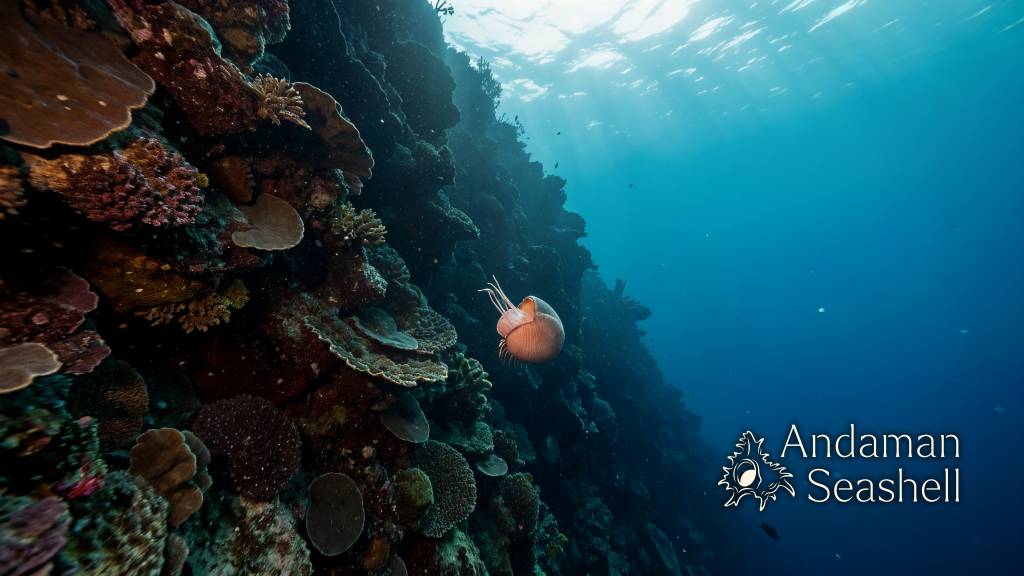
NOAA lists the chambered nautilus as a threatened species under the U.S. Endangered Species Act, and CITES Appendix II also regulates its international trade.[ref:1] That protected status matters because this is an animal built for patience, not speed. NOAA notes that mature shells are typically about 5 to 9 inches long, the animal can live 15 to 20 years, and it matures only around 10 to 15 years of age.[ref:1] Monterey Bay Aquarium adds another detail that makes the life story feel even slower and more remarkable: females lay only about 10 to 18 eggs per year, and those eggs take roughly 12 months to hatch.[ref:2]
A shell that works like engineering
The nautilus is the only cephalopod with an external shell.[ref:2] That shell is not dead packaging. It is part shelter, part record, part control system. Inside are chambers linked through a tube called the siphuncle, and the animal adjusts air and water within the shell to manage buoyancy.[ref:1] NOAA describes this as a system that helps power movement through jet propulsion, while Monterey Bay Aquarium notes that the nautilus can swim forward, backward, or sideways by directing water through a siphon near its head.[ref:1][ref:2]
That combination of mechanics and beauty is why the chambered nautilus keeps showing up in design, illustration, and natural-history collections. Yet the most impressive detail is not its polished symmetry. It is the fact that a newly hatched nautilus already begins life with seven or eight small chambers, then adds more as it grows until the adult shell carries about 30 chambers.[ref:2] The spiral is not decoration. It is a built history of survival.
A deep-reef daily routine
By day, chambered nautiluses stay deep along reef slopes, reaching depths of around 2,200 feet, or 700 metres, where cooler, darker water helps them avoid predators.[ref:2] At night, they migrate upward to about 230 feet, or 70 metres, to feed and lay eggs.[ref:2] That vertical commute gives the animal a quiet rhythm that feels almost tidal, even though it happens far below the surface world most beachcombers ever see.
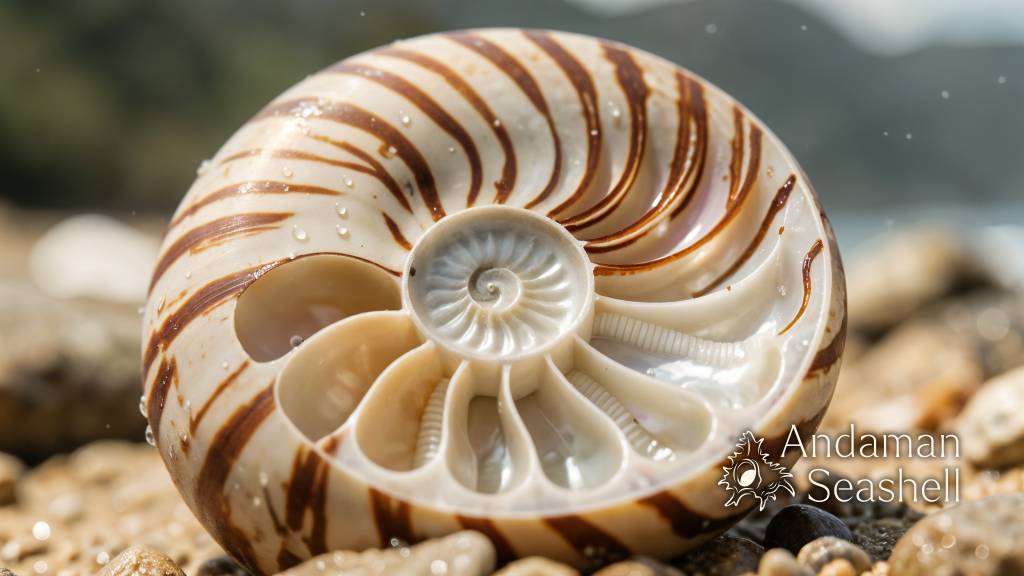
Its body is just as distinctive as its schedule. NOAA says the chambered nautilus has more than 90 suckerless tentacles.[ref:1] Monterey Bay Aquarium explains that these tentacles use grooves, ridges, and a sticky secretion to grip prey, which can include fish, crabs, shrimp, and other crustaceans.[ref:2] Simple eyes that mainly sense light and dark are balanced by strong chemical sensing, helping the nautilus find food in dim water.[ref:1][ref:2]
Why this old animal still feels new
Monterey Bay Aquarium describes the chambered nautilus as a creature that has changed little in roughly 150 million years.[ref:2] That is one reason it feels timeless. Another is that every part of it seems to hold two stories at once: a natural-history story about ancient cephalopods, and a design story about proportion, chambering, and mother-of-pearl light.
NOAA also notes that the species occurs mainly across the western Pacific and coastal areas of the Indian Ocean, often in small, isolated populations.[ref:1] That limited distribution, together with slow growth, low reproductive output, and demand for the shell trade, makes careful protection especially important.[ref:1] The lesson here is not to stop admiring shells. It is to admire them more intelligently — to appreciate the living animal, the long timeline behind each spiral, and the fact that some of the ocean’s most elegant forms were never made quickly.
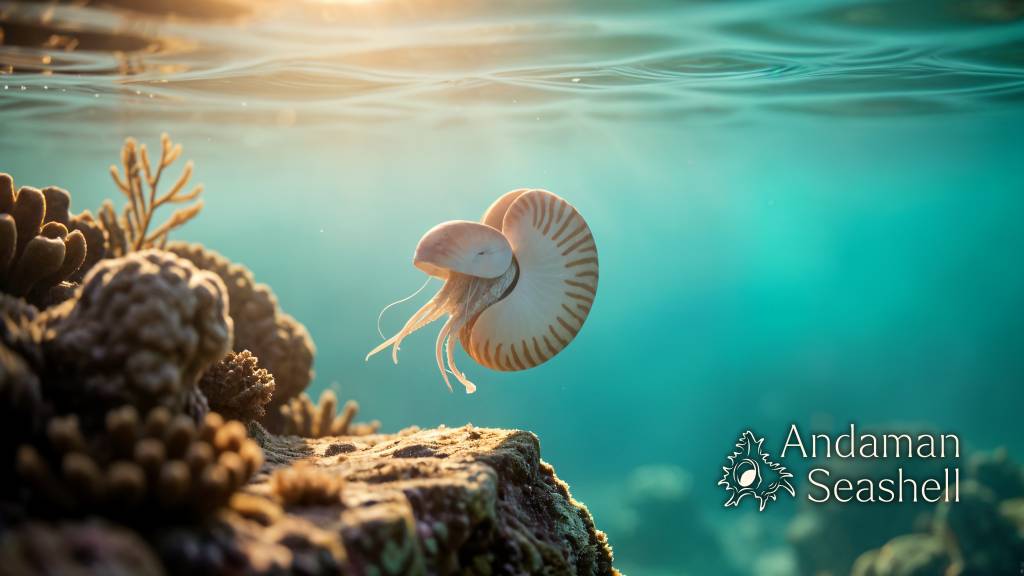
The chambered nautilus still feels like a time capsule because it really is one: a soft-bodied hunter inside a mathematical shell, rising at night, growing chamber by chamber, and carrying millions of years of ocean memory in one bright curve.[ref:1][ref:2]


No comments yet. Be the first to share a thought.