



Hold a chambered nautilus shell to your ear and you are holding a mathematical equation. Cut the shell open and the interior reveals a logarithmic spiral — a curve that expands at a constant rate, winding outward in a shape that has fascinated mathematicians since the seventeenth century [ref:1]. Every chambered nautilus in the Andaman Sea builds this spiral, one layer at a time, without knowing a thing about geometry.

The builder is not the shell
A shell is not a rock. It is not a bone. It is a biological structure built by a living animal called a mollusk — a soft-bodied creature related to snails, clams, and octopuses. The animal does not have bones inside it; instead, it secretes a hard protective casing around itself. That casing is the shell you find on the beach or see in a souvenir shop [ref:2].
The organ responsible is called the mantle. It is a thin layer of tissue that wraps around the mollusk's body like a cloak. The mantle absorbs calcium and carbonate ions from seawater and deposits them as calcium carbonate — the same mineral that makes up limestone and chalk — at the edge of the growing shell. Layer by layer, day by day, the shell expands outward from its center. When you hold a shell, you are holding a construction record. Each ridge, each growth line, each subtle change in texture is a day or a season in the life of the animal that built it [ref:2].
Why so many shells spiral
Look at the range of shells on an Andaman shore — conches, cowries, turban shells, volutes — and you will notice that most of them curve. They spiral. This is not coincidence. It is mathematics.
A logarithmic spiral is a shape that grows without changing proportion. Imagine drawing a curve that starts at a point and winds outward, getting wider with each turn but maintaining the same proportions throughout. This is the growth pattern that many shells follow [ref:1]. The reason is biological efficiency: by growing at the open end while keeping the same overall shape, the mollusk can increase its living space without having to redesign its body. The shell simply gets bigger versions of itself.
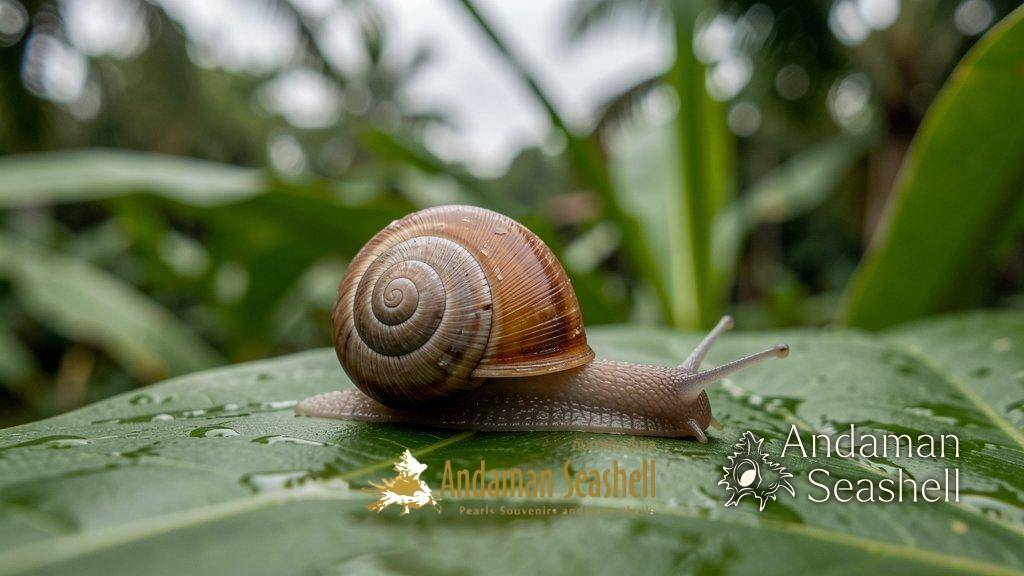
The nautilus takes this principle further. It does not just spiral outward; it builds a series of sealed chambers connected by a thin tube. As the animal grows, it moves forward, seals off the old chamber with a wall, and builds a new, larger one. The abandoned chambers are not empty — the nautilus pumps gas and fluid in and out through the connecting tube, adjusting its buoyancy like a miniature submarine. This chambered buoyancy system has worked so well that nautiluses have survived largely unchanged for 500 million years [ref:1].
Iridescence: the engineering behind the shine
Some shells do not just have shape; they have light. The inside of an oyster, an abalone, or a pearl shell glows with shifting rainbow colors. This effect is called iridescence, and it is produced by one of the most remarkable materials in nature: nacre, also known as mother-of-pearl.
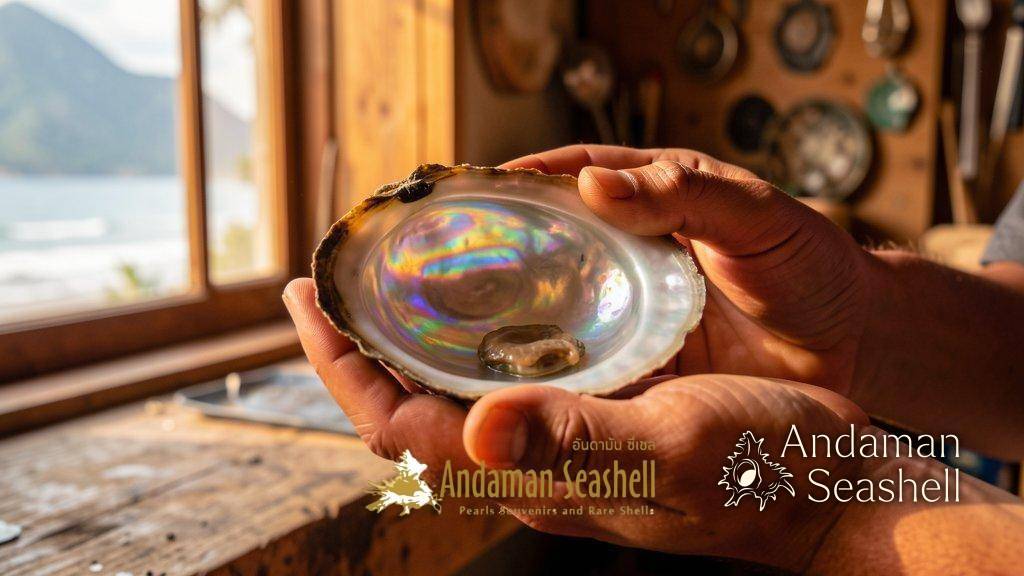
Nacre is built from microscopic hexagonal tiles of calcium carbonate, stacked like bricks and held together by a thin layer of organic protein. When light enters this layered structure, it bounces between the tiles at different angles. The light waves interfere with each other — some cancel out, some amplify — and the result is the shifting rainbow you see when you tilt the shell [ref:2]. This is the same physics that makes a soap bubble or an oil slick shimmer. The difference is that nacre builds the effect into a solid, durable surface.
This matters beyond beauty. Nacre is 3,000 times more fracture-resistant than the raw calcium carbonate it is made from. Materials scientists study it to design stronger ceramics and body armor. The mollusk solved a materials engineering problem millions of years before humans knew the field existed.
How to read a shell
The next time you pick up a shell on a Phang Nga or Phuket beach, do not just see a pretty object. Read it. Find the center — the protoconch, the very first chamber the animal built when it was barely visible. Trace the spiral outward. Count the growth lines, the way you would count rings on a tree. Notice whether the spiral coils to the right or the left. Turn it over and look at the opening, where the animal once extended its foot to crawl, feed, and breathe.
That shell is a record. It is a piece of engineering built by an animal with no brain, no blueprint, and no tools — only a mantle, some seawater, and a few million years of evolution. The spirals on the souvenir shop shelf are not decoration. They are mathematics made physical, one layer at a time, by creatures that lived and grew on this coast long before anyone arrived to collect them [ref:1].


No comments yet. Be the first to share a thought.