



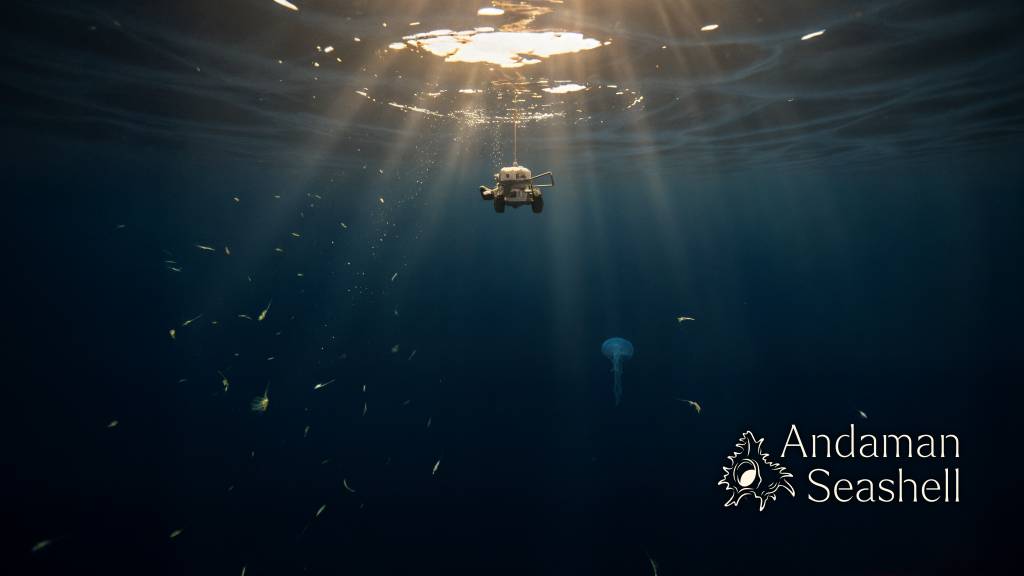
A translucent jellyfish drifts through dark blue water, and this time the robot beside it may know exactly what it is looking at. Across a new wave of ocean research, scientists are teaching underwater vehicles to detect, track, and classify marine animals in real time — a practical shift that could make the deep sea feel more visible, more measurable, and much more alive.[ref:1][ref:2]
That matters because the ocean still produces more visual data than human teams can comfortably review. MBARI’s FathomNet project was built for that bottleneck: it draws on nearly 26,000 hours of video, about 6.5 million observations, roughly 1 million images, and more than 4,600 concepts from MBARI’s long-running annotation systems to help train machine-learning models for underwater imagery.[ref:3] In other words, the challenge is no longer only getting cameras into the deep. It is helping those cameras notice patterns fast enough to keep up.
A new set of eyes for the deep
NOAA Ocean Exploration’s 2026 field plan now puts that ambition in clear public view. In its “Deployable Artificial Intelligence for Exploration and Discovery in the Deep Sea” project, NOAA says teams are developing software for remotely operated and autonomous underwater vehicles to detect, track, and classify seafloor and water-column animals in underwater video in real time.[ref:1] The system is being trained with FathomNet, the public underwater image training set that the project will also expand and augment.[ref:1][ref:3]
The setting is impressive by itself. NOAA describes the ocean twilight zone as a midwater realm from about 200 to 1,000 metres deep — dim below the sunlit layer, but full of life and deeply important to the ocean’s carbon cycle.[ref:5] This is also where traditional observation becomes awkward. Animals drift, pulse, rise, and sink through huge water volumes, and researchers often end up with far more video than people can label by hand.
MBARI researcher Kakani Katija’s Bioinspiration Lab is one of the groups building the tools for this moment. Her team combines novel imaging and illumination systems such as EyeRIS and DeepPIV with artificial intelligence through FathomNet, plus vehicle-based algorithms such as ML-Tracking, so robotic missions can observe life in the deep more consistently and persistently.[ref:2] The goal is not flashy automation for its own sake. It is better biology.
Robots that follow animals, not just routes
One of the clearest examples is Mesobot, a hybrid underwater robot designed for the midwater. A Science Robotics paper describes it as a 250-kilogram vehicle that can be teleoperated with a lightweight fibre-optic tether or run untethered with full autonomy.[ref:5] In field demonstrations at around 200 metres in Monterey Bay, Mesobot successfully tracked free-swimming dinner-plate jellyfish, Solmissus sp., and giant larvaceans, Bathochordaeus stygius.[ref:5]
That is a subtle but exciting difference. Many ocean robots are excellent at surveying water or mapping the seafloor. Mesobot was designed to stay with delicate animals over extended periods — hours to as much as a day — while carrying cameras, sensors, sonars, or samplers.[ref:5] For scientists, that means behavior can be studied in motion instead of inferred from quick encounters.
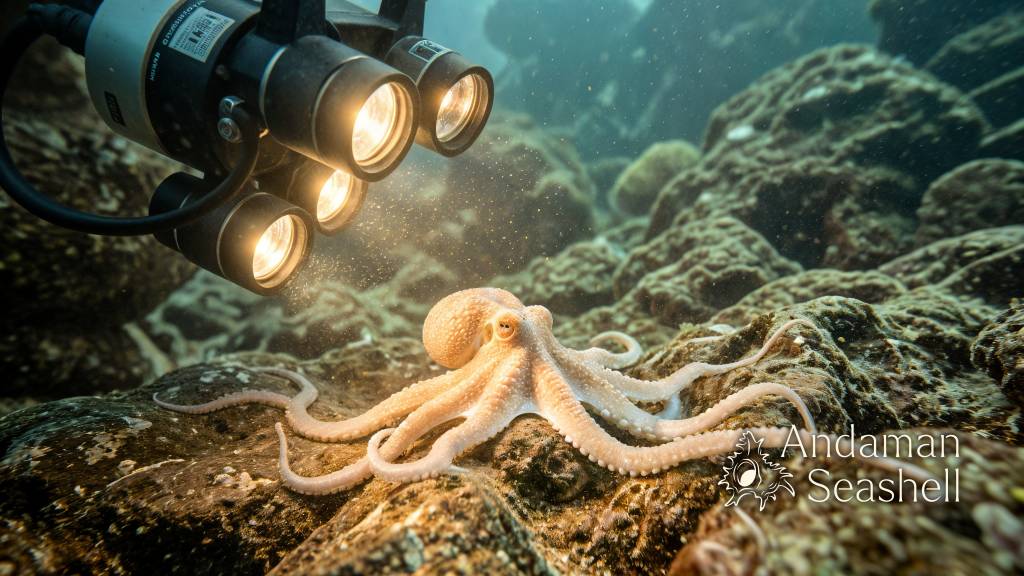
EyeRIS adds another layer of evidence. MBARI says the compact system can gather near real-time three-dimensional visual data and can be deployed to depths of 4,000 metres, or about 13,100 feet.[ref:4] Researchers used it to film pearl octopus, Muusoctopus robustus, at the Octopus Garden off Central California, showing how better imaging can reveal locomotion and biomechanics, not just presence or absence.[ref:4] When tools like EyeRIS and FathomNet meet vehicle tracking, the result is a richer picture: not just “an animal was here,” but how it moved, where it paused, and what kind of habitat surrounded it.
Why this changes ocean science
The practical value is easy to see. NOAA says automated collection and real-time analysis of large volumes of underwater visual data could help scientists, policymakers, and the public understand ocean life more rapidly.[ref:1] That speed matters in places that are still lightly explored. NOAA’s 2026 Cook Islands ROV exploration, for example, runs for 28 days from 19 July to 13 August and compares abyssal plain habitats and the Manihiki Plateau using ROVs, mapping tools, and in situ sensors.[ref:1] Another 2026 American Samoa expedition is scheduled from 20 August to 17 September, combining ROV dives, mapping, and telepresence in deep waters around the islands.[ref:1]
There is also a quieter scientific gift here: better timing. Midwater animals make daily vertical migrations that researchers describe as the largest migration on Earth, rising toward surface waters at night and dropping back into darker depths by day.[ref:5] If robots can recognize animals while they move instead of after months of manual review, researchers gain a more immediate view of one of the planet’s great living rhythms.
The deep ocean is still vast, dark, and wonderfully incomplete. But it is becoming less anonymous. With a public image database, better 3D cameras, and robots that can keep delicate creatures in frame, marine science is learning a new skill: not just going deeper, but paying attention faster.


No comments yet. Be the first to share a thought.