



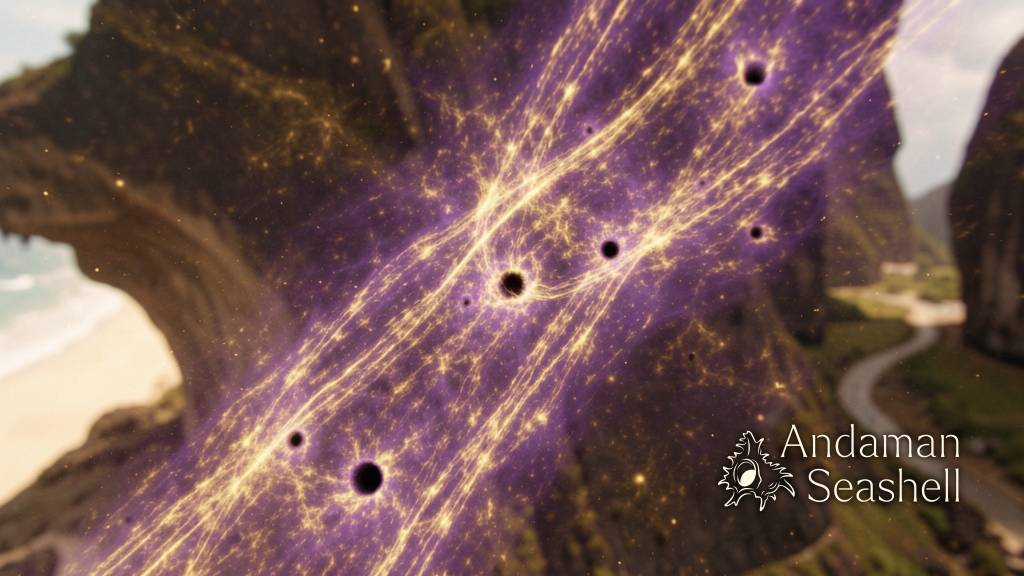
On a new X-ray map of the Shapley Supercluster, four galaxy clusters shine like bright knots, and between them runs a faint purple thread. It stretches so far that light would need 23 million years to cross it, yet astronomers were patient enough to spot it anyway. That alone is a lovely idea: the universe is not just a scatter of islands, but a woven place.[ref:1]

What makes this thread even better is what it is made of. The filament is hot intergalactic gas — ordinary matter, the same family of matter that makes stars, planets, oceans, shells, and us. For years, astronomers knew that a large share of this normal matter should exist, but could not point to all of it in the nearby universe. This new result shows that some of it really was waiting in the delicate lanes between the brightest cosmic landmarks.[ref:1][ref:2]
A thread astronomers hoped to find
Cosmologists have long had a cheerful sort of problem: their best models of the universe were working, but the census of ordinary matter looked incomplete. According to the new paper, about 30% to 40% of the expected baryons — the protons and neutrons that make up “normal” matter — had remained unaccounted for in the late-time universe.[ref:2] ESA’s summary puts it a little more simply: over one-third of the normal matter in the local universe seemed to be missing.[ref:1]
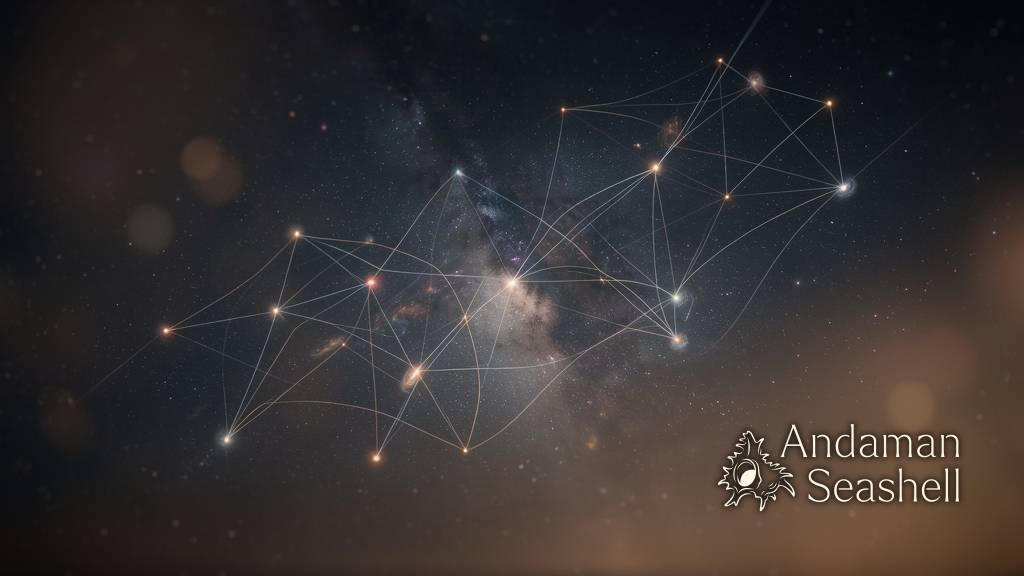
The leading idea was that this matter had not vanished at all. Instead, it was spread thinly through the cosmic web, the enormous network of filaments that links clusters and galaxies across space. The newly studied filament sits inside the Shapley Supercluster, one of the most massive structures in the nearby universe and home to more than 8,000 galaxies.[ref:1] In other words, astronomers were not looking for a random cloud. They were examining one of the grand junctions in the universe’s architecture.[ref:1][ref:2]
How they saw something so faint
The discovery relied on teamwork between two X-ray observatories: ESA’s XMM-Newton and JAXA’s Suzaku.[ref:1][ref:3] Suzaku was especially useful for mapping the faint glow across a wide area, while XMM-Newton helped researchers identify and subtract contaminating X-ray sources such as supermassive black holes that lay in the same line of sight.[ref:1] That cleaning step matters, because the filament itself is extremely dim compared with the busy universe around it.
In the peer-reviewed study, the team reports four Suzaku pointings focused on the filament region.[ref:2] Their imaging analysis found about 21±3% additional X-ray emission above the sky background, a signal detected at 6.1 sigma.[ref:2] That is the sort of measurement astronomers love: not just a pretty suggestion, but a strong statistical result. The paper also describes this as the first X-ray spectroscopic detection of pure warm-hot intergalactic medium emission from an individual, pristine filament without major contamination from unresolved point sources and gas clumps.[ref:2]
Why the numbers are so much fun
The filament is not a small bridge. ESA says it contains around 10 times the mass of the Milky Way and glows at more than 10 million degrees.[ref:1] The journal paper refines that picture with a gas temperature of about 0.8 to 1.1 keV, an electron density near 10^-5 particles per cubic centimetre, and a baryon overdensity of roughly 30 to 40.[ref:2] Those are technical numbers, but the feeling behind them is simple: this is real material, spread out thinly yet on a truly extravagant scale.
Its physical length is measured at 7.2 megaparsecs, or about 23 million light-years, and the team estimates that it sits at a 53-degree angle to the plane of the sky.[ref:2] ESA offers one of the most satisfying comparisons in the whole story: this is like traversing the Milky Way end to end around 230 times.[ref:1] Once you picture that, the cosmic web stops sounding abstract. It becomes a structure with reach, shape, and texture.
Why this matters beyond one filament
One successful filament does not solve every cosmic puzzle, but it does something wonderfully practical: it gives astronomers a benchmark. The measured temperature, density, and brightness match what large-scale simulations predicted for this kind of structure.[ref:1][ref:2] As lead author Konstantinos Migkas put it, “the models were right.”[ref:1][ref:3]
That matters because the cosmic web is the hidden scaffolding of the universe. Galaxy clusters are its bright nodes; filaments are the threads that connect them. ESA’s Euclid mission, launched in 2023, is now mapping this wider structure and exploring how dark matter and dark energy shape it.[ref:1] Discoveries like this one make that atlas feel more tangible. They show that when astronomers say the universe is woven, they mean it quite literally.
The nicest part of this story may be its mood. Nothing dramatic had to happen for the universe to become more beautiful. Researchers simply looked more carefully, removed the noise, and found a thread that had been there all along. Sometimes discovery is not about adding fireworks. Sometimes it is about learning to see the glow between the lights.


No comments yet. Be the first to share a thought.