



On the night of September 25, 2026, millions of people across Japan will step outside, look up, and quietly say thank you — to the moon. This is tsukimi (moon viewing), Japan's gentlest festival, and this year its main night, Jugoya — the fifteenth night of the eighth lunar month — falls just as autumn's biggest, brightest moon rises over the archipelago [ref:1].
A party that started on poetry boats
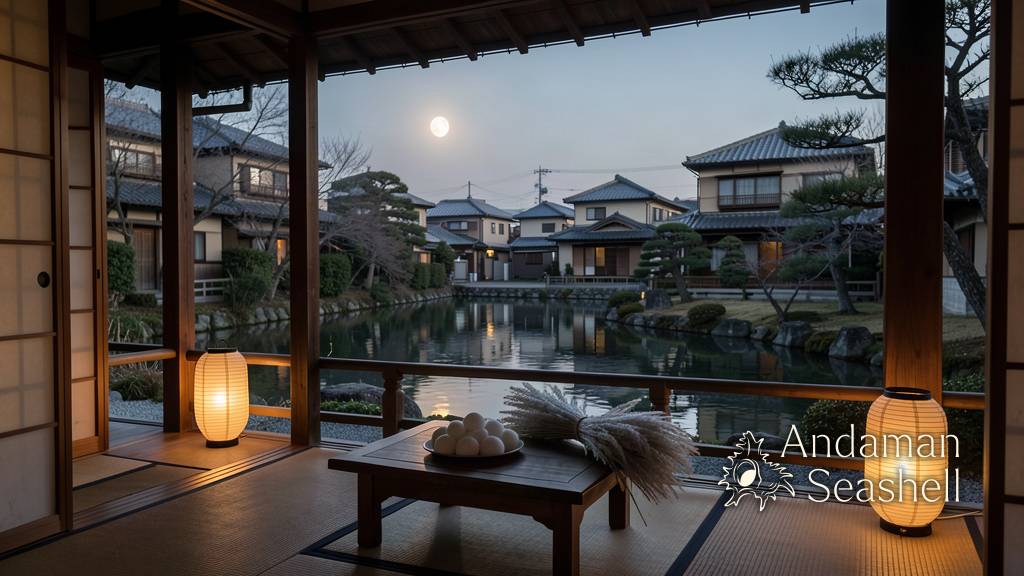
The custom is more than a thousand years old. Tsukimi dates to the Heian period (794–1185), when court aristocrats borrowed the Chinese Mid-Autumn Festival and turned it into something distinctly Japanese: gatherings of music and poetry composed by moonlight. Some revellers even boarded boats — not to look at the moon itself, but to admire its reflection trembling on the water [ref:1].
By the 1600s the celebration had drifted downstream from the palace to everyone, merging with the farm custom of offering the first rice harvest in gratitude. Today it remains a quiet night of dango rice dumplings, seasonal flowers, sake, and moonlight — a harvest thank-you letter written in food and stillness.
Fifteen dumplings and a bundle of grass
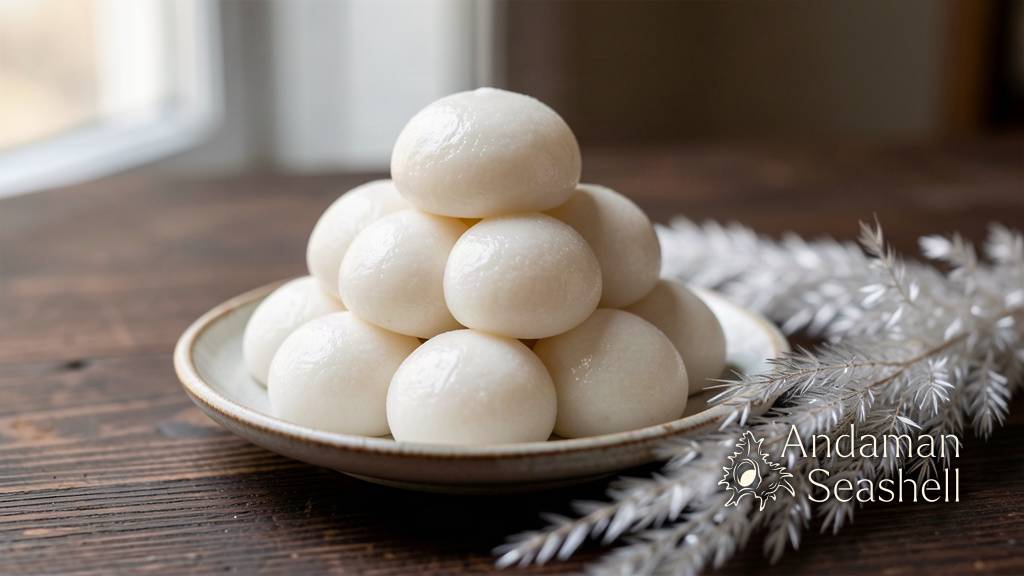
Every object on a tsukimi table means something. Tsukimi dango are small round rice-flour dumplings whose shape mirrors the full moon; they are traditionally stacked into a pyramid of fifteen — one for the fifteenth night — or twelve, for the months of the year [ref:1]. Beside them stands susuki, Japanese pampas grass, whose silver plumes resemble rice plants; a bundle of five or ten represents a wish for a bountiful harvest and is said to ward off misfortune [ref:1][ref:2].
And the season even has words for imperfect weather: if clouds hide the moon, the night is called mugetsu — "no moon" — and if it rains, ugetsu, "rain moon." The party happens anyway. In Japan, even the moon you cannot see is worth celebrating [ref:1].
Why there is a rabbit on the moon
Where Western skywatchers see a "man in the moon," Japan sees a rabbit pounding mochi with a mallet. One explanation is a Buddhist fable in which a rabbit offers itself to feed a hungry traveller who turns out to be a deity, who then honours the rabbit by placing its image on the moon. Another explanation is pure wordplay: mochizuki (full moon) sounds almost identical to mochitsuki (mochi-pounding) [ref:1]. The rest of the world's moons are crowded too — Eastern Europeans see a lady, Southern Europeans a crab, and Arabic traditions a lion [ref:2].
A seven-metre moon in Tokyo, and a burger with an egg
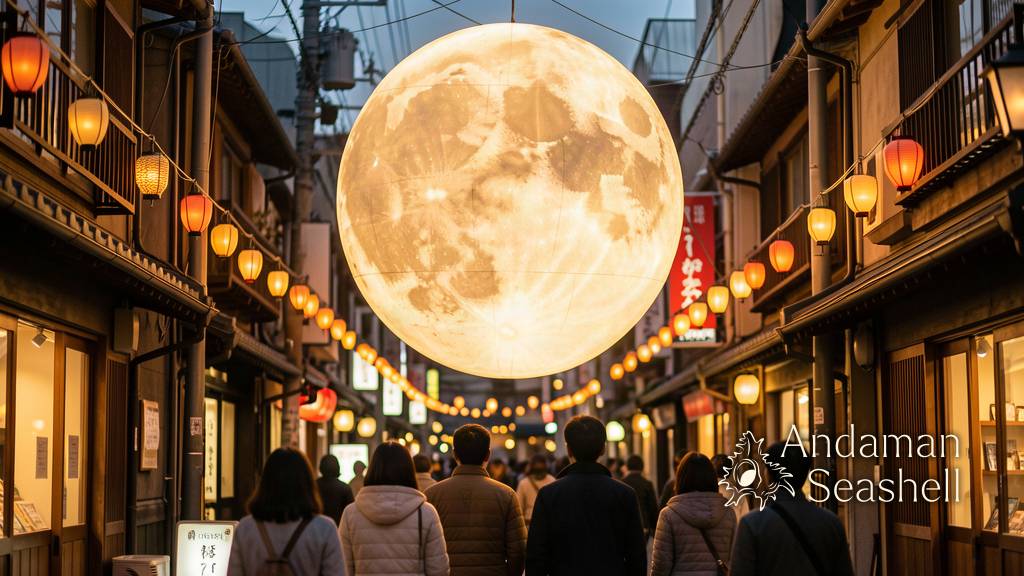
Modern Japan celebrates with both reverence and playfulness. In Tokyo's Shimokitazawa district, the art event Moon Art Night (September 18 – October 4, 2026) displays artist Luke Jerram's Museum of the Moon, a glowing lunar installation seven metres across, suspended where passersby can walk right up to the moon's surface [ref:2]. At Mukojima-Hyakkaen Garden in Sumida, the Tsukimi no Kai gathering — a tradition dating to the Edo period (1603–1868) — runs September 24–26, with harp music, ceremonial dango displays, and paper lanterns lighting the garden until 9 p.m. [ref:2]. Himeji Castle marks the night with taiko drumming and moon observation, and Ise Jingu with poetry readings [ref:1].
Fast-food Japan joins in too: every autumn, chains sell the Tsukimi Burger, a hamburger with a fried egg whose round yolk stands in for the harvest moon. Noodle shops do the same with tsukimi soba and tsukimi udon — a raw egg settling into hot broth like the moon into a night sky [ref:1][ref:2].
How to hold your own tsukimi
You do not need a castle or a garden. The essential recipe is simple: on the night of September 25, put out something round — dumplings, fruit, or a cup of tea — place a few stems of ornamental grass beside it, and spend a few minutes simply looking up. Thank the season, as farmers have since the 1600s. If you miss it, there is a second chance: Jusanya, the thirteenth-night moon viewing, follows on October 23 [ref:1].
For a thousand years, Japan has understood something worth borrowing: that pausing to admire the moon is not a waste of an evening. It is the evening.


No comments yet. Be the first to share a thought.