



A square of gold trembles above a sheet of washi paper, and for a second the whole workshop seems to hold its breath. In Kanazawa, this is ordinary work: a craftsperson guiding a material so thin it can drift if the air moves too quickly. More than 400 years after the craft took root in Ishikawa, Kanazawa still makes more than 98% of Japan’s gold leaf, and the city’s quiet workshops remain one of the best places to see patience turned into beauty.[ref:1][ref:4]
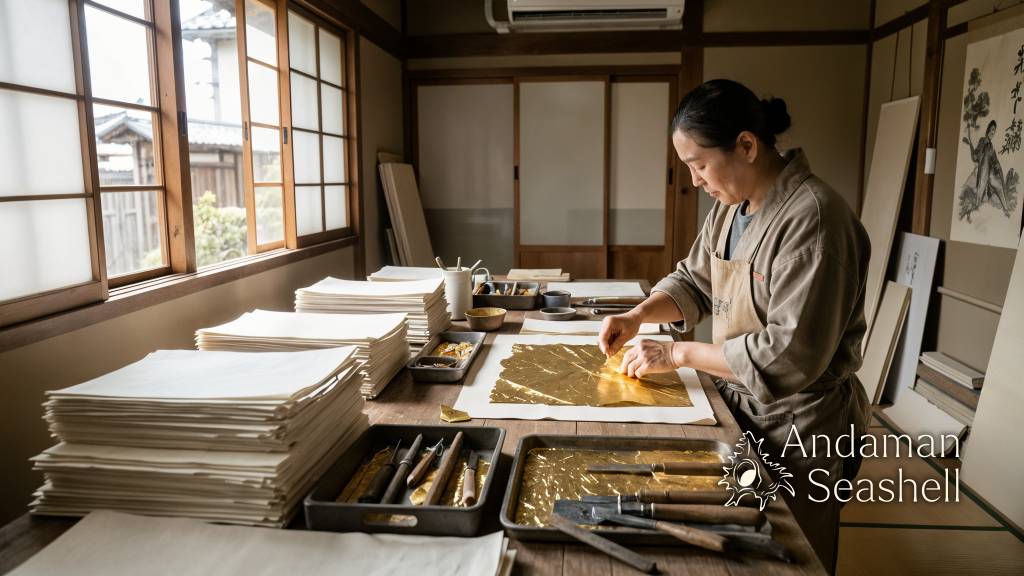
That staying power is part history, part climate, and part cultural choice. During the Edo period, Kanazawa grew under the Kaga clan, whose rulers encouraged crafts alongside ceramics and dyeing, helping gold leaf become one of the city’s signatures.[ref:1] UNESCO now recognises Kanazawa as a Creative City of Crafts and Folk Art, noting how samurai-influenced culture and artisan workshops still shape daily life there.[ref:2] A visit today does not feel like stepping into a frozen museum. It feels like entering a living city that still trusts the handmade.
Why Kanazawa became the gold leaf capital
The headline fact is wonderful on its own: Kanazawa produces about 99% of Japan’s gold leaf.[ref:3][ref:4] But the reason is even better. Gold leaf work depends on control — especially over static, moisture, and touch. Official Japanese sources note that Kanazawa’s humid climate helps reduce static electricity, making it easier to handle leaf that is almost impossibly light.[ref:1] That climate advantage met a city already rich in craft knowledge, and the tradition stayed.
The material itself is astonishing. Kanazawa gold leaf is beaten to about one-ten-thousandth of a millimeter thick.[ref:1][ref:3][ref:4] One gram of gold can be stretched to roughly one square meter, yielding about 50 sheets.[ref:1] In the traditional entsuke method, artisans first cut the gold into 5-centimeter squares, layer it between washi papers about 21 centimeters wide, and continue working until the leaf becomes a smooth 20-centimeter square before final trimming.[ref:1] The process can involve more than 70,000 strikes.[ref:1]
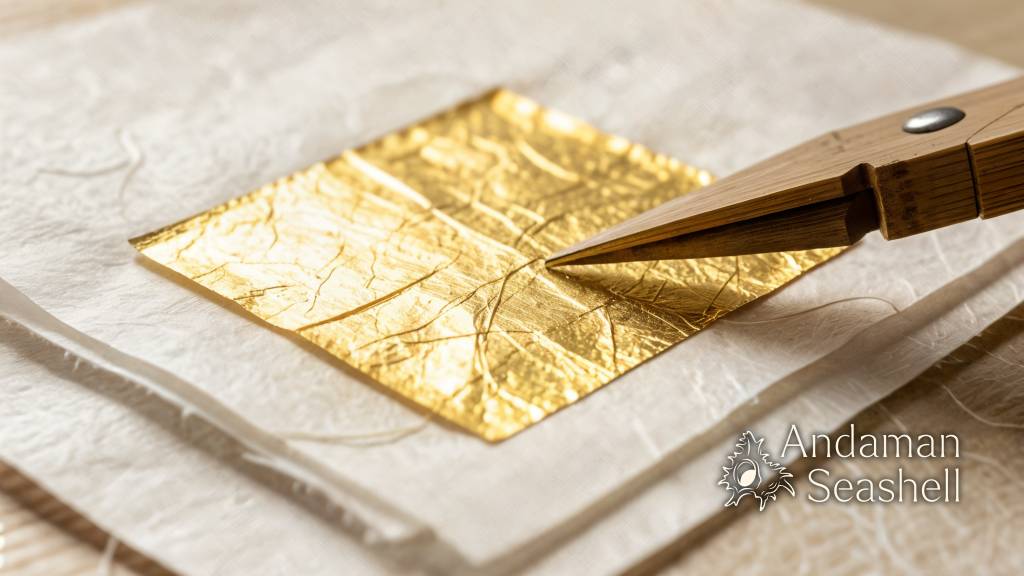
That level of care explains why Kanazawa leaf appears everywhere from temple restoration to contemporary design. Government sources say gold leaf used in restoring cultural properties in Japan is now almost always from Kanazawa.[ref:1] At the same time, the craft has expanded into mirrors, cups, lacquerware, accessories, interiors, and even food.[ref:1] The famous gold-covered soft-serve that spread after the Hokuriku Shinkansen reached Kanazawa in 2015 helped many first-time visitors discover the craft through delight rather than distance.[ref:1]
A craft city that invites you in
Kanazawa’s charm is that the story does not stop at admiration. Visitors can actually try the craft. The city’s tourism guides point travelers toward workshops near places like Higashi Chaya District, where many items can be completed and taken home the same day.[ref:3] Some experiences run about 60 minutes and start from around 1,760 yen, making the tradition feel surprisingly approachable.[ref:3] HOKURIKU x TOKYO also notes that most artisan shops welcome visitors year-round, though advance reservation is often recommended.[ref:4]
If you want context before trying it yourself, the Kanazawa Yasue Gold Leaf Museum is one of the most natural stops, especially because it sits near Higashi Chaya, one of the city’s most atmospheric historic districts.[ref:3] The workshop trail also leads to long-established makers such as Gold Leaf Sakuda and century-old manufacturers that now turn gold leaf into jewelry, tableware, and modern souvenirs without losing the old discipline behind them.[ref:3]
Kanazawa is broader than gold, too. BBC Travel notes that the city has 22 kinds of traditional arts and crafts and that UNESCO named it Japan’s first Creative City of Crafts and Folk Art in 2009.[ref:5][ref:2] That wider ecosystem matters. Gold leaf survives here not as an isolated specialty, but as part of a city that still believes craft belongs in ordinary life.
Why this craft feels familiar from far away
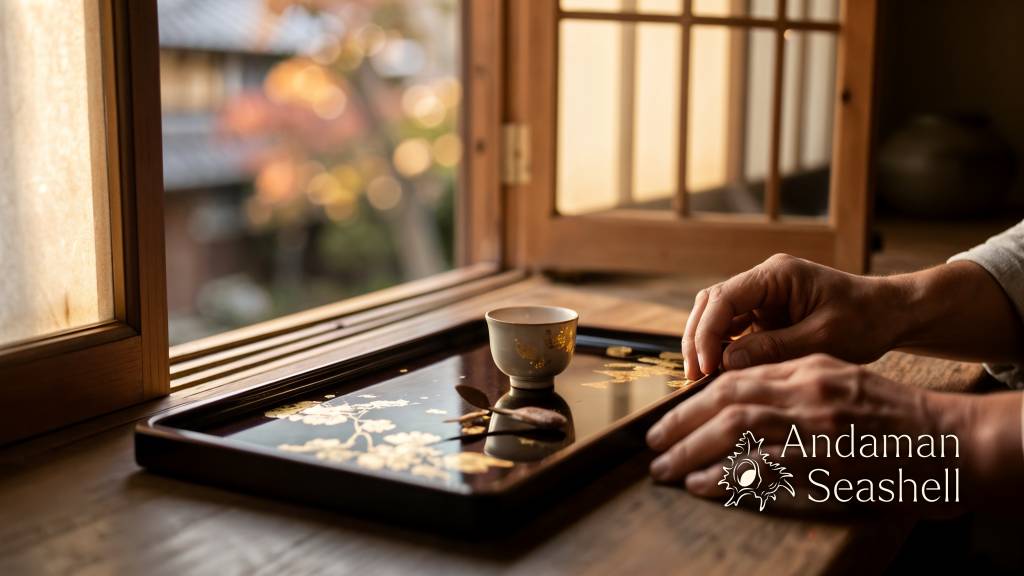
For readers in Thailand, especially anyone who loves shell inlay, lacquer, or hand-finished decor, Kanazawa’s gold leaf feels immediately understandable. The materials are different, but the rhythm is shared: steady hands, humidity-aware technique, surface, shimmer, and time. In both Japan and the Andaman world, beauty often arrives not through speed but through repetition.
That may be the loveliest part of Kanazawa’s gold leaf story. A city can modernise, welcome trains and tourists, open workshops, and still keep a fragile old skill alive — not by locking it away, but by letting people come close enough to wonder at it. In Kanazawa, the glow is not only in the gold. It is in the decision to keep making beautiful things with care.


No comments yet. Be the first to share a thought.