



A mother-of-pearl tray does something lovely in a Phuket room: it catches the afternoon light, then gives it back more softly. That small shimmer is why this old Thai craft still feels current. In a home shaped by sea air, teak, rattan, and open windows, shell inlay does not feel fussy at all. It feels calm, tactile, and deeply coastal.[ref:1][ref:2]
Phuket already has a strong public story about living heritage. UNESCO lists the island as a Creative City since 2015, notes a population of about 390,000, and describes the annual Old Town Festival as a three-day celebration of gastronomy, crafts and folk art, and visual arts that draws more than 400,000 people.[ref:1] That matters for home style, too. A place that celebrates craft in public tends to keep better taste in private: materials, objects, and stories stay connected.
The material is the design
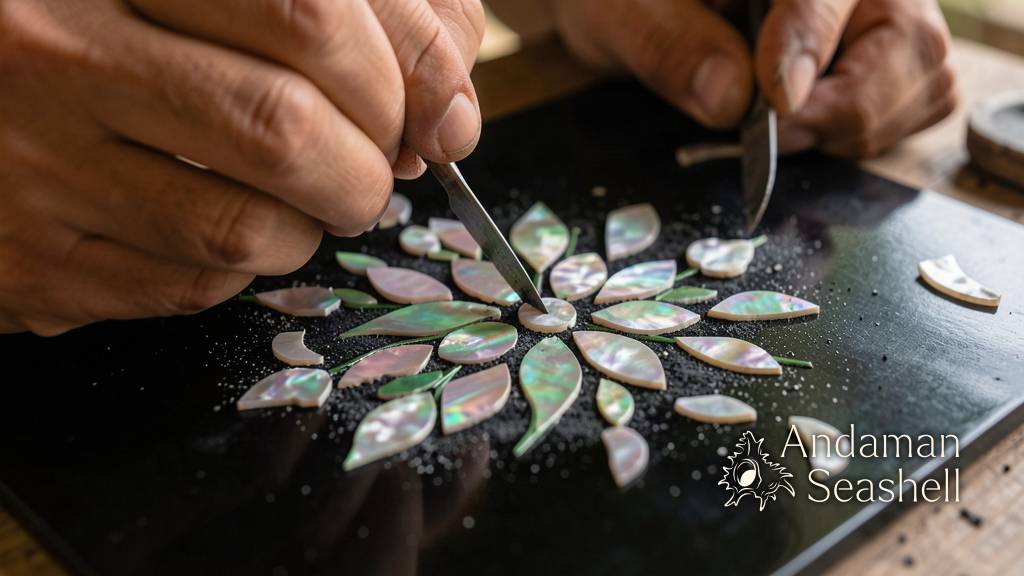
Mother-of-pearl is the lustrous inner shell layer found in mollusks such as pearl oysters, mussels, and turban snails.[ref:2] Thailand Foundation’s overview puts the process simply: shells are cut into small pieces and laid into black lacquer to build intricate patterns.[ref:3] That contrast is the whole magic. The pearl gives movement; the lacquer gives depth.
The craft is also more technically impressive than it first appears. The Met explains that lacquer comes from tree resin and hardens when exposed to oxygen and humidity at about 70 to 80 degrees Fahrenheit, becoming a natural plastic that resists water, certain acids, and heat.[ref:4] In other words, this is not decoration floating on the surface of a room. It is a finish system with real material intelligence, which helps explain why lacquer-and-shell objects have lasted across centuries.[ref:2][ref:4]
Why it still feels fresh now
Contemporary coastal homes often look best when they use fewer, better things. Mother-of-pearl works well in that language because it brings light without shouting for attention. A single inlaid tray, manuscript box, or cabinet front can do the work of both texture and highlight.
Thai examples show how scalable the craft can be. In the Met’s collection, an early 19th-century Thai palm-leaf manuscript storage box measures 62.2 centimeters wide and just 11.4 centimeters high and deep, proving that mother-of-pearl does not need to be monumental to feel refined.[ref:5] It can live on a shelf, a console, or a reading corner just as easily as on a ceremonial object.
There is also human warmth behind the finish. Thailand NOW’s profile of master artisan Jukkit Suksawat describes his original Bua Bang Len motif, inspired by lotus blossoms from his hometown in Nakhon Pathom.[ref:2] Thailand Foundation adds that he works to preserve ancient inlay patterns while experimenting with new styles.[ref:3] That balance—heritage plus reinvention—is exactly why the craft still feels modern.
A craft measured in patience
One of the article’s most memorable facts is also the one that makes you look at every finished piece differently. According to 1885 records cited by Thailand NOW, a pedestal tray only 25.5 centimeters wide required 1,500 to 2,000 shell pieces.[ref:2] The same source notes that the artisan Nai Yu could cut only 30 to 35 shell pieces a day, which meant that shell cutting alone could take almost two months for one small tray.[ref:2]
Those numbers are useful for design appreciation. They remind us that a shell-inlaid object is not merely shiny. It is a surface built from repetition, pressure, and hand control. If you place one in a Phuket home, it brings a rhythm of making into the room.
Science adds one more layer of wonder. UW–Madison researchers describe nacre as being 3,000 times more fracture resistant than aragonite, the mineral it is made from, and note that its microscopic structure can even record water temperature and depth.[ref:6] A decorative object, then, is also a small archive of marine life.
How to live with it in a coastal interior
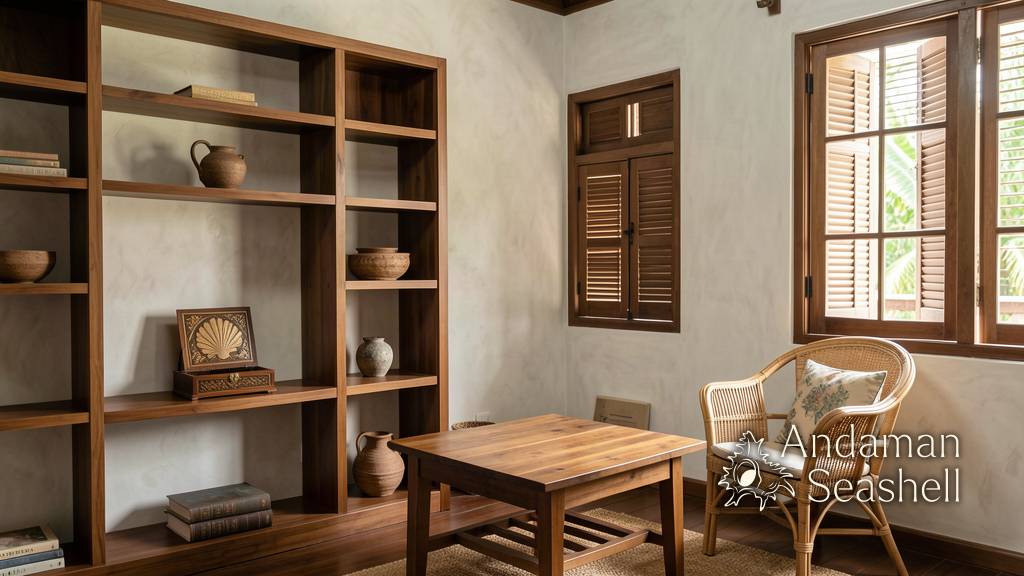
The best approach is restraint. Let mother-of-pearl sit where light can move across it: on a teak shelf, beside matte ceramics, near woven textures, or against a dark cabinet where the iridescence can breathe. It pairs especially well with natural linen, smoked wood, and the near-black tones already familiar in lacquer traditions.
For Phuket and the Andaman coast, that feels especially right. The sea is already part of the palette. Shell inlay simply translates that relationship into the home—more quietly than a beach-themed print, and with much more memory inside it.
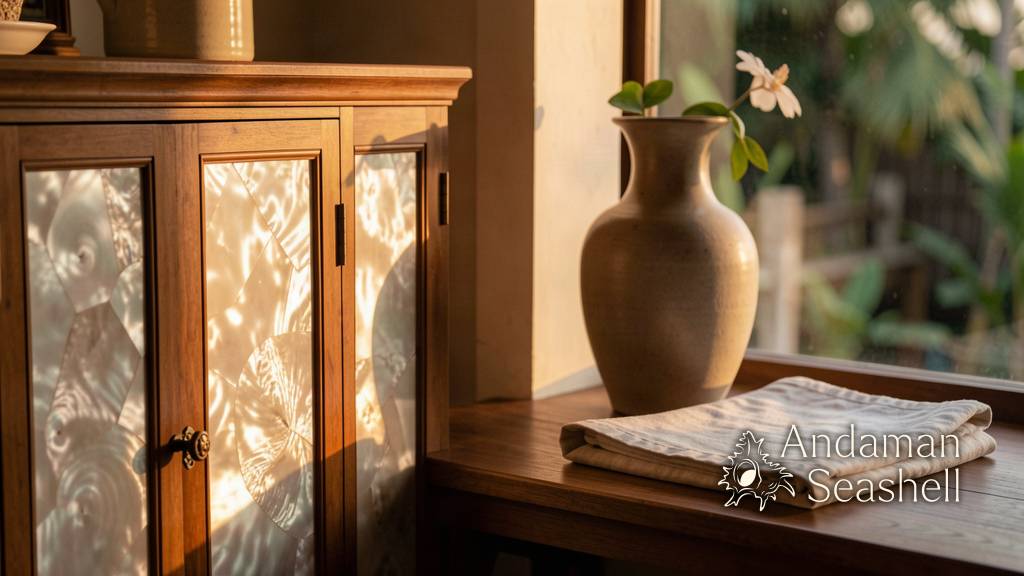
When a craft survives from temple doors and scripture cases to contemporary shelves and sideboards, it usually means the material still has something true to say. Mother-of-pearl says it in light: softly, patiently, and in a way Phuket homes still understand. [ref:1][ref:2][ref:4]


No comments yet. Be the first to share a thought.