



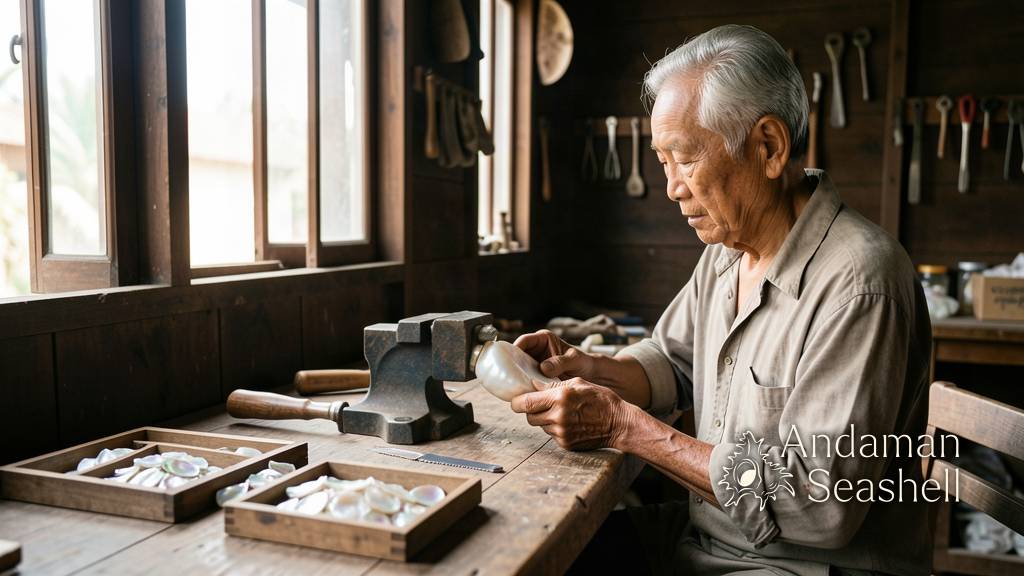
In a Bangkok workshop, a craftsman named Jukkit Suksawat bends over a sliver of shell no wider than a fingernail. With a fine saw, he coaxes a curve out of it — one small piece of mother-of-pearl that will join hundreds of others on a panel of black lacquer, until the surface reads like a constellation map. Thai people have a name for this art: pradup mook, and for centuries it has been one of the most patient, most luminous crafts on Earth. It is now having a genuine design renaissance, and our homes are the better for it.
A material that fooled four ancient civilisations
Mother-of-pearl — the iridescent inner layer of certain mollusc shells, called nacre — has been prized since around 3000 BCE, when cultures across Mesopotamia, Egypt, China and the Indus Valley hand-cut and polished it for jewellery, ritual objects and inlay [ref:4]. What they were responding to is something modern materials science still finds remarkable: nacre is roughly 3,000 times more resistant to fracture than the mineral it is mostly made of, because molluscs build it in staggered microscopic bricklayers of aragonite and protein.
The craft that grew around it follows a rhythm you can still watch today. The artisan draws a motif on wood, carves out the outline, shapes each nacre piece to fit, sets it in place, then sands, burns and varnishes the surface — historically with melted natural resin [ref:1]. Because dark wood makes the white shimmer sing, masters have always favoured thick, deep-toned timbers: walnut, ebony and mahogany [ref:1].
Thailand's royal constellation-makers
In Thailand, mother-of-pearl inlay is recognised as a high art practised for more than four centuries. It appeared in the region as early as the Dvaravati period (ca. 600–1000) and reached its zenith under the Ayutthaya kingdom (1351–1767) [ref:2]. In the 15th century, King Borommatrailokkanat went so far as to establish a royal Department of Mother-of-Pearl Artisans, reserving the finest practitioners for the court and instantly conferring "high art" status on the craft [ref:2].
You can still read the craft's confidence in its own work. The scripture-hall door panels at Bangkok's Temple of the Emerald Buddha carry a mother-of-pearl inscription recording that King Borommakot ordered their making, how many craftsmen worked on them, and the completion date — a shimmering signature, set in shell itself [ref:3]. On rattan and bamboo cores joined with lacquer, those panels have kept their glow for centuries.
The pace of the work explains its preciousness. The master artist Nai Yu could cut only 30 to 35 shell pieces in a single day; a single major commission could demand close to two months of cutting alone [ref:2].
From ornament to surface
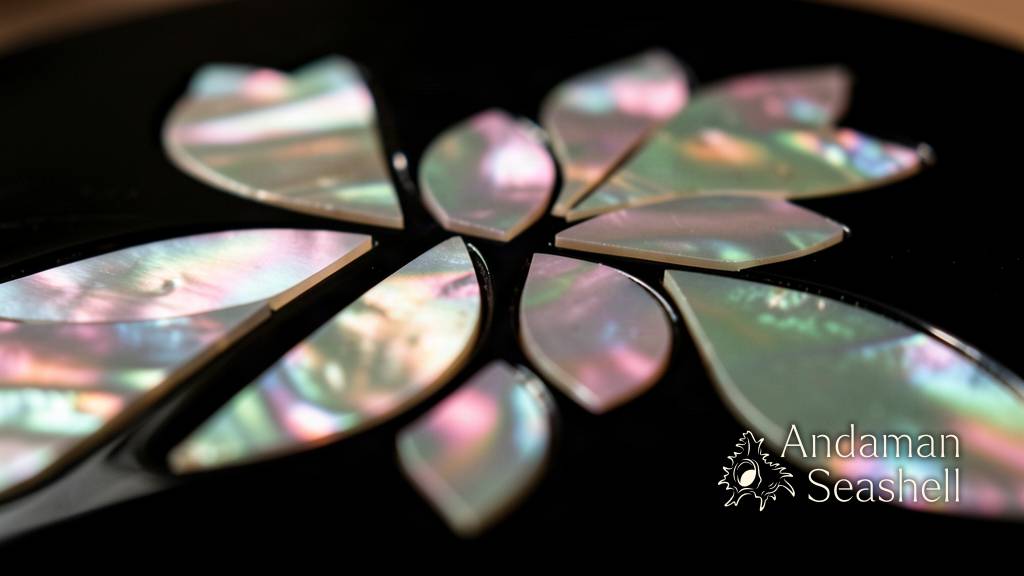
For most of history, nacre stayed an accent — a star here, a petal there. The 19th century changed that: industrial precision saws and grinding wheels made it possible to slice shell into thin, uniform sheets that could be bonded to furniture, boxes, even piano keys [ref:4]. Korean makers, drawing on their Najeon Chilgi lacquerware tradition, industrialised shell veneer from the late 1990s [ref:4].
Today's veneers go further still. Diamond blades and CNC cutting produce nacre sheets often thinner than half a millimetre, on flexible backings that can wrap curved panels and clad whole walls [ref:4]. And the sourcing has matured with the technology: most modern mother-of-pearl veneer now comes from regulated fisheries or as a by-product of pearl farming, so the beauty arrives with responsibility attached [ref:4]. In 2023, UNESCO recognised the intangible heritage of the craft, inscribing mother-of-pearl inlay on its Representative List of the Intangible Cultural Heritage of Humanity [ref:1].
Designers leaning into natural, tactile interiors — the biophilic and Japandi currents shaping 2026 rooms — have taken note. A surface that no machine can fully standardise, that shifts colour as daylight moves across it, is exactly what the moment asks for.
Bringing the shimmer home
You don't need palace doors. A single inlaid box, tray or frame does the work of a small moon in a room:
- Pair it with darkness. Nacre loves contrast. Set a mother-of-pearl box on walnut, ebony-stained teak or a charcoal linen surface, the way the old masters did [ref:1].
- Let light find it. Place inlay where low, raking light — morning or late afternoon — can travel across the surface; the iridescence changes hour by hour.
- Keep it dry-minded. Wipe with a soft, barely damp cloth; skip harsh detergents. In humid tropical climates, a natural lacquer finish ages gracefully — Ayutthaya-era work has survived hundreds of years on natural materials alone [ref:2].
- One is enough. Because every piece of nacre is unique, a single inlaid object reads as intentional. Cluster too many and the constellation becomes clutter.
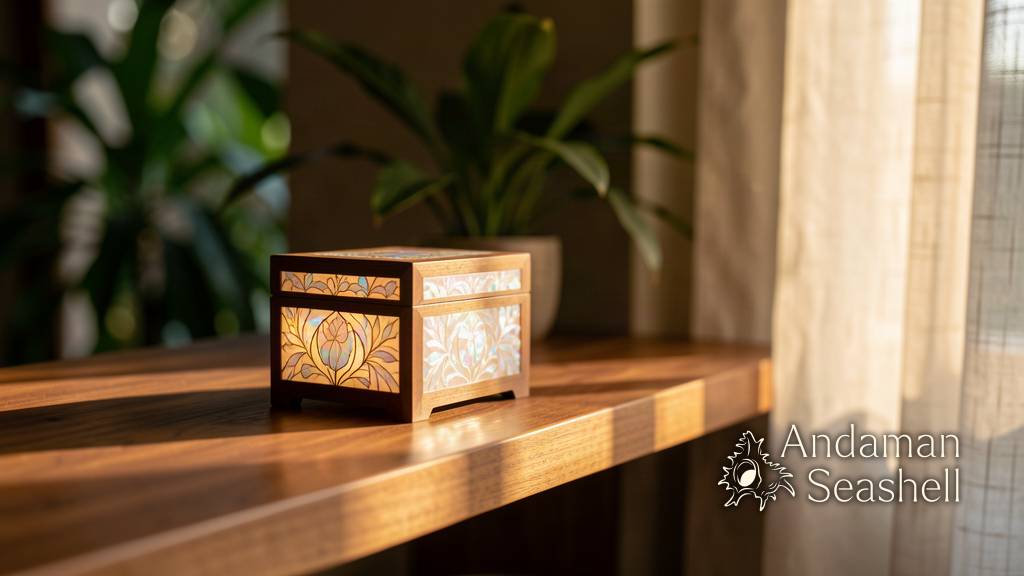
On a shelf in a Phang Nga home, a small inlaid tray catches the last light of the day, and for a moment the room holds a piece of the sea's oldest magic — cut by patient hands, set by patient hands, and still, after four thousand years, impossible to imitate.


No comments yet. Be the first to share a thought.