



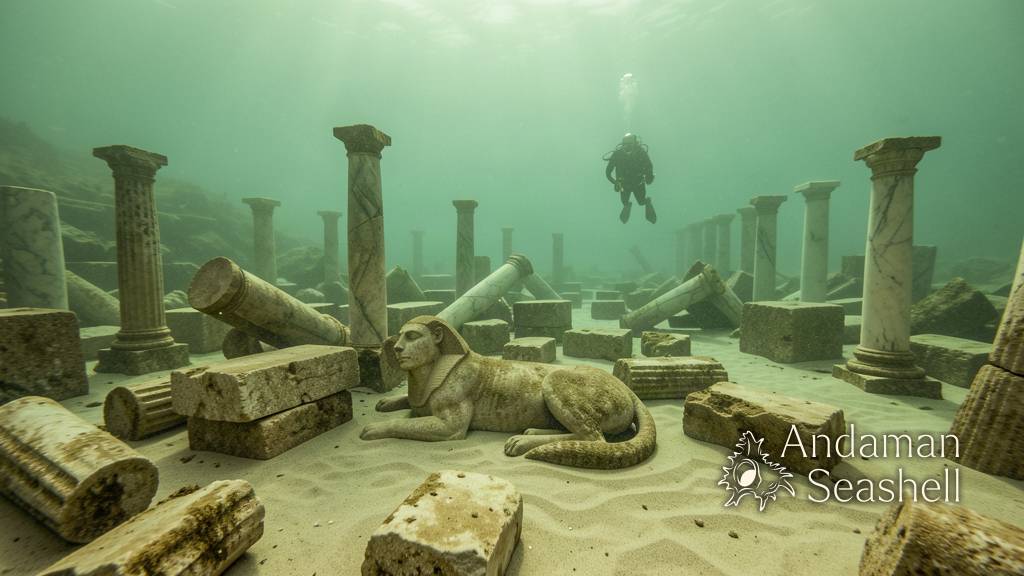
On 7 October 2026, in the green underwater light of Alexandria's Great Harbour, a diver from the European Institute for Underwater Archaeology brushed sand from something small and circular on the seabed of the sunken Royal Island of Antirhodos — and realised it was staring at a portrait of a lost Wonder of the Ancient World [ref:2].
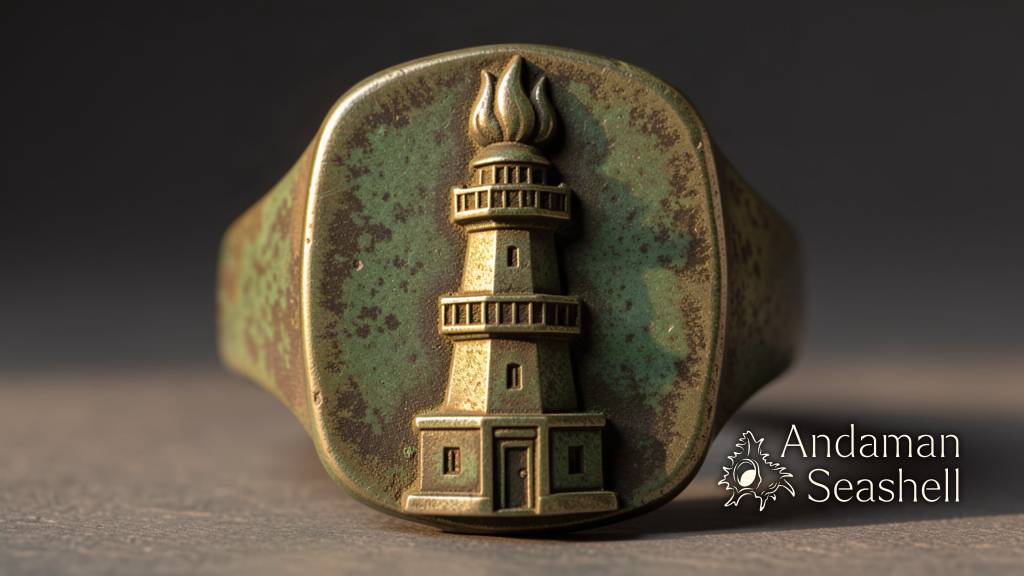
The object was a bronze signet ring, engraved with the Lighthouse of Alexandria. It is the first ring of its kind known to exist anywhere on Earth [ref:1]. For a team that has spent three decades mapping a drowned royal quarter, it was the kind of morning underwater archaeologists dream about: the ancient world's tallest building, captured on an object small enough to wear on a finger.
The smallest portrait of the tallest building
Think about the scale of that contrast. The Lighthouse of Alexandria — the Pharos — is estimated to have stood between 103 and 118 metres tall, making it one of the tallest man-made structures on the planet for centuries; only the pyramids of Giza rose higher [ref:3]. Someone compressed that colossal tower into a carving barely two centimetres wide: square base, octagonal middle, cylindrical crown, exactly as ancient descriptions record [ref:3].
Better still, the tiny relief is instantly recognisable. Egypt's Ministry of Tourism and Antiquities confirmed that the engraving matches known images of the lighthouse on coins from the second century AD — the first time the Pharos has ever been found engraved on a seal ring [ref:2]. It is, in effect, a signed portrait from antiquity.
A wonder that took twelve years to build
The tower the ring celebrates was built in the third century BC, commissioned by Ptolemy I Soter and completed under his son Ptolemy II Philadelphus, who ruled from 280 to 247 BC [ref:3]. Ancient sources say it took twelve years to finish and cost 800 talents of silver — a fortune that could have funded a small fleet [ref:3].
At night, a fire burned at its summit, and its light was said to reach ships up to 47 kilometres away. Sailors crossing the flat, reef-fringed coast of North Africa must have wept with relief at the sight of it. The tower was so iconic that its island name — Pharos — became the very word for lighthouse in languages across the Mediterranean, and the light finally went out only after earthquakes in the Middle Ages, with the structure abandoned by 1303 AD [ref:3].
Found in the offices that ran the light
Here is the detail that makes the discovery almost poetic. The ring was not found just anywhere in the harbour — it lay within the ruins of the palace on Antirhodos, the royal island visited by the Greek geographer Strabo between 29 and 25 BC. As excavation director Franck Goddio explained, the palace at some point housed offices with administrative functions, including the administration of the famous lighthouse itself [ref:2].
In other words: the ring was found in the ancient office complex that once ran the very building it depicts. Somewhere in that bureaucracy, an official likely carried the Pharos on his finger as a mark of his duty.
Thirty years of a city beneath the waves
The IEASM team, supported by the Hilti Foundation and working with Egypt's Ministry of Tourism and Antiquities, has been revealing the submerged royal quarters since 1996 [ref:1][ref:4]. The excavations on Antirhodos have uncovered architectural remains across several thousand square metres [ref:2].
The island keeps giving up treasures. Among the earlier finds: an 80-centimetre granite head attributed to Caesarion — the son of Cleopatra VII and Julius Caesar — from a statue that once stood about five metres tall, plus a life-sized priest statue carrying an Osiris-Canopus jar, two sphinxes, and a marble torso of Hermes [ref:4]. Egypt's Minister of Tourism and Antiquities, Sherif Fathy, visited the research vessel in person to see the new ring — a measure of how much this small object matters [ref:2].
The sea kept the light
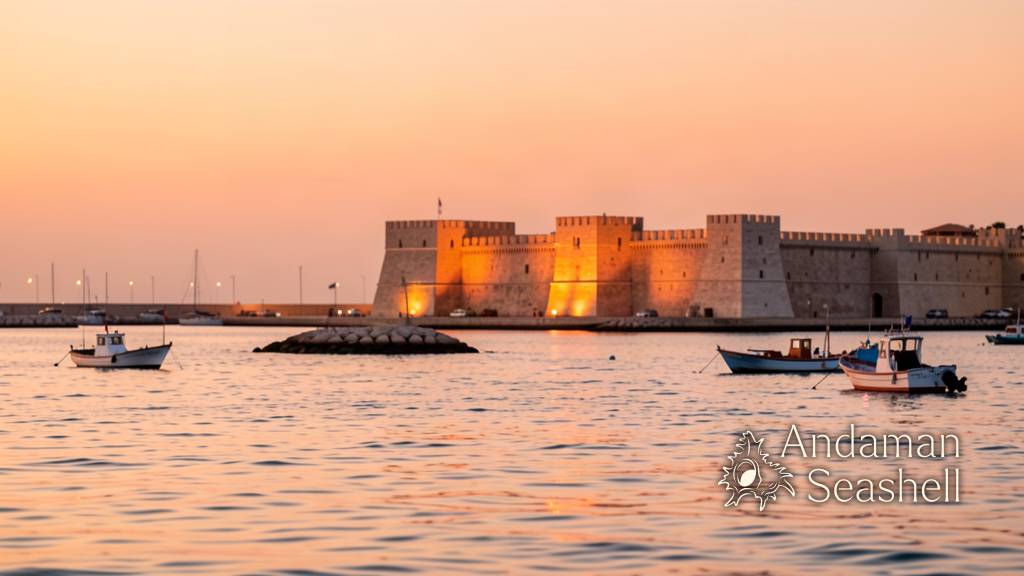
The Pharos itself is long gone — toppled by earthquakes, its stones carried off in 1477 to build the Qaitbay fortress that still guards the harbour mouth today [ref:3]. Walk that fortress rampart at dusk and you are, quite literally, walking on the lighthouse.
But the sea held one more keepsake. A bronze ring, lost in a palace office more than seventeen centuries ago, waited patiently beneath the harbour water to reintroduce us to the tallest building of the ancient world. The tallest thing on the coast, remembered by one of the smallest things on the seabed.


No comments yet. Be the first to share a thought.