



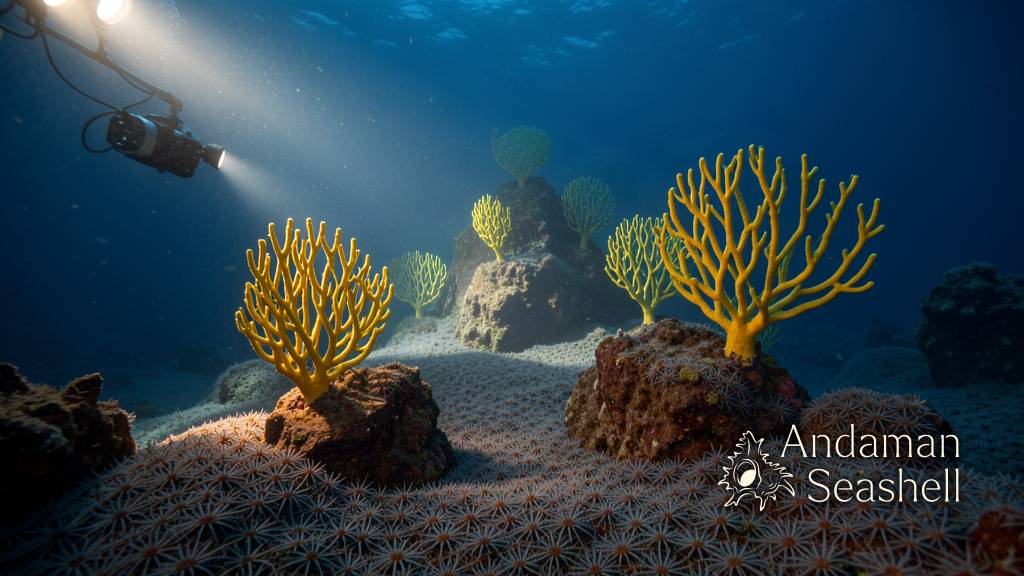
Two hundred leagues off Costa Rica's Pacific shore, a robot submarine's floodlights sweep across a rocky ridge half a kilometre down — and the dark seafloor answers in gold. Rising from the rock, metre after metre, stand branching yellow coral trees, and around their bases the ground is so thick with small, star-shaped brittle stars that the whole landscape seems to glitter. The researchers watching the live feed from the research vessel Falkor (too) would later say it looked like an elvish forest. Then the DNA tests came back, and the story got stranger [ref:1].
A forest nobody had catalogued
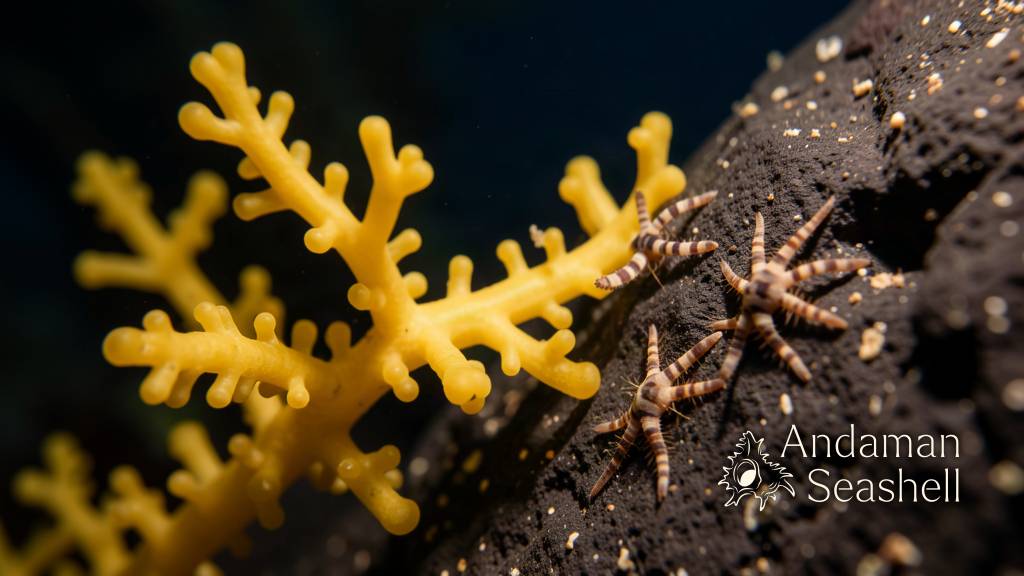
The coral was found growing between 360 and 529 metres below the surface — that is 1,180 to 1,735 feet down, in the twilight zone of the tropical eastern Pacific — on seamounts near Isla del Coco and along Costa Rica's Pacific margin. It was especially abundant on rocky outcrops where brittle stars, spiny relatives of starfish, covered nearly every available surface. Some colonies stand more than a metre tall, branching like young oaks, in a yellow so saturated it seems lit from within [ref:2].
Scientists collected specimens with the remotely operated vehicle SuBastian during expeditions in 2019 and 2023 aboard the Schmidt Ocean Institute's research vessels Falkor and Falkor (too). The first sighting goes back to that 2019 dive; the decisive samples came from the 2023 expedition, at a seamount site the team calls Las Gemelas II [ref:1].
When the DNA refused to answer
Here is where the chronicle turns properly mysterious. To place a new coral on the family tree, scientists usually sequence three genes that act like barcodes. The team, led by Dr Odalisca Breedy of the Universidad de Costa Rica, did exactly that — and each of the three genes pointed to a different, entirely unrelated family. Three witnesses, three different testimonies [ref:1].
So the researchers escalated. Using phylogenomics, a method that compares hundreds of genes at once, the molecular team — Cathy McFadden, Catalina Murillo and Andrea Quattrini — found the answer hiding in plain sight: the coral belongs to no known family at all. It is its own evolutionary lineage, closest to the family Eunicellidae, yet different enough in genetics and anatomy that the team had to build a new family around it. One species, one new genus, one new family: a triple debut, described on 30 June 2026 in the open-access journal ZooKeys [ref:2].
A name written in Elvish
When the time came to name their golden discovery, the scientists reached for a language invented on land, far from any ocean. The new genus, Laurinque, comes from "Laurinquë" — "golden tree" in Quenya, the Elvish language J.R.R. Tolkien created for The Lord of the Rings and The Silmarillion. The species name, elenya, means "of the stars" in the same tongue, a nod to the brittle stars crowding the coral's feet [ref:1].
Dr Breedy put it plainly: she saw the octocoral garden for the first time in 2019 and was impressed by the beauty of the landscape, which later inspired the elvish name. She assumed the species would fit a known family — until the morphology made clear it matched nothing on record [ref:3].
Why one new family matters
Species are described every year; whole families are not. A family-level discovery means an entire branch of the coral tree of life that science had never mapped — living, growing and glowing on seamounts that were, until recently, almost entirely unexplored. It is a reminder that the ocean's deep mountains hold lineages evolution has been writing for millions of years, waiting for a submarine with headlights to come read them [ref:2].
The golden trees still stand at Las Gemelas II, among their field of stars, with a name borrowed from Middle-earth and a family all their own. Somewhere between the pages of a taxonomic journal and the floor of the Pacific, wonder found a permanent address.
References
- ScienceDaily — 'This golden tree coral was too strange for any known family' (Oct 8, 2026)
- ZooKeys — 'A coral among stars: A new octocoral family from seamounts in the tropical eastern Pacific' (June 30, 2026)
- Phys.org — 'A coral among the stars: New species discovered on Costa Rica's deep-sea seamounts' (Aug 11, 2026)


No comments yet. Be the first to share a thought.