



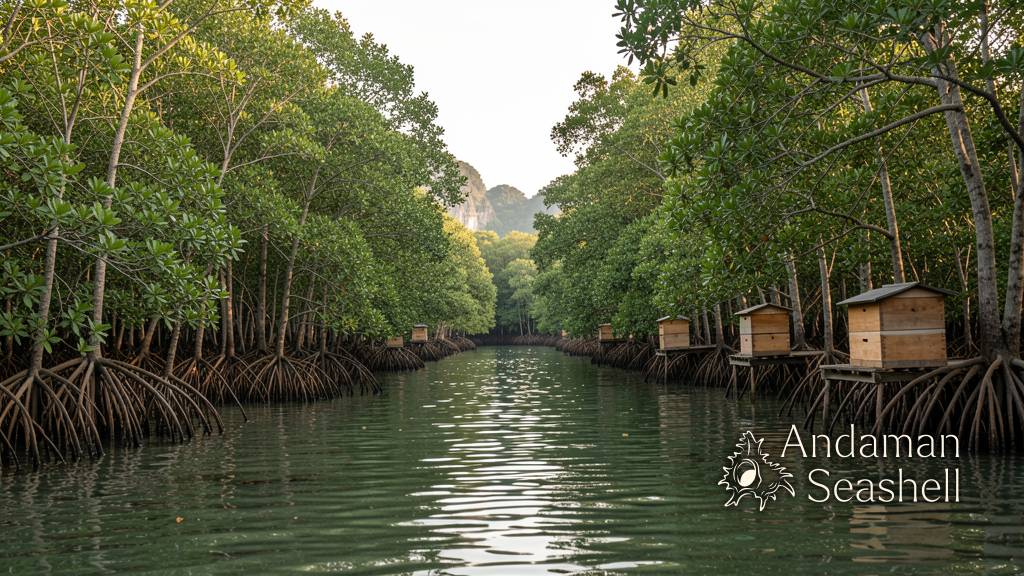
Walk into the mangrove forest at Ban Nai Nang on a still morning, and the first thing you notice is the sound — a low, warm hum rising from wooden hive boxes nestled among the stilted roots. The tide is out. Herons stand like ornaments in the shallows. And somewhere between the trunks of Avicennia alba and Sonneratia caseolaris, thousands of native honey bees are doing two jobs at once: making one of the most distinctive wild honeys on the Andaman coast, and quietly rebuilding the forest that protects it.
This is not a story about charity or grand policy. It is a story about a village of 1,700 people in Phang Nga Bay who looked at their coastline and decided that the answer was already living among the trees.
How Bees Became Forest Keepers
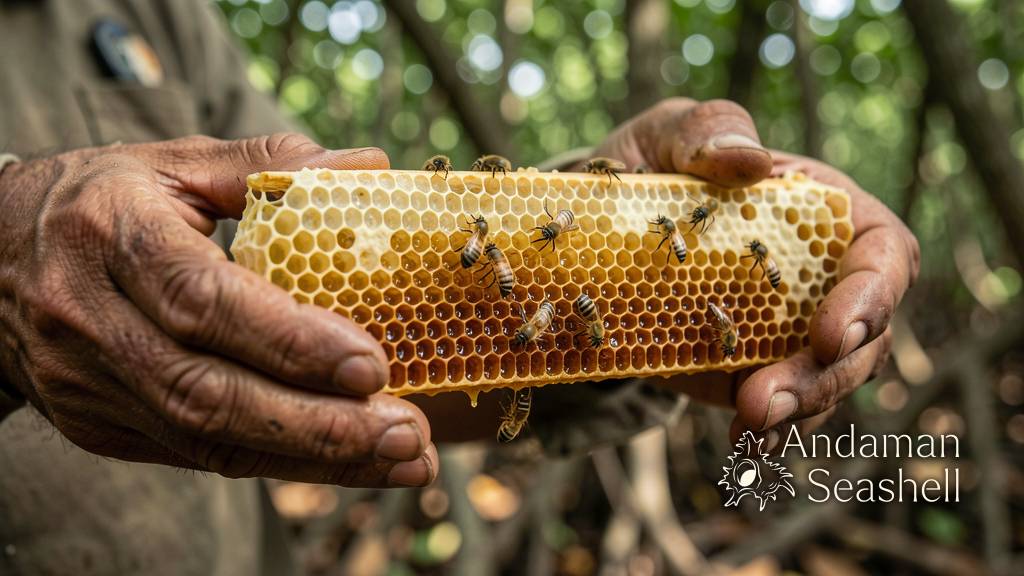
The beekeeping initiative launched in 2014, when the village partnered with the Mangrove Action Project (MAP), a nonprofit that had been working along the Andaman coast for over a decade [ref:1]. The idea was elegant in its simplicity: place beehive boxes near the mangrove forest, let native Apis cerana bees and around twelve species of stingless bees pollinate the flowering trees, and harvest the honey as a livelihood.
What the community discovered surprised even the scientists. The bees did not just make honey — they accelerated the forest's natural recovery. Pollination boosted flowering and fruiting across multiple mangrove species, especially the Xylocarpus trees that had previously struggled to reproduce. The forest grew back denser, more diverse, and more resilient [ref:2].
"We have realized that we're not raising the bees, the bees are raising us. The honey isn't the only thing we get from the bees." — Bang Sutee Pankwan, Nai Nang Apiculture Group
The Method Behind the Green
The restoration approach is called Community-Based Ecological Mangrove Restoration, or CBEMR, and it is fundamentally different from the government tree-planting campaigns that dominated the 1990s and 2000s. Those campaigns often planted a single species — Rhizophora — in neat rows across abandoned shrimp ponds, only to watch the seedlings drown in waterlogged ground.
CBEMR takes the opposite philosophy. As Jim Enright, MAP's former Asia coordinator, put it: "Fix the problem that's preventing the ecosystem from self-restoring, and then allow nature to take its course" [ref:1]. That means restoring tidal water flow, ensuring mature seed-source trees stand nearby, and then letting the forest regenerate on its own terms. The bees, it turns out, are nature's enthusiastic assistants in that process.
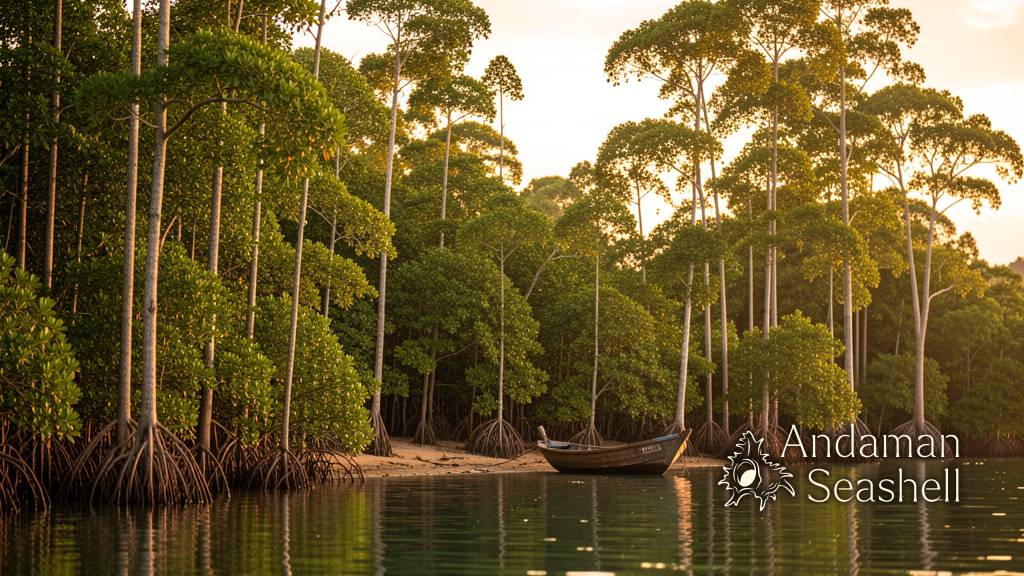
The results are visible. On restored sites that were once barren shrimp ponds, mangrove trees now stand over six metres tall, their canopies alive with mixed-age, mixed-species growth that looks nothing like a plantation and everything like a real forest [ref:1].
Honey With a Hint of Sea
The craft side of the story is just as compelling. Ban Nai Nang's 32 beekeeping families manage roughly 1,200 hives across a community forest of more than 600 hectares [ref:1]. The honey itself carries a signature: because the bees forage on mangrove species that grow in brackish, tidal water, the honey has a distinctive taste with what beekeepers describe as a gentle hint of sea salt.
Ten percent of all honey profits flow back into a community conservation fund that supports ongoing mangrove protection [ref:2]. The village's Women's Group has expanded the range into value-added products — soaps, shampoos, balms, and lotions — sold to visitors and businesses across Krabi and Phuket.
The stingless bee honey is especially prized. Rich in propolis, a resin-like substance with documented medicinal properties, it commands premium prices and has become a symbol of what a healthy mangrove ecosystem can offer when it is allowed to thrive.
A Model Spreading Along the Coast
What makes this story ripple outward is the peer-to-peer sharing model. Ban Nai Nang has already trained 15 community groups across eight districts in Krabi province, covering beekeeping, mangrove conservation, marketing, and conservation-fund setup [ref:1]. The approach is built on a simple trust: villagers learn best from other villagers who have done it themselves.
This matters for the entire Andaman coast. Mangrove forests are among the most productive ecosystems on Earth — they store carbon at rates that dwarf terrestrial forests, they shelter the juvenile fish and shellfish that sustain local fisheries, and they stand as a living buffer between the sea and the communities behind it [ref:2]. Every hectare restored is a kilometre of coastline made safer and a stretch of water made richer.
The Sweetest Defence
There is something deeply hopeful about a model where the thing that tastes good is also the thing that does good. The beekeepers of Ban Nai Nang did not wait for a perfect solution. They started with what they had — bees, knowledge, and a forest they refused to give up on — and built something the entire region can learn from.
The next time you taste wild honey from the Andaman coast, let it sit on your tongue for a moment. That faint saltiness is not just flavour. It is the taste of a forest growing back, of families building livelihoods from craft, and of a coastline learning to defend itself — one hive, one tree, one tide at a time.


No comments yet. Be the first to share a thought.