



A little after breakfast in the Cook Islands, a robot begins dropping through dark blue water while anyone with an internet connection can watch. That is the unusually generous pleasure of the 2026 Cook Islands ROV Exploration: a 26-day research cruise that turns real deep-ocean fieldwork into a front-row public experience.[ref:1][ref:2]
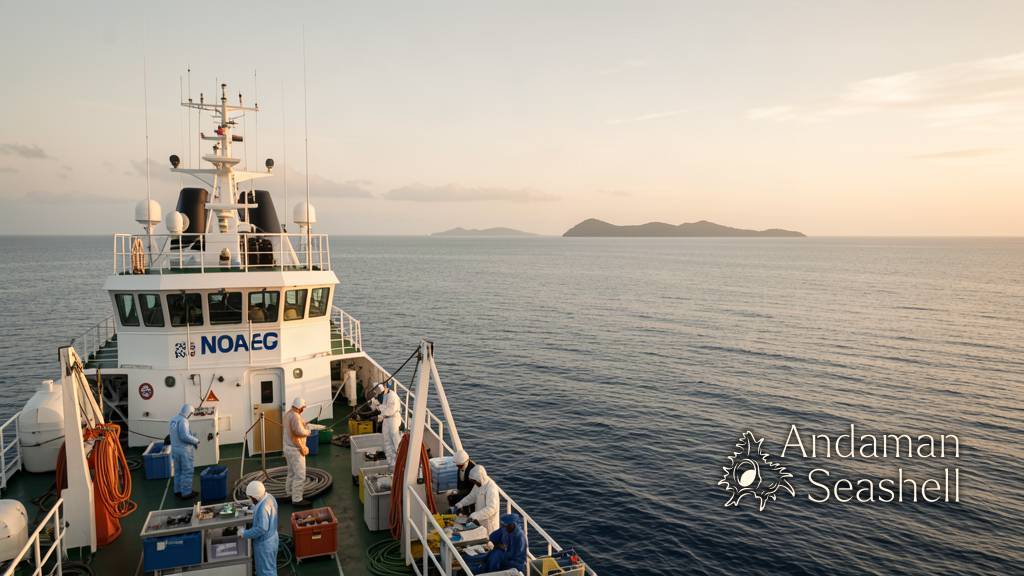
The expedition began on 2026-07-19 and runs through 2026-08-13 aboard NOAA Ship Okeanos Explorer, a vessel working with the Cook Islands Seabed Minerals Authority and other partners to map, explore, and characterize deepwater habitats off the islands.[ref:1][ref:3] The scale alone is enough to reset your sense of proportion. The Cook Islands has 15 islands but nearly 2 million square kilometers of surrounding ocean, and the average depth inside its Exclusive Economic Zone is about 5,000 meters.[ref:1][ref:3] In many places, the water is deeper than 2,500 meters, which is why this cruise focuses on tools that can see and work where divers never could.[ref:1]
What the expedition is actually doing
This is not a vague “ocean awareness” voyage. NOAA’s plan is highly specific. The ship is using multibeam sonar to fill gaps in mapping data, ROV dives to inspect seafloor habitats, CTD-mounted sensors and other instruments to describe the water column, and Argo floats to add wider ocean observations.[ref:1][ref:4] During dives, the team explores seamounts, knolls, plateau features, and abyssal plains at depths ranging from roughly 2,500 to 6,000 meters.[ref:1][ref:2]
That depth range matters because the underwater landscape changes with it. A seamount ridge can host one kind of community; a flatter abyssal plain can host another. NOAA’s stated goal is to compare those habitats, document the animals living there, and build a baseline that can help Cook Islands decision-makers understand what exists in these waters before future choices are made.[ref:1][ref:4]
Why this cruise is fun to follow from shore
The lovely twist is telepresence. Most days during the active dive window, the public can tune into three live camera feeds while scientists and ROV pilots talk through what they are seeing.[ref:2] NOAA even notes that the red laser dots visible in the video are set 10 centimeters apart, giving viewers a built-in sense of scale.[ref:2] On 2026-08-04, for example, Dive 11 was scheduled to begin near the Cook Islands’ northern boundary with American Samoa at about 5,600 meters depth, with estimated launch, seafloor arrival, and departure times shared publicly.[ref:2]
The dives are not just scenic. They are already producing memorable details. On Dive 04, which started at 2,900 meters on a western seamount ridge, the team reported glass sponges attached to nodule-covered seafloor, a crinoid perched on a sponge stalk, two larger polymetallic nodules collected for geochemical work, one primnoid octocoral collected for DNA voucher and isotopic analysis, and five water samples, including one for environmental DNA.[ref:4] That is the kind of concrete field science that makes the deep sea feel legible rather than abstract.
Dive 09, on 2026-07-29, moved across a rugged abyssal plain at around 5,600 meters and found dense nodule coverage, sponges, sea cucumbers, polychaete worms, snails, a nudibranch, and a cusk eel in the family Ophidiidae.[ref:5] The public-facing bonus was a live interaction with Cook Islands Prime Minister Mark Brown, who remotely guided the collection of a very large shark tooth during the dive.[ref:5]
The best small fact so far: the shark teeth
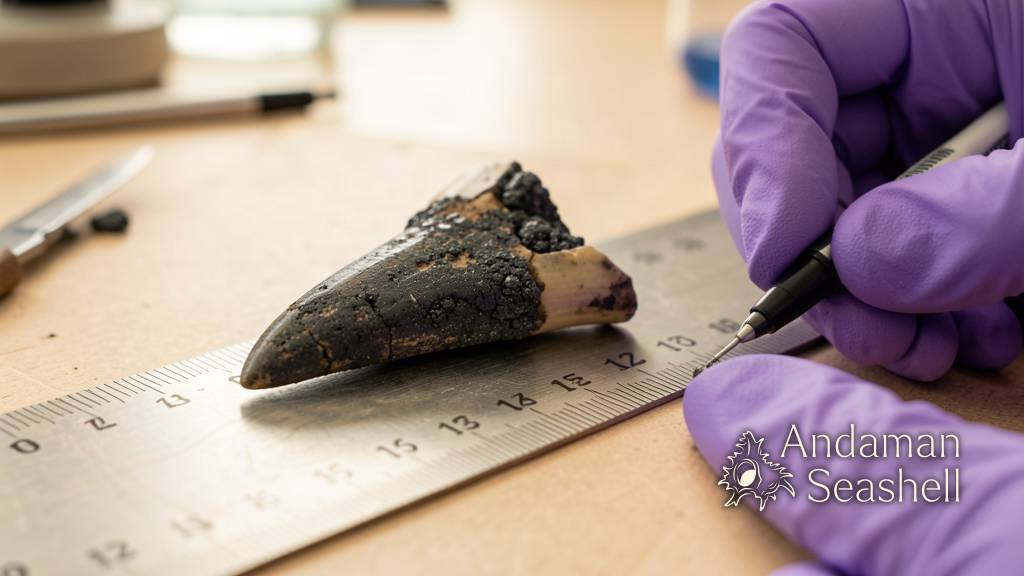
One of the most shareable discoveries is wonderfully tactile. NOAA says seven shark teeth were collected during several dives, and many measured more than seven centimeters long.[ref:6] The largest reached 13 centimeters — about five inches — and, based on size, many likely belonged to megalodon sharks.[ref:6] Better still, these are not just dramatic souvenirs. NOAA explains that fossil fish teeth can absorb trace and rare earth elements such as neodymium, making them useful for reconstructing past ocean circulation patterns, and they can even act as nuclei around which polymetallic nodules grow over millions of years.[ref:6]
A scientific invitation, not a closed room
That may be the most attractive thing about this whole project. It is big science with open doors. SBMA has Cook Islands team members rotating aboard the ship, including Chloe Ane Wragg, Tanga Morris Jr., Dr. John Parianos, and Rima Browne, so the voyage is also building national capability in knowledge management and deep-sea science.[ref:3] NOAA says the expedition’s data will be submitted to public archives within 120 days after completion, while the live video is making the process visible right now.[ref:1][ref:2]
For readers who like science best when it feels immediate, this cruise is a gift: a map still being drawn, an ocean still introducing itself, and a public invitation to watch discovery happen in real time.
References
- NOAA Ocean Exploration — 2026 Cook Islands ROV Exploration
- NOAA Ocean Exploration — Livestream status page
- Cook Islands SBMA — expedition media release
- NOAA Ocean Exploration — Dive 04: Seamount B1
- NOAA Ocean Exploration — Dive 09: Southern Boundary Abyss
- NOAA Ocean Exploration — Shark teeth feature


No comments yet. Be the first to share a thought.