



The crab comes up in the net trailing a cluster of orange eggs, and the fisher's hands slow. Instead of dropping it into the day's catch, she cradles the mud crab—Scylla serrata—and carries it across the pier to a floating bamboo enclosure bobbing in the shade of mangrove prop roots. By the time the tide rises tonight, those eggs will have hatched, and thousands of larvae will drift into the waterways of Ban Sam Chong.
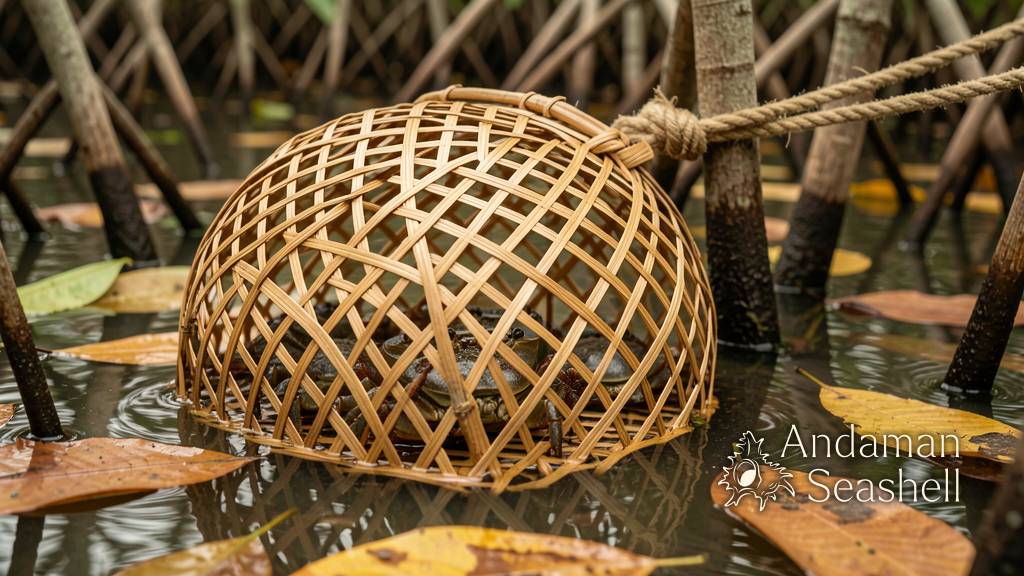
This is the village's crab bank: a simple, low-cost conservation practice that has been gaining traction across Thailand's coastal communities for over a decade [ref:1]. The premise is straightforward. When fishers catch egg-bearing female crabs—recognizable by the bright orange or brown egg mass tucked beneath their apron—they deposit them in communal enclosures rather than selling them at market. Once the larvae release naturally, the mother crabs go back to the sea or, in some villages, are sold to cover operating costs.
Where Three Canals Meet
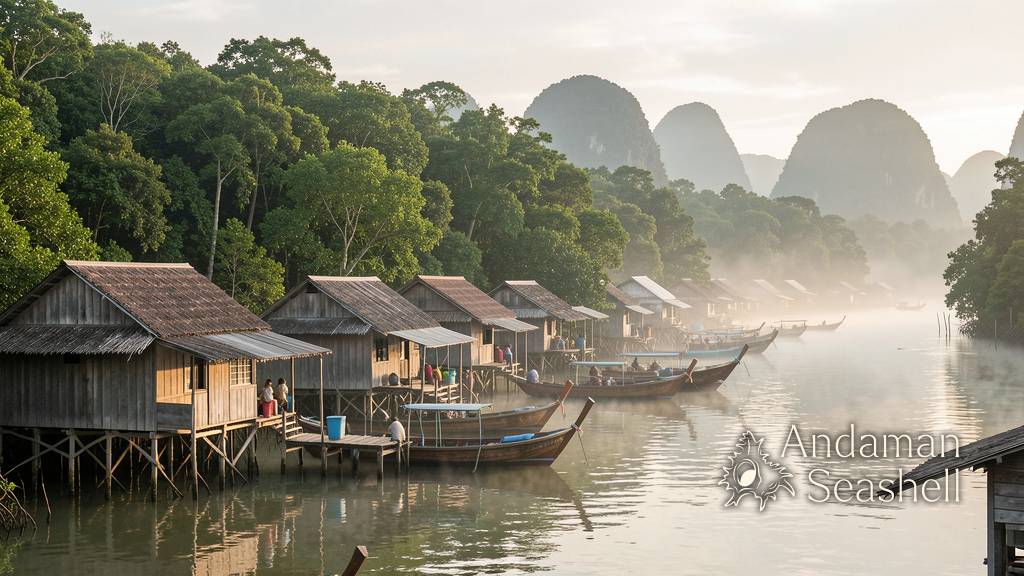
Ban Sam Chong sits in Kalai Subdistrict, Takua Thung District—about an hour's drive from Phang Nga town. The name itself tells its geography: sam chong means "three canals," referring to Khlong Bang Lam, Khlong Chiang Mai, and Khlong Ta Jo, which converge here before emptying into Phang Nga Bay [ref:2]. The village is split between two settlements—Sam Chong Tai on the mainland cliff, home to around 100 households, and Sam Chong Nuea on a separate island of roughly 250 households, connected by a five-minute boat crossing.
The mangrove forests that fringe these canals are the economic backbone. Locals harvest mud crabs and blue swimming crabs (Portunus pelagicus), raise fish in floating baskets, and collect ark shells at low tide. More recently, green-season visitors have come for longtail-boat tours, kayaking through the mangroves, and overnight homestays where the menu features steamed telescope snails with spicy dip and coconut-milk curry with local cockles.
How the Crab Bank Works
The mechanics are deceptively simple [ref:3]. Fishers bring gravid females to a central collection point—often a floating pen made from bamboo slats or netting, anchored near mangrove roots where water salinity and temperature remain stable (around 28 PSU and 28–32 °C). The crabs stay for a few days until their eggs hatch. A single female blue swimming crab can carry roughly one million eggs; even with the brutal attrition of ocean survival, that translates to an estimated 160 crabs reaching maturity per brood.
The community sets its own rules. In many villages, no one may harvest crabs smaller than a certain carapace width, and the reproductive closure month—when crab catches are voluntarily suspended—is observed collectively. Enforcement is social rather than legal: everyone knows whose boat is out of line.
The Payoff: More Crabs, Stronger Mangroves
Documented outcomes from similar crab-bank programmes elsewhere in Thailand are encouraging. In Trat Province's Pred Nai community, crab harvests rose from 8 kg per day among six collectors to 15 kg per day among 30 collectors over a five-year span—nearly doubling per-capita income for participants [ref:1]. In Bandon Bay, Surat Thani, juvenile crab yields climbed significantly within four to eight months of launching a crab bank, even as overall fishing pressure remained steady [ref:3].
For Ban Sam Chong, the benefits ripple outward. Healthy crab populations mean robust mangrove ecosystems: crabs aerate the sediment, process organic detritus, and form a crucial link in the food web that sustains fish, birds, and even the monitor lizards that sun themselves on the canal banks. Visitors who come for the kayak tours and sunrise boat trips are, in effect, paying for ecosystem services—generating tourism revenue that reinforces the incentive to keep the mangroves intact.
Visiting Ban Sam Chong
The village is accessible year-round, though the green season (May–October) brings quieter waters and fewer crowds. A standard day trip includes a longtail-boat ride through the mangrove channels, a stop at the crab nursery, and a walk to see the "Love Trees"—a pair of 70-year-old Avicennia mangroves that have grown together in the shallows and are visible only when the tide drops [ref:2]. Homestay options let visitors stay overnight, waking to the call to prayer and the splash of fishers heading out before dawn.
To reach Sam Chong Tai, drive from Phang Nga town toward Takua Thung, turn right at the Ban Sam Chong junction, and continue past the Mangrove Forest Research Centre until you reach the southern village pier. From there, a short boat ride (20 baht fare) brings you to Sam Chong Nuea on the island.
A Model That Travels
Crab banks have now spread to Cambodia, Indonesia, and Vietnam, adapted to local species and governance structures [ref:3]. Thailand's Department of Fisheries actively supports the model, and GCF-funded climate-adaptation projects are scaling marine life banks along the Gulf and Andaman coasts [ref:4]. What makes Ban Sam Chong notable is not its uniqueness but its ordinariness: a village that found a practical way to keep catching crabs by catching fewer of them at the right time.
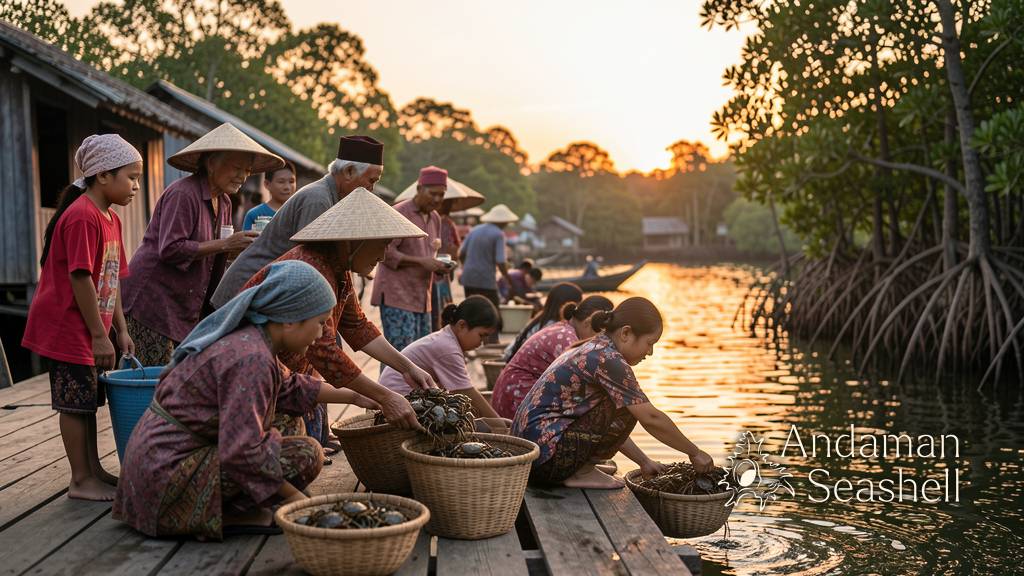
Standing on the pier at dusk, watching a cluster of fishers lower baskets of young crabs into the outgoing tide, the logic feels intuitive. The mangroves gave them a livelihood; the crab bank gives the mangroves a future. The exchange is not charity—it is common sense, woven into the rhythm of tides and generations.


No comments yet. Be the first to share a thought.