



The Nautilus Survived 500 Million Years — and Its Famous Spiral Isn't What You Think
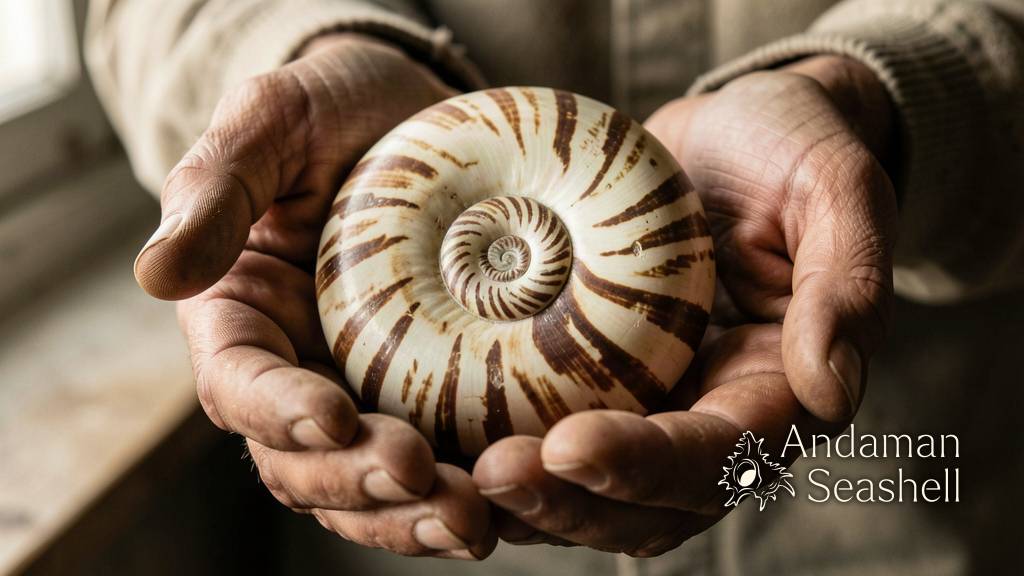
Pick up a nautilus shell and the first thing you feel is weight. This is not a fragile thing. It sits in your palm like a smooth stone, dense and cool, its cream-and-russet stripes catching the light in bands. Turn it slowly and the spiral tightens inward, chamber after chamber, until the eye loses the thread and the shell becomes a single glowing curve.
This animal has been building that shell for roughly 500 million years. Nautiluses appeared in the Late Cambrian oceans and have remained essentially unchanged ever since — older than trees, older than insects, older than the first four-legged animals that crawled onto land [ref:2]. They survived every major extinction event the planet has thrown at life. The dinosaurs came and went. The nautilus stayed.
A Cousin With 90 Tentacles
The nautilus — scientific name Nautilus pompilius — is a cephalopod, which places it among octopuses, squids, and cuttlefish. But while an octopus has eight arms and a squid has ten, the nautilus goes further: it has more than 90 tentacles, and they have no suckers. Instead, they are coated in a sticky substance that grips prey — crabs, lobsters, small fish — which the nautilus then crushes with a heavily calcified beak [ref:1].
An adult nautilus carries a shell typically 5 to 9 inches across and weighs at least two pounds. It can live 15 to 20 years — a remarkably long span for a cephalopod, most of whose cousins die in a fraction of that time [ref:1].
Thirty Sealed Rooms and a Built-In Submarine
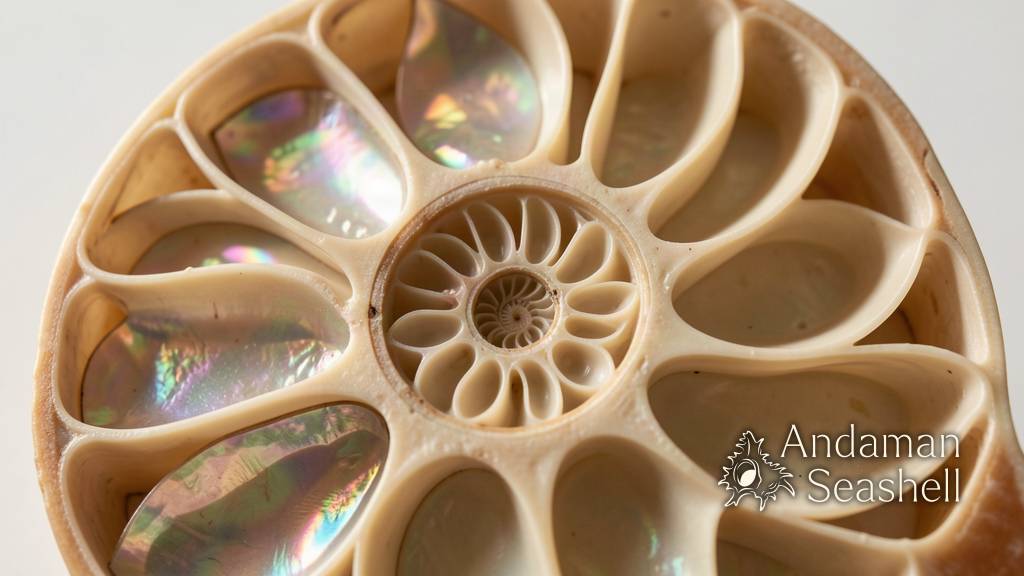
The shell's interior is what makes the nautilus an engineer. Cut one open and you see a spiral corridor of sealed chambers — up to 30 in a full-grown adult. The animal lives only in the outermost room. The rest are filled with gas and seawater in carefully adjusted ratios [ref:3].
By pumping liquid and gas in and out of these chambers through a tube called the hyponome, the nautilus controls its buoyancy the way a submarine does. Flood a chamber, and it sinks. Empty one, and it rises. The same hyponome also works as a jet nozzle, squirting water backward to propel the animal through the dark [ref:1].
There is a limit, though. Below about 800 metres — roughly 2,600 feet — the water pressure exceeds what the shell can withstand, and it would implode. So the nautilus stays above that depth, hunting the slope waters of the western Pacific and Indian Oceans where tropical currents keep things warm [ref:2].
The Math Myth Everyone Loves
Here is the part that surprises people. For decades, the nautilus shell has been held up as nature's poster child for the golden ratio — that famous number, approximately 1.618, also called phi, which appears in art, architecture, and countless pop-math books. The claim is that the nautilus spiral grows by exactly that ratio with each quarter turn, fitting a perfect golden rectangle.
It does not.
When researchers actually measure the shell, the ratio of each successive turn comes out closer to 1.33:1 — not even close to 1.618 [ref:4]. The nautilus spiral is logarithmic, meaning it widens at a constant rate, but it is not the golden spiral. It follows its own elegant geometry, one that served this animal perfectly well for half a billion years without needing to match a number humans find beautiful.
In a way, the correction makes the shell more interesting, not less. The nautilus did not borrow its design from our mathematics. We borrowed our myths from its shell.
Seven Species We Are Still Learning About
For a creature so famous, the nautilus remains surprisingly mysterious. NOAA Fisheries currently recognises seven species across two genera — Nautilus and Allonautilus — though the taxonomy is still debated among scientists [ref:1]. In 2023, conservation biologist Gregory Barord and his colleagues described three entirely new species from the Coral Sea and South Pacific: Nautilus vitiensis, N. vanuatuensis, and N. samoaensis [ref:2].
The discovery method is wonderfully old-school. Researchers bait steel-and-mesh traps with raw meat, lower them to 300 metres at dusk, and haul them up the next morning full of nautiluses. The animals are measured, photographed, and returned — carefully, because a nautilus brought to the surface too fast can trap air bubbles in its shell. Researchers do something called "nautilus burping": swimming the animal down 30 metres to release trapped air before letting it descend on its own [ref:2].
A Slow Life That Asks for Patience
The nautilus grows slowly, maturing at 10 to 15 years of age. Its eggs take at least a year to hatch. A female produces only a small number of them across her long life [ref:1]. This life strategy — slow, steady, invested — worked beautifully for hundreds of millions of years. But it also means that when populations are pressured, they recover at a glacial pace.
Because of that vulnerability, the chambered nautilus was listed as Threatened under the U.S. Endangered Species Act in 2018, and the entire nautilus family was added to CITES Appendix II in 2016, meaning all international trade in nautilus shells now requires permits to ensure it is sustainable [ref:1]. The beauty that made the shell famous in markets and jewellery shops is the same beauty that put the animal at risk.
The good news is that awareness is growing, protections are in place, and researchers like Barord are still finding new species — proof that the ocean's oldest spiral architect still has secrets to share.
What a Shell Can Teach
Hold a nautilus shell to your ear and you will not hear the ocean. But you will hold something older than every forest on Earth, built by an animal with 90 arms and a submarine's instincts, following a geometry it perfected long before anyone thought to name it.
It does not need the golden ratio to be beautiful. It needs only time, deep water, and the chance to keep going.


No comments yet. Be the first to share a thought.