



A tiny point of light can carry a huge story. In Euclid’s new sky survey, astronomers found 31 ancient quasars—brilliant galaxy cores powered by feeding supermassive black holes—and two of them were already shining when the universe was only about 670 million years old, roughly 5% of its current age.[ref:1][ref:2]
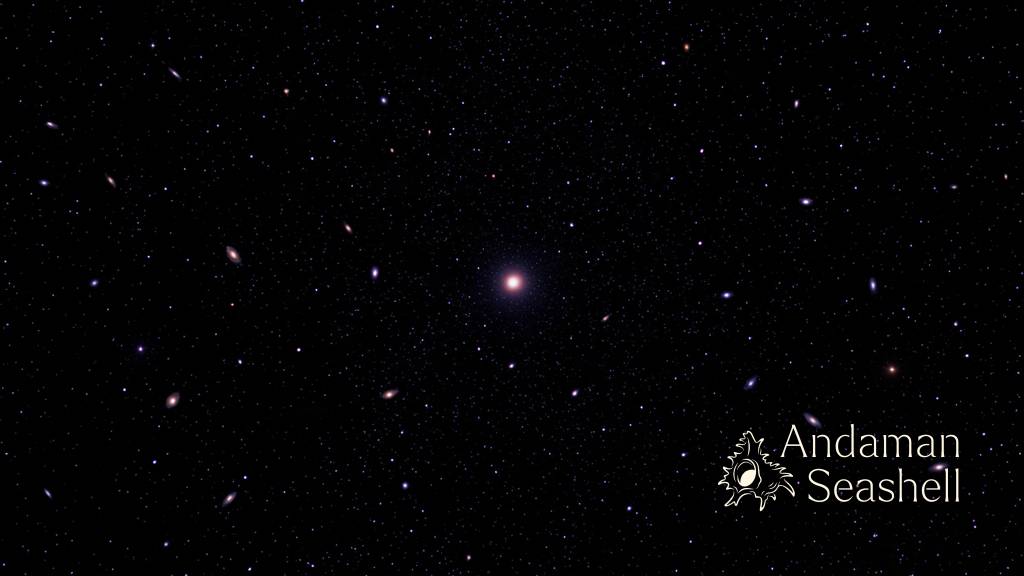
That is what makes this discovery feel so delightful: these are not just distant dots, but working lighthouses from cosmic dawn. ESA announced the result on 2026-07-06, and the underlying study in Astronomy & Astrophysics reports quasars spanning redshifts 6.6 to 7.8—an interval that reaches into the universe’s first billion years.[ref:1][ref:3]
What Euclid actually found
A quasar appears when huge amounts of gas and dust spiral toward a supermassive black hole at the center of a galaxy. Friction and gravity heat that material to extraordinary temperatures, releasing so much energy that the quasar can outshine all the stars in its host galaxy combined.[ref:2] In this new sample, the two earliest objects are especially dazzling: ESA says they shone with the light of about a trillion Suns.[ref:1]
The numbers are the part worth slowing down for. Of the 31 newly identified quasars, 12 date to the universe’s first 770 million years, and 14 have redshifts of 7 or higher.[ref:2][ref:3] The current record-holder is EUCL J172902.75+641018.1 at redshift 7.77, followed closely by EUCL J125308.55+705432.3 at redshift 7.69.[ref:1] The previous record-holder, discovered in 2021, had a redshift of 7.64, so Euclid has pushed the known frontier a little farther back.[ref:1]
Why this was so hard before
Ancient quasars are rare, and they love to hide in plain sight. Their light is faint by the time it reaches us, and in ordinary imaging they can resemble much closer stars in our own Milky Way.[ref:2][ref:3] There is another challenge too: because the universe has been expanding for billions of years, the ultraviolet light from these distant quasars gets stretched into the near infrared.[ref:3]
From the ground, that is awkward territory because Earth’s atmosphere glows in near-infrared wavelengths, making extremely faint targets harder to isolate.[ref:3] Euclid has an elegant advantage here. Launched in July 2023 and conducting routine science observations since 14 February 2024, the space telescope observes above the atmosphere and can combine wide-area coverage with deep, sharp infrared-sensitive imaging.[ref:1] ESA says the Euclid Wide Survey will eventually cover more than one-third of the entire sky while mapping billions of galaxies.[ref:1][ref:2]
That combination is the real breakthrough. For years, astronomers found only a handful of the brightest ancient quasars. The new paper more than doubles the known population of quasars from this extreme era, and ScienceDaily notes that it took more than a decade to find roughly the first 10 quasars with redshift 7 or above.[ref:3] Euclid has already moved that count forward in a single year.[ref:3]
Why astronomers are smiling about it
These objects are wonderful because they are both beautiful and useful. They sit inside the epoch of reionisation, the transitional era when the young universe shifted from cold, dark, neutral gas to a cosmos lit and transformed by the first energetic sources.[ref:1] In other words, quasars like these help researchers study how the first giant black holes formed, how early galaxies built themselves, and how the wider universe changed around them.[ref:2][ref:3]
One especially vivid detail comes from follow-up work on the second most ancient quasar. ESA reports that it sits inside a dusty, gas-rich galaxy that is furiously forming new stars, giving astronomers a glimpse of what the host of an early supermassive black hole may have looked like.[ref:1]
The next chapter
Euclid’s discovery is only the opening move. NASA notes that the mission’s dark-universe mapping will also help inform future work with the Nancy Grace Roman Space Telescope.[ref:2] Meanwhile, the teams behind this study are already aiming higher: they want to find the first known quasar beyond redshift 8, which would reveal a beacon from within the universe’s first 630 million years.[ref:3]
For readers who love a simple image, this may be the nicest way to hold the story in your head: Euclid scanned a huge, quiet stretch of sky and found 31 tiny lamps still burning from the universe’s early morning. Each one is small to our eyes, but together they make the young cosmos feel brighter, busier, and much more alive.


No comments yet. Be the first to share a thought.