



Steady, golden, and quietly beautiful — that bright point hanging in the evening sky this month is Saturn, and it just gave the whole world a wonderful surprise. On 2 September 2026, ESA and NASA announced that the Hubble Space Telescope has tracked a brand-new ten-sided atmospheric wave — a "decagon" — taking shape around Saturn's south pole [ref:1]. It is the first time a large, straight-sided jet pattern has ever been observed in the planet's southern hemisphere [ref:2].
A polygon made of wind
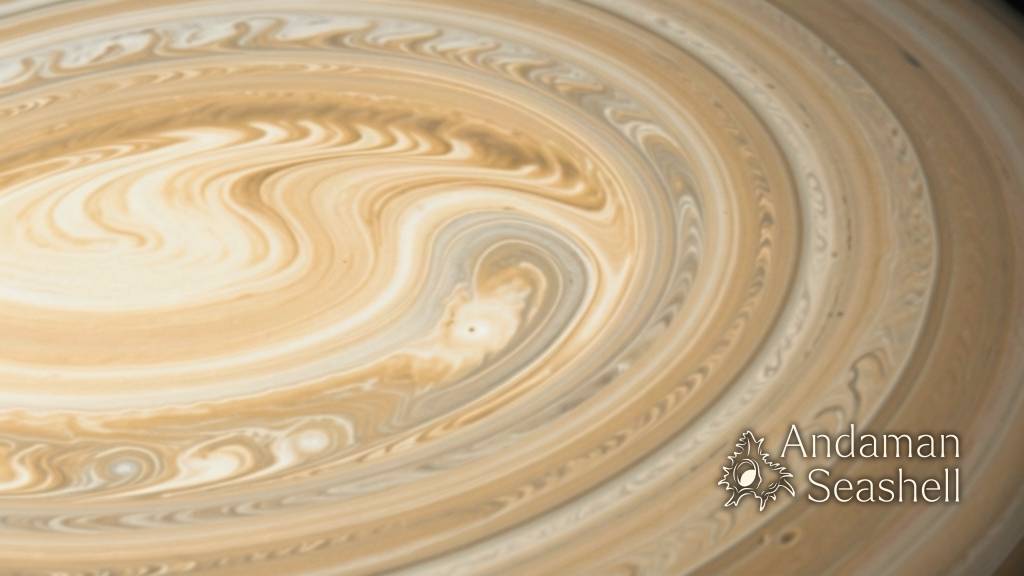
Saturn is a gas giant, which means there is no ground to stand on — just layer after layer of atmosphere, stirred by ferocious jet streams. The new decagon sits inside one of those jet streams, and here is the part that makes planetary scientists smile: it is not just a surface decoration. The wave extends through multiple layers of the atmosphere, making it a tall, vertically extended structure rather than a single cloud feature [ref:1].
There is even a poetic clue hidden in the data. The decagon's apparent position shifts slightly depending on the wavelength used to observe it — because different wavelengths probe different altitudes in Saturn's atmosphere. Look through one filter and the shape sits in one place; switch filters and it drifts. The decagon is, in effect, a three-dimensional sculpture we can only see slice by slice [ref:1].
The hexagon's little sibling
Saturn's north pole has worn its famous hexagon for more than forty years. "The northern hexagon has been there every time we've looked for more than 40 years," said Amy Simon of NASA's Goddard Space Flight Center, a co-author of the study. "This feature is different — it appears to be strengthening, giving us the rare opportunity to watch a giant atmospheric pattern develop" [ref:1].
Nobody saw the southern twin coming. The Cassini spacecraft orbited Saturn from 2004 to 2017 and photographed the planet in extraordinary detail — and showed no inkling of a long-lived southern formation. Only later, when Saturn's slowly shifting seasons tilted the south pole back into view from Earth, did the new wave reveal itself. Piecing together years of observations, researchers found that Hubble's archive already held subtle hints of the structure in images from 2023 [ref:1].
The results are published in the journal Science Advances, led by Agustín Sánchez-Lavega of the University of the Basque Country [ref:1].
Backyard astronomers saw it first
Here is the most heartwarming part of the story: some of the earliest hints did not come from a giant observatory. They came from ground-based images submitted to the Planetary Virtual Observatory Laboratory, a website run by the University of the Basque Country that collects planetary photos from observers all over the world. In those images, first in 2024, Sánchez-Lavega and amateur astronomers Trevor Barry and Jean-Paul Oger noticed a subtle undulating band along the southern pole. Additional imagery from 2025 hinted even more strongly at the ten-sided structure — and that is when Hubble stepped in to confirm it from space, free from the blur of Earth's atmosphere [ref:1].
The discovery is also a gift of patience. Hubble's Outer Planet Atmospheres Legacy program — OPAL — has photographed the outer planets annually for more than a decade. "A lot of the discoveries we see coming from OPAL are not just based on one observation, but on years and years of data," said co-author Mike Wong of the University of California, Berkeley [ref:1]. Yearly portraits, stacked together, turned a slow ripple into a front-page discovery.
What happens next
The team will keep watching to see whether the decagon settles into a long-lived, stable configuration like its northern sibling, or keeps evolving into something new. Further observations from Hubble and the James Webb Space Telescope, plus computer modelling, should reveal what drives the wave — and what it teaches us about giant-planet weather everywhere [ref:1].

Try tonight
Saturn is one of the headline targets in NASA's skywatching guide for September 2026 [ref:3]. You don't need a decagon-sized telescope: even a small backyard scope shows the rings, and this month the planet is well placed in the evening sky. Find the steady golden "star" that doesn't twinkle, and you're looking at the planet that is, right now, growing a new shape.
We are the generation watching a giant planet change in real time — one patient photograph at a time.


No comments yet. Be the first to share a thought.