



On October 24, 2025, Robert Wagner, an image analyst on NASA's Lunar Reconnaissance Orbiter team, was doing one of the quietest jobs in planetary science — comparing old maps of the Moon against new ones, hunting for changes wider than 150 feet. Usually the software hands him nothing but shadows and false signals. That day, what appeared was a vast bright patch ringed by dark, covering hundreds of pixels. "I immediately stopped everything and started figuring out what that spot was," Wagner later recalled [ref:2].
What he had found was McGetchin — a fresh impact crater on the Moon's eastern rim, and the largest newly formed crater ever identified anywhere in the solar system. The research was published on September 16, 2026, in two companion papers in Science Advances [ref:1][ref:3].
A visitor nobody saw
Sometime between April 11 and May 22, 2024, an asteroid or comet roughly the size of a three-to-six-storey building slammed into the lunar surface. The Moon has no atmosphere to slow it down or burn it up the way Earth does, so the object arrived at full speed — silently, with no witness [ref:2].
The result is a crater 728 feet (222 metres) wide — about two football fields laid end to end — and 141 feet deep. Stack three yellow school buses nose-to-tail and they would still fit inside. Scientists estimate an impact of this scale happens on the Moon roughly once a century, or less. The crater was named in honour of Tom McGetchin, a towering figure in lunar science [ref:1][ref:2].
How do you catch an invisible impact?
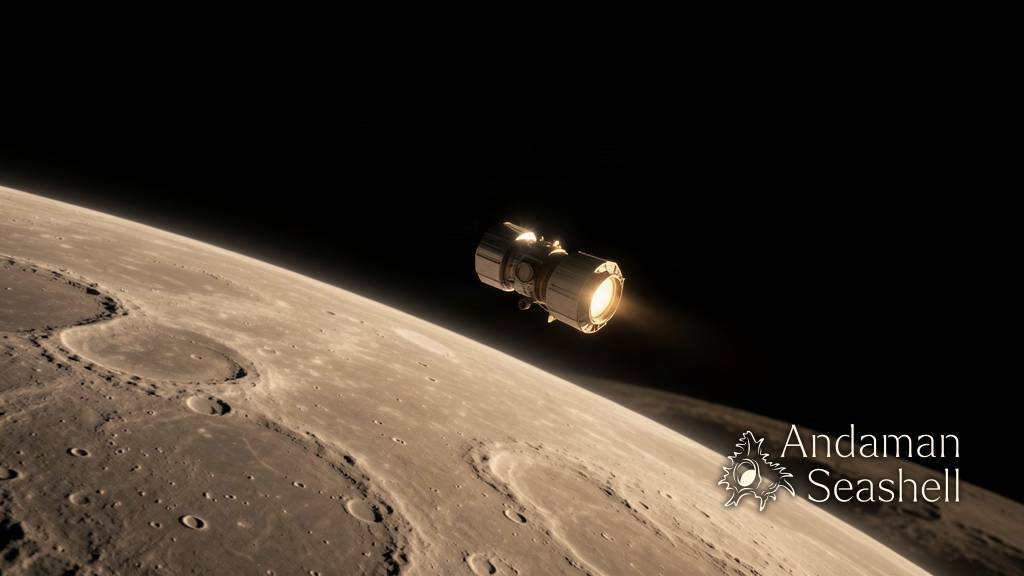
LRO has circled the Moon for more than 17 years, carrying seven instruments about 60 miles above the surface. The team's method is a lesson in patience: stack hundreds of "before" and "after" images on top of each other. Unchanged ground shows as gray; anything new glows brighter — or darker — than it did before [ref:2].
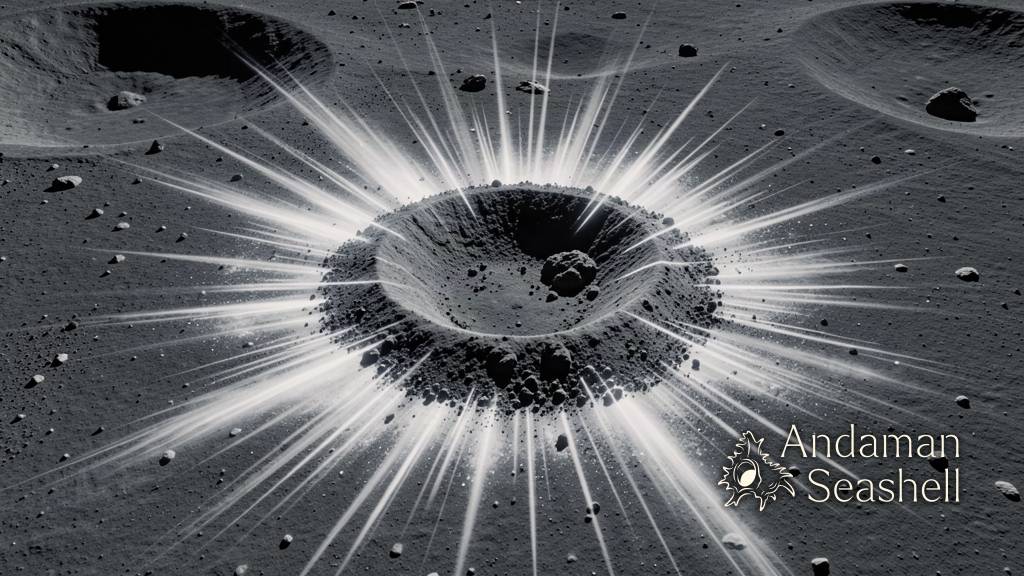
Fresh small craters usually appear as a faint halo around a single pixel. McGetchin was unlike anything the team had seen. "It's the clearest ejecta pattern I have ever seen in these images," Wagner said [ref:2]. So the team turned to the Narrow-Angle Camera, with resolution of roughly 3 feet per pixel, to measure the crater's size, shape, and surrounding debris field with precision [ref:1].
A mysterious cold zone four miles wide
Then the story got stranger. When scientists aimed LRO's Diviner temperature instrument at the site, they found that a zone about 4 miles (roughly 6 kilometres) across surrounding the crater cools at night by about 16 degrees Fahrenheit more than the ground beyond it [ref:2].
The second paper, published the same day, explains why: the impact's shock loosened the lunar soil — the regolith — reducing its density so it radiates heat away faster after sunset [ref:4]. The discovery thrilled scientists because it shows a single collision can reshape the surface far beyond the crater's rim — and it matters for how future rover wheels will grip the ground [ref:2].
The Moon is a notebook still being written
McGetchin may be spectacular, but it is not alone. Over 17 years, the LRO team has catalogued at least 1,000 fresh craters and around 100,000 surface changes [ref:2]. Impacts that carve craters about 30 feet across — from boulders the size of monster-truck tires — happen roughly 140 times a year [ref:2].
That constant resurfacing is a gift. Every new scar is a page in a notebook with a clear date stamp, telling us how lunar soil reacts when struck, and how it cools.
The next time you look up at a bright Moon, picture a new crater on it — one huge enough to be a once-in-a-century event that nobody saw happen, until a small, patient spacecraft finally noticed.


No comments yet. Be the first to share a thought.